• Fri frakt över 249 kr
  • •
  • Snabba leveranser
  • •
  • Billiga böcker
Kundservice

Du är på sajten för privatpersoner.

Företag, bibliotek eller offentlig verksamhet?

Du handlar på classic.bokus.com, där alla dina funktioner finns intakta.
Till classic.bokus.com
Bokus logotyp. Gå till startsidan.
  • Erbjudanden
  • Nyheter
  • Student
  • Topplistor
  • Barn & ungdom
  • Bokus Play
  • E-böcker
  • Pocketböcker
  • Spel & pussel

10% rabatt på allt med kod NYSTART10 →

Sidfot

Mina sidor

    Hjälp

    • Kundservice
    • Vanliga frågor och svar
    • Frakt och leverans
    • Retur vid ångerrätt
    • Reklamera vara
    • Betalning
    • Köpvillkor
    • Allmänna villkor
    • Information om webbplatsens tillgänglighet

    Om Bokus

    • Om oss
    • Pressrum
    • För studenter
    • För företag
    • För bibliotek och offentlig verksamhet
    • För leverantörer
    • Hållbarhet

    Populärt

    • Aktuella erbjudanden
    • Presentkort
    • Studentlitteratur
    • Nya böcker
    • Topplistor
    • Signerade böcker
    • Engelska böcker

    Inspiration

    • Boktips
    • BookTok
    • Populära bokserier
    • Barnbokskaraktärer
    • Populära författare
    Logotyp för Bokus
    Följ oss på Facebook (extern länk)Följ oss på Instagram (extern länk)Följ oss på YouTube (extern länk)Följ oss på TikTok (extern länk)
    bokus @ CookiesAnpassa cookiesIntegritetspolicyKöpvillkor
    Till Citymail hemsida (extern länk)Till Budbee hemsida (extern länk)Till Postnord hemsida (extern länk)Till Schenker hemsida (extern länk)Till Early Bird hemsida (extern länk)Till Walleys hemsida (extern länk)
    1. Data och IT
    2. Programmeringsböcker

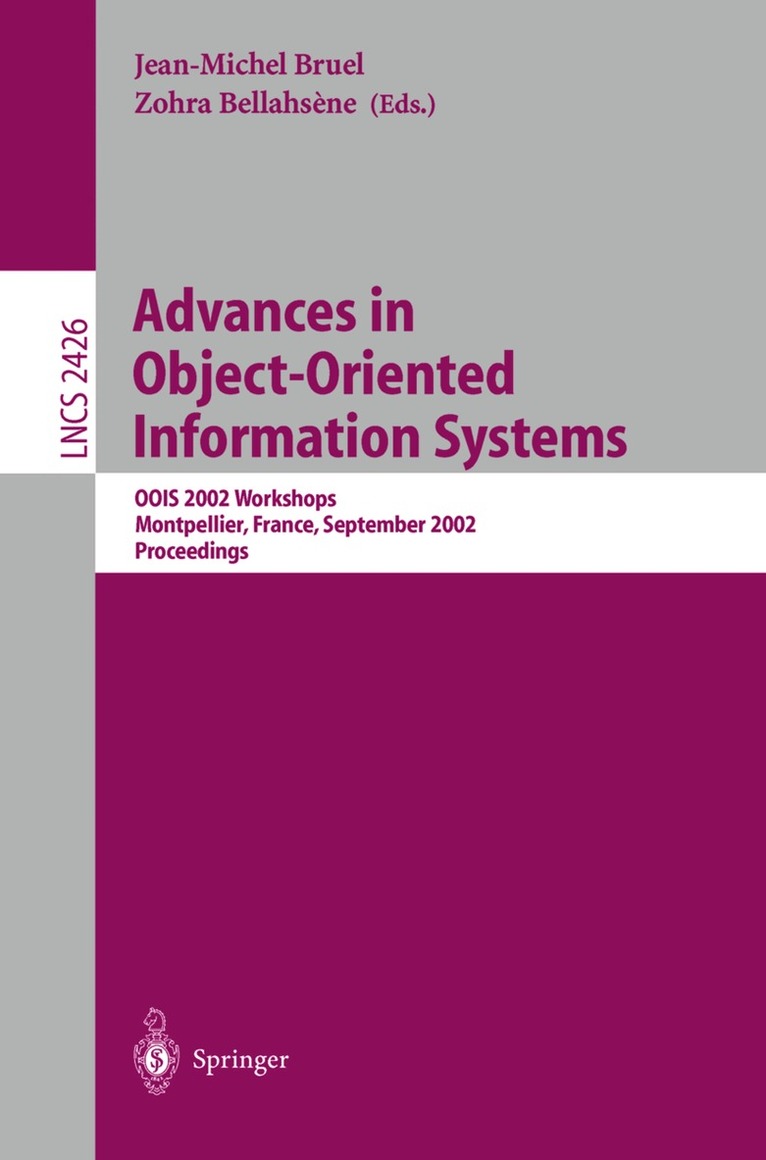
    Advances in Object-Oriented Information Systems

    OOIS 2002 Workshops, Montpellier, France, September 2, 2002 Proceedings

    AvJean-Michel Bruel,Zohra Bellahsene

    Häftad, Engelska, 2002

    Del i serien Lecture Notes in Computer Science

    563 kr

    Beställningsvara. Skickas inom 10-15 vardagar. Fri frakt över 249 kr.

    Beskrivning

    For the ?rst time four workshops have been held in conjunction with the 8th Object-Oriented Information Systems conference, OOIS 2002, to encourage - teraction between researchers and practitioners. Workshop topics are, of course, inline with the conference’s scienti?c scope and provide a forum for groups of researchers and practitioners to meet together more closely and to exchange opinions and advanced ideas, and to share preliminary results on focused issues in an atmosphere that fosters interaction and problem solving. The conference hosted four one-day workshops. The four selected workshops were fully in the spirit of a workshop session hosted by a main conference. Indeed, OOIS deals with all the topics related to the use of object-oriented techniques for the development of information systems. The four workshops are very speci?c and contribute to enlarging the spectrum of the more general topics treated in the main conference. The ?rst workshop focused on a very speci?c and key c- cept of object-oriented development, the specialization/generalization hierarchy. The second one explored the use of “non-traditional” approaches (at the edge of object-oriented techniques, such as aspects, AI, etc.) to improve reuse. The third workshop dealt with optimization in Web-based information systems. And ?nally the fourth workshop investigated issues related to model-driven software development.

    Produktinformation

    • Utgivningsdatum:2002-08-21
    • Mått:155 x 235 x 19 mm
    • Vikt:511 g
    • Format:Häftad
    • Språk:Engelska
    • Serie:Lecture Notes in Computer Science
    • Antal sidor:326
    • Upplaga:2002
    • Förlag:Springer-Verlag Berlin and Heidelberg GmbH & Co. KG
    • ISBN:9783540440888

    Utforska kategorier

    • Programmeringsböcker inom Data och IT

    Innehållsförteckning

    • Managing Specialization/Generalization Hierarchies.- Managing Specialization/Generalization HIerarchies.- “Real World” as an Argument for Covariant Specialization in Programming and Modeling.- Maintaining Class Membership Information.- Hierarchies in Object Oriented Conceptual Modeling.- Specialization/Generalization in Object-Oriented Analysis: Strengthening and Multiple Partitioning.- Towards a New Role Paradigm for Object-Oriented Modeling.- Analysing Object-Oriented Application Frameworks Using Concept Analysis.- Using Both Specialisation and Generalisation in a Programming Language: Why and How?.- Automatic Generation of Hierarchical Taxonomies from Free Text Using Linguistic Algorithms.- Guessing Hierarchies and Symbols for Word Meanings through Hyperonyms and Conceptual Vectors.- Reuse in OO Information Systems Design.- Reuse in Object-Oriented Information Systems Design.- Software Reuse with Use Case Patterns*.- Promoting Reuse through the Capture of System Description.- A Specification-Oriented Framework for Information System User Interfaces.- The Role of Pattern Languages in the Instantiation of Object-Oriented Frameworks.- IS Components with Hyperclasses.- Collaborative Simulation by Reuse of COTS Simulators with a Reflexive XML Middleware1.- Efficient Web-Based Information Systems.- Efficient Web-Based Information Systems.- Semantic Integration and Query Optimization of Heterogeneous Data Sources*.- Extracting Information from Semi-structured Web Documents.- Object-Oriented Mediator Queries to Internet Search Engines.- Warp-Edge Optimization in XPath.- A Caching System for Web Content Generated from XML Sources Using XSLT.- Finding Similar Queries to Satisfy Searches Based on Query Traces.- WOnDA: An Extensible Multi-platform Hypermedia Design Model.-Model-Driven Approaches to Software Development.- Model-Driven Approaches to Software Development.- Executable and Symbolic Conformance Tests for Implementation Models (Position Paper).- Object-Oriented Theories for Model Driven Architecture.- Systems Engineering Foundations of Software Systems Integration.- Using the Model Paradigm for Real-Time Systems Development: ACCORD/UML.- Generating Enterprise Applications from Models.- Tool Support for Aspect-Oriented Design.- Model-Driven Architecture.- Model-Based Development of Embedded Systems.