• Fri frakt över 249 kr
  • •
  • Snabba leveranser
  • •
  • Billiga böcker
Kundservice

Du är på sajten för privatpersoner.

Företag, bibliotek eller offentlig verksamhet?

Du handlar på classic.bokus.com, där alla dina funktioner finns intakta.
Till classic.bokus.com
Bokus logotyp. Gå till startsidan.
  • Erbjudanden
  • Nyheter
  • Student
  • Topplistor
  • Barn & ungdom
  • Bokus Play
  • E-böcker
  • Pocketböcker
  • Spel & pussel

10% rabatt på allt med kod: NYSTART10 →

Sidfot

Mina sidor

    Hjälp

    • Kundservice
    • Vanliga frågor och svar
    • Frakt och leverans
    • Retur vid ångerrätt
    • Reklamera vara
    • Betalning
    • Köpvillkor
    • Allmänna villkor
    • Information om webbplatsens tillgänglighet

    Om Bokus

    • Om oss
    • Pressrum
    • För studenter
    • För företag
    • För bibliotek och offentlig verksamhet
    • För leverantörer
    • Hållbarhet

    Populärt

    • Aktuella erbjudanden
    • Presentkort
    • Studentlitteratur
    • Nya böcker
    • Topplistor
    • Signerade böcker
    • Engelska böcker

    Inspiration

    • Boktips
    • BookTok
    • Populära bokserier
    • Barnbokskaraktärer
    • Populära författare
    Logotyp för Bokus
    Följ oss på Facebook (extern länk)Följ oss på Instagram (extern länk)Följ oss på YouTube (extern länk)Följ oss på TikTok (extern länk)
    bokus @ CookiesAnpassa cookiesIntegritetspolicyKöpvillkor
    Till Citymail hemsida (extern länk)Till Budbee hemsida (extern länk)Till Postnord hemsida (extern länk)Till Schenker hemsida (extern länk)Till Early Bird hemsida (extern länk)Till Walleys hemsida (extern länk)
    1. Samhälle och politik
    2. Sociologi och antropologi
    3. Sociologi

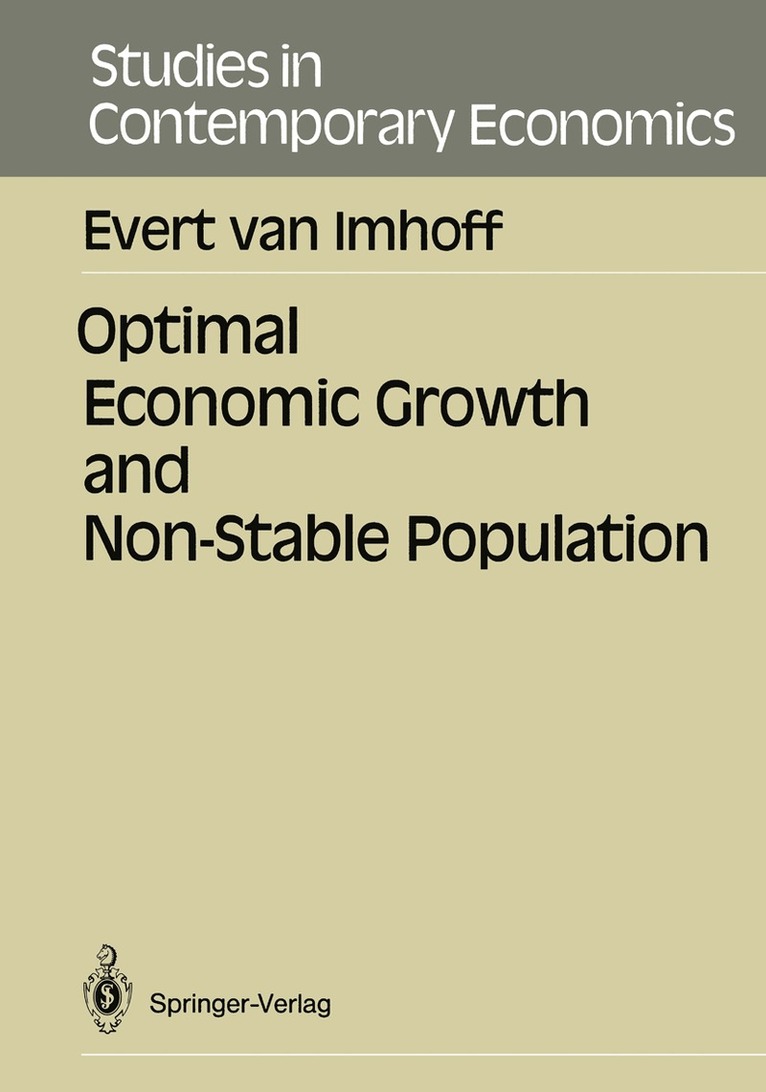
    Optimal Economic Growth and Non-Stable Population

    AvEvert van Imhoff

    Häftad, Engelska, 1989

    Del i serien Studies in Contemporary Economics

    1 086 kr

    Beställningsvara. Skickas inom 10-15 vardagar. Fri frakt över 249 kr.

    Fler format och utgåvor

    E-bok

    1 413 kr

    Beskrivning

    This book studies optimal economic growth in a closed economy which experiences non-stable population growth. The economy is described by means of a neoclassical growth model which distinguishes overlapping generations within the population. The basic neoclassical growth model is extended to include various types of technical change, as well as investment in human capital or education. The research described in this book connects the analytical tools of traditional growth theory with the actual demographic experience of most industrialized countries. The role of demographic processes in the growth­ theoretical literature is discussed in the next section. The discussion will show that growth theory needs to extend its scope through the construction of growth models which explicitly recognize demographic forces as a potential source of non-stationarities. This book constitutes a first attempt at such a demographic extension. 1.1 Growth theory and demographic change The theory of economic growth (e.g. Solow, 1970; Burmeister & Dobell, 1970; Wan, 1971) attempts to describe and to explain the long-run development of an economic system (or, in short, economy). An economic system is essentially dynamic in nature. Among the most important sources of dynamics in economics are the following: accumulation of capital (investment); technical change; population growth. Some of these dynamic forces are, at least in part, endogenous to the economic system (i.e. determined by economic variables).

    Produktinformation

    • Utgivningsdatum:1989-10-18
    • Mått:170 x 242 x 13 mm
    • Vikt:405 g
    • Format:Häftad
    • Språk:Engelska
    • Serie:Studies in Contemporary Economics
    • Antal sidor:219
    • Upplaga:1982
    • Förlag:Springer-Verlag Berlin and Heidelberg GmbH & Co. KG
    • ISBN:9783540515562

    Utforska kategorier

    • Sociologi inom Samhälle och politik

    Innehållsförteckning

    • 1 Introduction.- 1.1 Growth theory and demographic change.- 1.2 Optimal economic growth.- 1.3 Population dynamics and economic development.- 1.4 Research goals and outline of the book.- 2 Optimal economic growth in the simple one-sector growth model.- 2.1 The simple one-sector growth model.- 2.2 The Non-Stationary Golden Rule.- 2.3 Comparative statics and the Golden Rule.- 2.4 Optimal population growth.- 2.5 The non-stationary optimal growth path.- 2.6 Summary.- 3 Technical change and economic growth.- 3.1 On the concept of technical change.- 3.2 Classifications of technical change.- 3.3 Technical change in one-sector growth models.- 4 Optimal economic growth under conditions of technical change.- 4.1 A model with exogenous disembodied technical change.- 4.2 A model with exogenous embodied technical change Contents.- 4.3 A model with endogenous technical change.- Appendix to Chapter 4.3.- 5 Education and economic growth.- 5.1 Economics and education.- 5.2 Education as a production process.- 5.3 Selection of models.- 6 Optimal economic growth and investment in education.- 6.1 A model with homogeneous human capital.- 6.2 A model with heterogeneous human capital.- 7 Optimal educational policy under conditions of technical change.- 7.1 Education and exogenous disembodied technical change.- 7.2 A model with education as transmitter of technical change.- 8 Simulations for the Netherlands.- 8.1 Demographic data.- 8.2 Simulation for the model with homogeneous human capital.- 8.3 Simulations for the model with heterogeneous human capital.- 9 Summary and evaluation.- 9.1 Summary.- 9.2 Evaluation.- References.- Author index.