• Fri frakt över 249 kr
  • •
  • Snabba leveranser
  • •
  • Billiga böcker
Kundservice

Du är på sajten för privatpersoner.

Företag, bibliotek eller offentlig verksamhet?

Du handlar på classic.bokus.com, där alla dina funktioner finns intakta.
Till classic.bokus.com
Bokus logotyp. Gå till startsidan.
  • Erbjudanden
  • Nyheter
  • Student
  • Topplistor
  • Barn & ungdom
  • Bokus Play
  • E-böcker
  • Pocketböcker
  • Spel & pussel

10% rabatt på allt med kod NYSTART10 →

Sidfot

Mina sidor

    Hjälp

    • Kundservice
    • Vanliga frågor och svar
    • Frakt och leverans
    • Retur vid ångerrätt
    • Reklamera vara
    • Betalning
    • Köpvillkor
    • Allmänna villkor
    • Information om webbplatsens tillgänglighet

    Om Bokus

    • Om oss
    • Pressrum
    • För studenter
    • För företag
    • För bibliotek och offentlig verksamhet
    • För leverantörer
    • Hållbarhet

    Populärt

    • Aktuella erbjudanden
    • Presentkort
    • Studentlitteratur
    • Nya böcker
    • Topplistor
    • Signerade böcker
    • Engelska böcker

    Inspiration

    • Boktips
    • BookTok
    • Populära bokserier
    • Barnbokskaraktärer
    • Populära författare
    Logotyp för Bokus
    Följ oss på Facebook (extern länk)Följ oss på Instagram (extern länk)Följ oss på YouTube (extern länk)Följ oss på TikTok (extern länk)
    bokus @ CookiesAnpassa cookiesIntegritetspolicyKöpvillkor
    Till Citymail hemsida (extern länk)Till Budbee hemsida (extern länk)Till Postnord hemsida (extern länk)Till Schenker hemsida (extern länk)Till Early Bird hemsida (extern länk)Till Walleys hemsida (extern länk)
    1. Data och IT
    2. Programmeringsböcker
    3. Programvaruutveckling

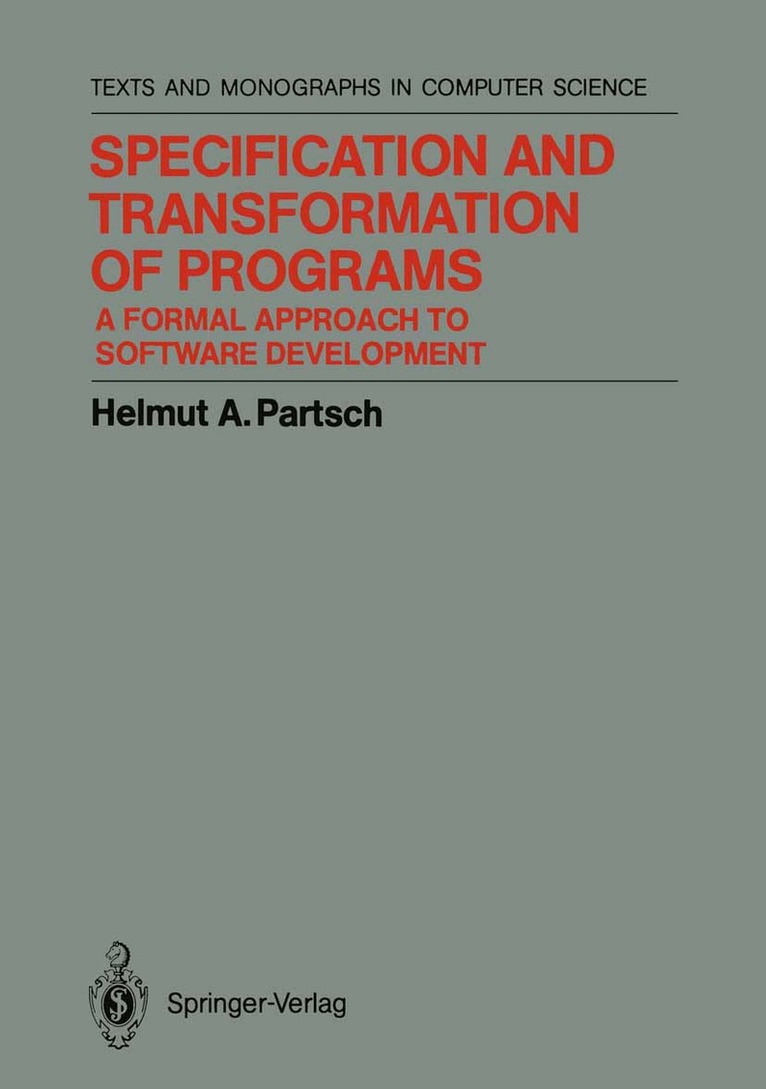
    Specification and Transformation of Programs

    A Formal Approach to Software Development

    AvHelmut A. Partsch

    Häftad, Engelska, 1990

    Del i serien Springer Texts in Electrical Engineering

    563 kr

    Beställningsvara. Skickas inom 10-15 vardagar. Fri frakt över 249 kr.

    Fler format och utgåvor

    Inbunden

    563 kr

    E-bok

    732 kr

    Beskrivning

    "Specification and transformation of programs" is short for a methodology of software development where, from a formal specification of a problem to be solved, programs correctly solving that problem are constructed by stepwise application of formal, semantics-preserving transformation rules. The approach considers programming as a formal activity. Consequently, it requires some mathematical maturity and, above all, the will to try something new. A somewhat experienced programmer or a third- or fourth-year student in computer science should be able to master most of this material - at least, this is the level I have aimed at. This book is primarily intended as a general introductory textbook on transformational methodology. As with any methodology, reading and understanding is necessary but not sufficient. Therefore, most of the chapters contain a set of exercises for practising as homework. Solutions to these exercises exist and can, in principle, be obtained at nominal cost from the author upon request on appropriate letterhead. In addition, the book also can be seen as a comprehensive account of the particular transformational methodology developed within the Munich CIP project.

    Produktinformation

    • Utgivningsdatum:1990-07-05
    • Mått:170 x 242 x undefined mm
    • Vikt:874 g
    • Format:Häftad
    • Språk:Engelska
    • Serie:Springer Texts in Electrical Engineering
    • Antal sidor:493
    • Förlag:Springer-Verlag Berlin and Heidelberg GmbH & Co. KG
    • ISBN:9783540525899

    Utforska kategorier

    • Programvaruutveckling inom Data och IT
    • Programspråk inom Data och IT

    Innehållsförteckning

    • 1. Introduction.- 1.1 Software Engineering.- 1.2 The Problematics of Software Development.- 1.3 Formal Specification and Program Transformation.- 1.4 Our Particular View of Transformational Programming.- 1.5 Relation to Other Approaches to Programming Methodology.- 1.6 An Introductory Example.- 2. Requirements Engineering.- 2.1 Introduction.- 2.2 Some Formalisms Used in Requirements Engineering.- 3. Formal Problem Specification.- 3.1 Specification and Formal Specification.- 3.2 The Process of Formalization.- 3.3 Definition of Object Classes and Their Basic Operations.- 3.4 Additional Language Constructs for Formal Specifications.- 3.5 Structuring and Modularization.- 3.6 Examples.- 3.7 Exercises.- 4. Basic Transformation Techniques.- 4.1 Semantic Foundations.- 4.2 Notational Conventions.- 4.3 The Unfold/Fold System.- 4.4 Further Basic Transformation Rules.- 4.5 Sample Developments with Basic Rules.- 4.6 Exercises.- 5. From Descriptive Specifications to Operational Ones.- 5.1 Transforming Specifications.- 5.2 Embedding.- 5.3 Development of Recursive Solutions from Problem Descriptions.- 5.4 Elimination of Descriptive Constructs in Applicative Programs.- 5.5 Examples.- 5.6 Exercises.- 6. Modification of Applicative Programs.- 6.1 Merging of Computations.- 6.2 Inverting the Flow of Computation.- 6.3 Storing of Values Instead of Recomputation.- 6.4 Computation in Advance.- 6.5 Simplification of Recursion.- 6.6 Examples.- 6.7 Exercises.- 7. Transformation of Procedural Programs.- 7.1 From Tail Recursion to Iteration.- 7.2 Simplification of Imperative Programs.- 7.3 Examples.- 7.4 Exercises.- 8. Transformation of Data Structures.- 8.1 Implementation of Types in Terms of Other Types.- 8.2 Implementations of Types for Specific Environments.- 8.3 Libraries of Implementations.- 8.4 Transformation of Type Systems.- 8.5 Joint Development.- 8.6 An Example: Cycles in a Graph.- 8.7 Exercises.- 9. Complete Examples.- 9.1 Warshall’s Algorithm.- 9.2 The Majority Problem.- 9.3 Fast Pattern Matching According to Boyer and Moore.- 9.4 A Text Editor.- References.