• Fri frakt över 249 kr
  • •
  • Snabba leveranser
  • •
  • Billiga böcker
Kundservice

Du är på sajten för privatpersoner.

Företag, bibliotek eller offentlig verksamhet?

Du handlar på classic.bokus.com, där alla dina funktioner finns intakta.
Till classic.bokus.com
Bokus logotyp. Gå till startsidan.
  • Erbjudanden
  • Student
  • Topplistor
  • Barn & ungdom
  • Bokus Play
  • E-böcker
  • Ljudböcker
  • Pocketböcker
  • Spel och pussel

Pocketfynda! Hundratals böcker för 49 kr/st →

Sidfot

Mina sidor

    Hjälp

    • Kundservice
    • Vanliga frågor och svar
    • Frakt och leverans
    • Retur vid ångerrätt
    • Reklamera vara
    • Betalning
    • Köpvillkor
    • Allmänna villkor
    • Information om webbplatsens tillgänglighet

    Om Bokus

    • Om oss
    • Pressrum
    • För studenter
    • För företag
    • För bibliotek och offentlig verksamhet
    • För leverantörer
    • Hållbarhet

    Populärt

    • Aktuella erbjudanden
    • Presentkort
    • Studentlitteratur
    • Nya böcker
    • Topplistor
    • Signerade böcker
    • Engelska böcker

    Inspiration

    • Boktips
    • BookTok
    • Barnbokskaraktärer
    • Populära författare
    Logotyp för Bokus
    Följ oss på Facebook (extern länk)Följ oss på Instagram (extern länk)Följ oss på YouTube (extern länk)Följ oss på TikTok (extern länk)
    bokus @ CookiesAnpassa cookiesIntegritetspolicyKöpvillkor
    Till Citymail hemsida (extern länk)Till Budbee hemsida (extern länk)Till Postnord hemsida (extern länk)Till Schenker hemsida (extern länk)Till Early Bird hemsida (extern länk)Till Walleys hemsida (extern länk)
    1. Data och IT
    2. Systemvetenskap och AI

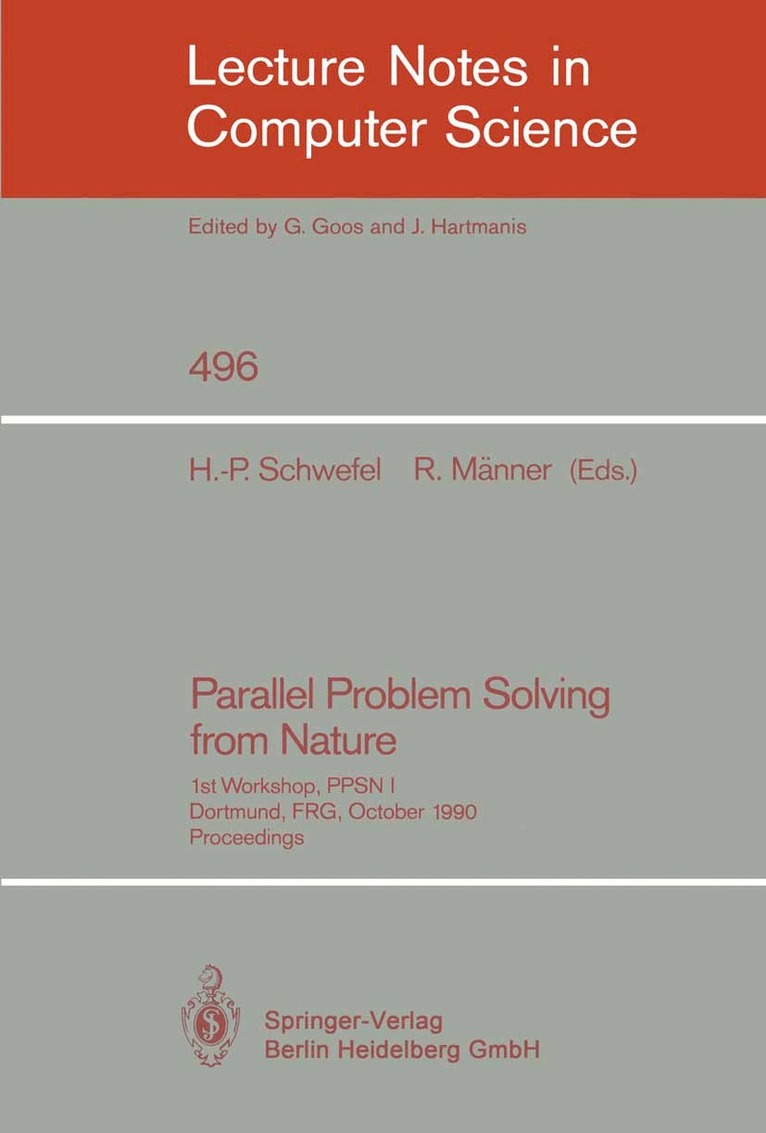
    Parallel Problem Solving from Nature

    1st Workshop, PPSN I Dortmund, FRG, October 1-3, 1990. Proceedings

    AvHans-Paul Schwefel,Reinhard Männer

    Häftad, Engelska, 1991

    Del i serien Lecture Notes in Computer Science

    542 kr

    Beställningsvara. Skickas inom 10-15 vardagar. Fri frakt över 249 kr.

    Beskrivning

    With the appearance of massively parallel computers, increased attention has been paid to algorithms which rely upon analogies to natural processes. This development defines the scope of the PPSN conference at Dortmund in 1990 whose proceedings are presented in this volume. The subjects treated include: - Darwinian methods such as evolution strategies and genetic algorithms; - Boltzmann methods such as simulated annealing; - Classifier systems and neural networks; - Transfer of natural metaphors to artificial problem solving. The main objectives of the conference were: - To gather theoretical results about and experimental comparisons between these algorithms, - To discuss various implementations on different parallel computer architectures, - To summarize the state of the art in the field, which was previously scattered widely both among disciplines and geographically.

    Produktinformation

    • Utgivningsdatum:1991-06-12
    • Mått:155 x 235 x 28 mm
    • Vikt:756 g
    • Format:Häftad
    • Språk:Engelska
    • Serie:Lecture Notes in Computer Science
    • Antal sidor:489
    • Upplaga:1991
    • Förlag:Springer-Verlag Berlin and Heidelberg GmbH & Co. KG
    • ISBN:9783540541486

    Utforska kategorier

    • Systemvetenskap och AI inom Data och IT
    • Tillämpad matematik inom Naturvetenskap och teknik

    Innehållsförteckning

    • Global convergence of genetic algorithms: A markov chain analysis.- The theory of virtual alphabets.- Towards an optimal mutation probability for genetic algorithms.- An alternative Genetic Algorithm.- An analysis of the interacting roles of population size and crossover in genetic algorithms.- Gleam a system for simulated "intuitive learning".- Genetic algorithms and highly constrained problems: The time-table case.- An evolution standing on the design of redundant manipulators.- Redundant coding of an NP-complete problem allows effective Genetic Algorithm search.- Circuit partitioning with genetic algorithms using a coding scheme to preserve the structure of a circuit.- Genetic algorithms, production plan optimisation and scheduling.- System identification using genetic algorithms.- Conformational analysis of DNA using genetic algorithms.- Operator-oriented genetic algorithm and its application to sliding block puzzle problem.- A topology exploiting genetic algorithm to control dynamic systems.- Genetic local search algorithms for the traveling salesman problem.- Genetic programming artificial nervous systems artificial embryos and embryological electronics.- Concept formation and decision tree induction using the genetic programming paradigm.- On solving travelling salesman problems by genetic algorithms.- Genetic algorithms and punctuated equilibria in VLSI.- Implementing the genetic algorithm on transputer based parallel processing systems.- Explicit parallelism of genetic algorithms through population structures.- Parallel genetic packing of rectangles.- Partitioning a graph with a parallel genetic algorithm.- Solving the mapping-problem — Experiences with a genetic algorithm.- Optimization using distributed genetic algorithms.- Application of theEvolutionsstrategie to discrete optimization problems.- A variant of evolution strategies for vector optimization.- Application of evolution strategy in parallel populations.- Global optimization by means of distributed evolution strategies.- Solving sequential games with Boltzmann-learned tactics.- Optimizing simulated annealing.- Parallel Implementations Of Simulated Annealing / A local timing model for parallel optimization with Boltzmann Machines.- Error-free parallel implementation of simulated annealing.- Trimm: A parallel processor for image reconstruction by simulated annealing.- The response-time constraint in neural evolution.- An artificial neural network representation for artificial organisms.- Feature construction for back-propagation.- Improved convergence rate of back-propagation with dynamic adaption of the learning rate.- Performance evaluation of evolutionarily created neural network topologies.- Optical image preprocessing for neural network classifier system.- Gannet: Genetic design of a neural net for face recognition.- The application of a genetic approach as an algorithm for neural networks.- Genetic improvements of feedforward nets for approximating functions.- Exploring adaptive agency III: Simulating the evolution of habituation and sensitization.- A learning strategy for neural networks based on a modified evolutionary strategy.- Genetic algorithms and the immune system.- Selectionist categorization.- A classifier system with integrated genetic operators.- The fuzzy classifier system: Motivations and first results.- Hints for adaptive problem solving gleaned from immune networks.- A reactive robot navigation system based on a fluid dynamics metaphor.- Transfer of natural metaphors to parallel problem solving applications.- Modelling and simulation of distributed evolutionary search processes for function optimization.- Parallel, decentralized spatial mapping for robot navigation and path planning.- Ecological dynamics under different selection rules in distributed and iterated prisoner's dilemma game.- Adaptation in signal spaces.- A principle of minimum complexity in evolution.- The emergence of data structures from local interactions.- The view from the adaptive landscape.- Boltzmann-, Darwin- and Haeckel-strategies in optimization problems.- Optimizing complex problems by nature's algorithms: Simulated annealing and evolution strategy—a comparative study.- Genetic Algorithms and evolution strategies: Similarities and differences.- Building the ultimate machine: The emergence of artificial cognition.