• Fri frakt över 249 kr
  • •
  • Snabba leveranser
  • •
  • Billiga böcker
Kundservice

Du är på sajten för privatpersoner.

Företag, bibliotek eller offentlig verksamhet?

Du handlar på classic.bokus.com, där alla dina funktioner finns intakta.
Till classic.bokus.com
Bokus logotyp. Gå till startsidan.
  • Erbjudanden
  • Nyheter
  • Student
  • Topplistor
  • Barn & ungdom
  • Bokus Play
  • E-böcker
  • Pocketböcker
  • Spel & pussel

10% rabatt på allt med kod: NYSTART10 →

Sidfot

Mina sidor

    Hjälp

    • Kundservice
    • Vanliga frågor och svar
    • Frakt och leverans
    • Retur vid ångerrätt
    • Reklamera vara
    • Betalning
    • Köpvillkor
    • Allmänna villkor
    • Information om webbplatsens tillgänglighet

    Om Bokus

    • Om oss
    • Pressrum
    • För studenter
    • För företag
    • För bibliotek och offentlig verksamhet
    • För leverantörer
    • Hållbarhet

    Populärt

    • Aktuella erbjudanden
    • Presentkort
    • Studentlitteratur
    • Nya böcker
    • Topplistor
    • Signerade böcker
    • Engelska böcker

    Inspiration

    • Boktips
    • BookTok
    • Populära bokserier
    • Barnbokskaraktärer
    • Populära författare
    Logotyp för Bokus
    Följ oss på Facebook (extern länk)Följ oss på Instagram (extern länk)Följ oss på YouTube (extern länk)Följ oss på TikTok (extern länk)
    bokus @ CookiesAnpassa cookiesIntegritetspolicyKöpvillkor
    Till Citymail hemsida (extern länk)Till Budbee hemsida (extern länk)Till Postnord hemsida (extern länk)Till Schenker hemsida (extern länk)Till Early Bird hemsida (extern länk)Till Walleys hemsida (extern länk)
    1. Ekonomi och Ledarskap
    2. Nationalekonomi
    3. Mikroekonomi

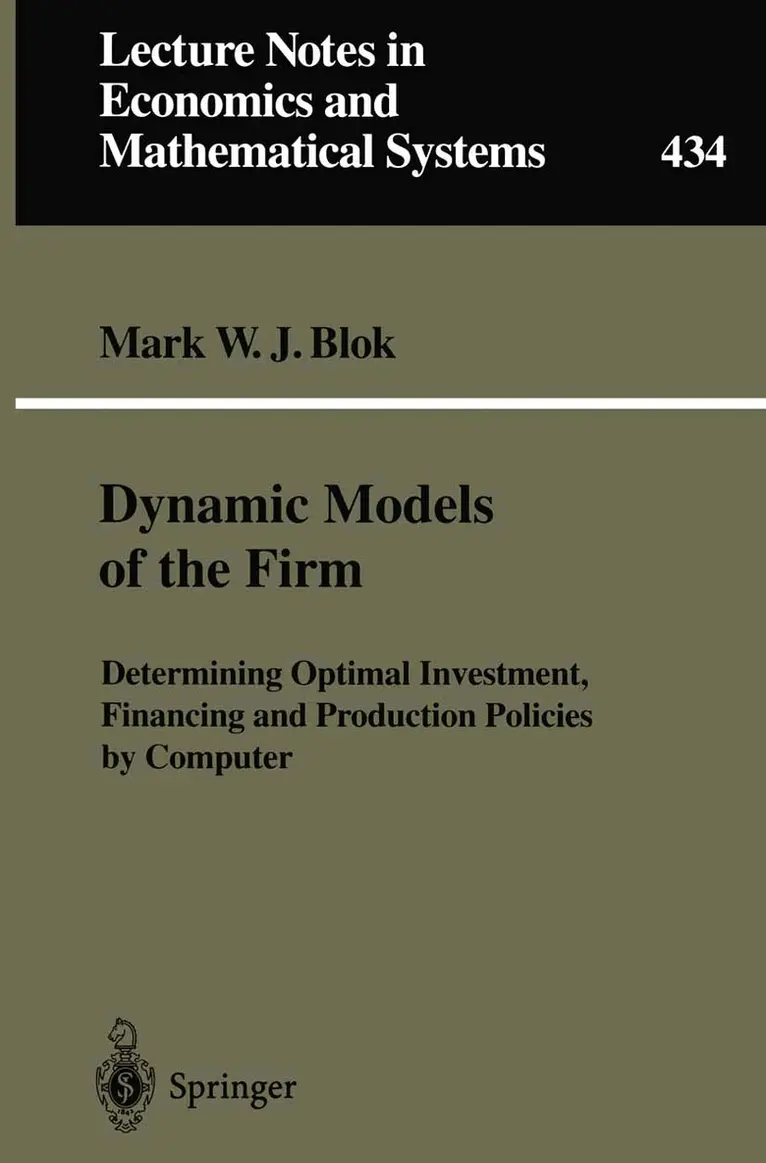
    Dynamic Models of the Firm

    Determining Optimal Investment, Financing and Production Policies by Computer

    AvMark W.J. Blok,A.T. Kearney

    Häftad, Engelska, 1996

    Del 434 i serien Lecture Notes in Economics and Mathematical Systems

    547 kr

    Beställningsvara. Skickas inom 10-15 vardagar. Fri frakt över 249 kr.

    Beskrivning

    The research described in this book contributes to the scientific field of optimal control theory applied to dynamic models of the firm. In 1963, Jorgenson first wrote about the use of optimal control theory in order to analyze the dynamic investment behaviour of a hypothetical firm. A decade later, reports appeared of work on more realistic models of the firm carried out by, amongst others, Lesourne [1973) and Bensoussan et al. [1974). In The Netherlands, P. A. Verheyen, Professor of Management Science at Tilburg University, further instigated studies in this field which led to several publications, for example: Van Loon [1983], Van Schijndel [1988), Kort [1989]' Van Hilten [1991) and Van Hilten et al. [1993). Their investigations are char- acterized by an analytical approach to optimization problems (The Maximum Principle of Pontryagin combined with the path coupling procedure of Van Loon). Inherent to this approach, a good economic interpretation of solutions is obtained; however, analytical solving becomes practically unfeasible when simulation models become more complex, e. g. by stronger non-linearity, explic- itly time-dependent functions and larger numbers of state variables, control variables and subsidiary conditions.For example, the path coupling procedure is complicated for optimization problems where discontinuities in the costate variables occur. At Eindhoven University of Technology, P. M. E. M.

    Produktinformation

    • Utgivningsdatum:1996-03-07
    • Mått:155 x 235 x 12 mm
    • Vikt:324 g
    • Format:Häftad
    • Språk:Engelska
    • Serie:Lecture Notes in Economics and Mathematical Systems
    • Antal sidor:193
    • Förlag:Springer-Verlag Berlin and Heidelberg GmbH & Co. KG
    • ISBN:9783540608028

    Utforska kategorier

    • Mikroekonomi inom Ekonomi och Ledarskap
    • Systemvetenskap och AI inom Data och IT
    • Tillämpad matematik inom Naturvetenskap och teknik

    Innehållsförteckning

    • 1 Introduction.- 2 Mathematical Background to Dynamic Optimization.- 2.1 Introduction.- 2.2 Analytical approach to the optimization problem.- 2.3 Numerical approach to the optimization problem.- 2.4 Economic interpretation of the adjoint variables.- 2.5 General procedure.- 3 The Basic Model.- 3.1 Introduction.- 3.2 The model and its assumptions.- 3.3 Examination of the paths.- 3.4 Case study.- 3.5 Conclusions.- 4 A Model with Start-up Costs.- 4.1 Introduction.- 4.2 The model and its assumptions.- 4.3 Examination of the paths.- 4.4 Case study.- 4.5 Conclusions.- 5 Models with a Business Cycle.- 5.1 Introduction.- 5.2 The basic model.- 5.3 A model with a variable utilization rate.- 5.4 A model with a cash balance.- 5.5 A model with an inventory of finished goods.- 5.6 Conclusions.- 6 A Model with Increasing Returns to Scale, an Experience Curve and a Production Life Cycle.- 6.1 Introduction.- 6.2 Description of the model.- 6.3 Case study.- 6.4 Conclusions.- Appendices.- A Mathematical Details for Chapter 3.- A.1 Problem formulation.- A.2 Necessary conditions for optimality.- A.3 Elaborating the transversality conditions.- A.4 Further examination of some paths.- B Mathematical Details for Chapter 4.- B.1 Problem formulation.- B.2 Necessary conditions for optimality.- B.3 Elaborating the transversality conditions.- B.4 Further examination of some paths.- C Mathematical Details for Chapter 5.- C.1 The basic model.- C.1.1 Determining the coupling points for Subsection 5.2.2.- C.1.2 Determining the coupling points for Subsection 5.2.3.- C.1.3 Deriving relationships (5.22) and (5.27).- C.1.4 Determining the coupling points for Subsection 5.2.4.- C.l.5 Determining the coupling points for Subsection 5.2.5.- C.1.6 Deriving relationships (5.45) and (5.49).- C.2 A model with a variable utilization rate.- C.2.1 Necessary conditions for optimality.- C.2.2 Further examination of some paths.- C.2.3 Determining the coupling points for Subsection 5.3.2.- C.2.4 Determining the coupling points for Subsection 5.3.3.- C.2.5 Determining the coupling points for Subsection 5.3.4.- C.3 A model with a cash balance.- C.3.1 Necessary conditions for optimality.- C.3.2 Further examination of some paths.- C.3.3 Determining the coupling points for Subsection 5.4.2.- C.3.4 Determining the coupling points for Subsection 5.4.3.- C.3.5 Determining the coupling points for Subsection 5.4.5.- C.4 A model with an inventory of finished goods.- C.4.1 Necessary conditions for optimality.- C.4.2 Further examination of some paths.- C.4.3 Determining the coupling points for Subsection 5.5.2.- C.4.4 Determining the coupling points for Subsection 5.5.3.- D Mathematical Details for Chapter 6.- D.1 Necessary conditions for optimality.- Symbols and Notation.- Summary.