• Fri frakt över 249 kr
  • •
  • Snabba leveranser
  • •
  • Billiga böcker
Kundservice

Du är på sajten för privatpersoner.

Företag, bibliotek eller offentlig verksamhet?

Du handlar på classic.bokus.com, där alla dina funktioner finns intakta.
Till classic.bokus.com
Bokus logotyp. Gå till startsidan.
  • Erbjudanden
  • Nyheter
  • Student
  • Topplistor
  • Barn & ungdom
  • Bokus Play
  • E-böcker
  • Pocketböcker
  • Spel & pussel

Upp till 20% på populära nyheter →

Sidfot

Mina sidor

    Hjälp

    • Kundservice
    • Vanliga frågor och svar
    • Frakt och leverans
    • Retur vid ångerrätt
    • Reklamera vara
    • Betalning
    • Köpvillkor
    • Allmänna villkor
    • Information om webbplatsens tillgänglighet

    Om Bokus

    • Om oss
    • Pressrum
    • För studenter
    • För företag
    • För bibliotek och offentlig verksamhet
    • För leverantörer
    • Hållbarhet

    Populärt

    • Aktuella erbjudanden
    • Presentkort
    • Studentlitteratur
    • Nya böcker
    • Topplistor
    • Signerade böcker
    • Engelska böcker

    Inspiration

    • Boktips
    • BookTok
    • Populära bokserier
    • Barnbokskaraktärer
    • Populära författare

    Mina sidor

      Hjälp

      • Kundservice
      • Vanliga frågor och svar
      • Frakt och leverans
      • Retur vid ångerrätt
      • Reklamera vara
      • Betalning
      • Köpvillkor
      • Allmänna villkor
      • Information om webbplatsens tillgänglighet

      Om Bokus

      • Om oss
      • Pressrum
      • För studenter
      • För företag
      • För bibliotek och offentlig verksamhet
      • För leverantörer
      • Hållbarhet

      Populärt

      • Aktuella erbjudanden
      • Presentkort
      • Studentlitteratur
      • Nya böcker
      • Topplistor
      • Signerade böcker
      • Engelska böcker

      Inspiration

      • Boktips
      • BookTok
      • Populära bokserier
      • Barnbokskaraktärer
      • Populära författare
      Logotyp för Bokus
      Följ oss på Facebook (extern länk)Följ oss på Instagram (extern länk)Följ oss på YouTube (extern länk)Följ oss på TikTok (extern länk)
      bokus @ CookiesIntegritetspolicyKöpvillkor
      Till Citymail hemsida (extern länk)Till Budbee hemsida (extern länk)Till Postnord hemsida (extern länk)Till Schenker hemsida (extern länk)Till Early Bird hemsida (extern länk)Till Walleys hemsida (extern länk)
      1. Ekonomi och Ledarskap
      2. Ledarskapsböcker

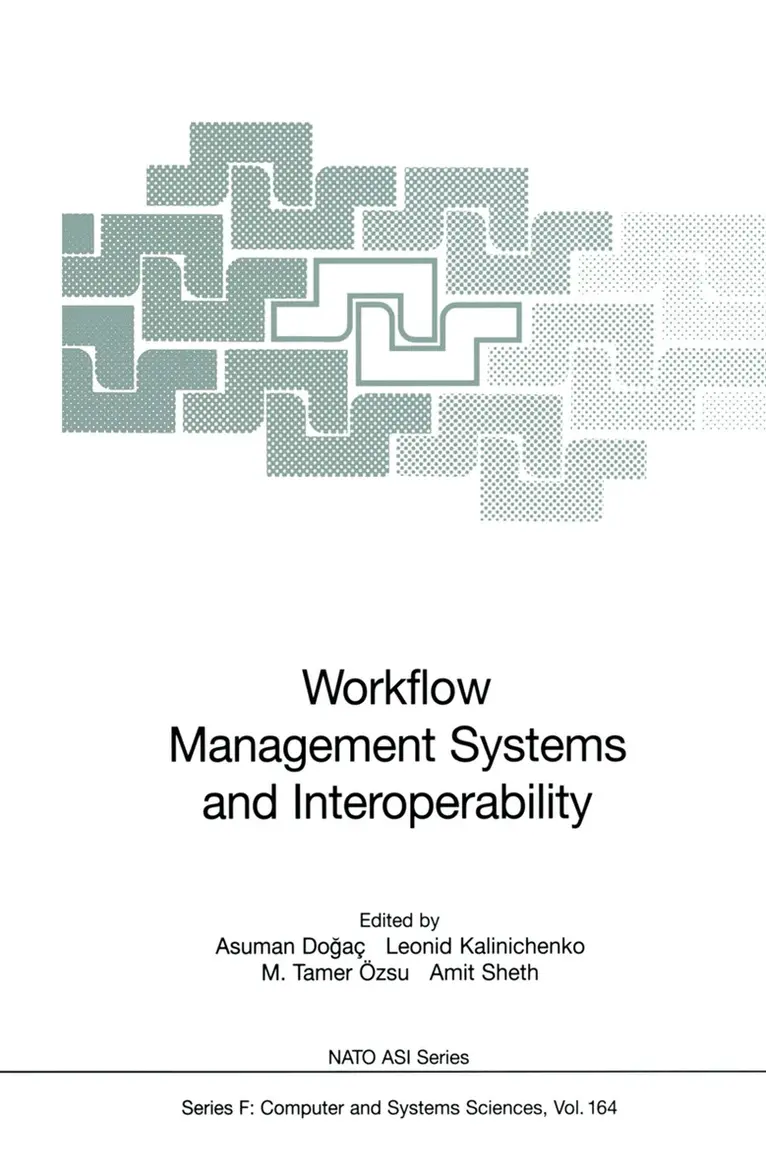
      Workflow Management Systems and Interoperability

      AvAsuman Dogac,Leonid Kalinichenko

      Inbunden, Engelska, 1998

      Del 164 i serien NATO ASI Subseries F:

      1 124 kr

      Beställningsvara. Skickas inom 10-15 vardagar. Fri frakt över 249 kr.

      Beskrivning

      Workflow management systems (WFMS) are enjoying increasing popular­ ity due to their ability to coordinate and streamline complex organizational processes within organizations of all sizes. Organizational processes are de­ scriptions of an organization's activities engineered to fulfill its mission such as completing a business contract or satisfying a specific customer request. Gaining control of these processes allows an organization to reengineer and improve each process or adapt them to changing requirements. The goal of WFMSs is to manage these organizational processes and coordinate their execution. was demonstrated in the first half The high degree of interest in WFMSs of the 1990s by a significant increase in the number of commercial products (once estimated to about 250) and the estimated market size (in combined $2 billion in 1996. Ensuing maturity product sales and services) of about is demonstrated by consolidations during the last year. Ranging from mere e-mail based calendar tools and flow charting tools to very sophisticated inte­ grated development environments for distributed enterprise-wide applications and systems to support programming in the large, these products are finding an eager market and opening up important research and development op­ portunities. In spite of their early success in the market place, however, the current generation of systems can benefit from further research and develop­ ment, especially for increasingly complex and mission-critical applications.

      Produktinformation

      • Utgivningsdatum:1998-09-17
      • Mått:155 x 235 x 34 mm
      • Vikt:980 g
      • Format:Inbunden
      • Språk:Engelska
      • Serie:NATO ASI Subseries F:
      • Antal sidor:526
      • Upplaga:1998
      • Förlag:Springer-Verlag Berlin and Heidelberg GmbH & Co. KG
      • ISBN:9783540644118

      Utforska kategorier

      • Ledarskapsböcker inom Ekonomi och Ledarskap
      • Systemvetenskap och AI inom Data och IT
      • Affärsförhandlingar inom Ekonomi och Ledarskap

      Innehållsförteckning

      • Workflow Management: State of the Art Versus State of the Products.- 1. Introduction.- 1.1 Background.- 1.2 Workflow Systems.- 2. Workflow Products.- 2.1 Current Status.- 2.2 Industry Trends.- 3. Workflow Research.- 3.1 Transactional Workflow.- 3.2 Distributed Workflow Execution.- 3.3 Dynamic Workflow.- 4. Conclusions.- A Distributed Workflow and Product Data Management Application for the Construction of Large Scale Scientific Apparatus.- 1. Introduction.- 2. Background.- 3. General Architecture and Design.- 4. Data Distribution Philosophy.- 5. Workflow Management in CRISTAL.- 6. Workflow System Design.- 7. Coping with Dynamic Change.- 8. Conclusions and Project Status.- Workflow Applications to Research Agenda: Scalable and Dynamic Work Coordination and Collaboration Systems.- 1. Introduction.- 2. Agenda for Current and Future Research.- 3. Application Driven Motivation and Requirements.- 3.1 Scalability.- 3.2 Adaptive and Dynamic Workflows.- 3.3 Integral Support for Collaboration.- 4. METEOR2 WFMS and its Support for Scalability.- 4.1 Workflow Design and Application Building in METEOR2.- 4.2 The Runtime Code Generator.- 4.3 METEOR2 Runtime Support System.- 4.4 The ORBWork Workflow Enactment System.- 4.5 Scalability of ORBWork.- 5. New Challenges to Support Dynamic and Collaborative Work.- 5.1 Work Coordination and Collaboration System.- 5.2 WCCS Design.- 5.3 WCCS Architecture.- 5.4 Work Coordination and Collaboration Engine.- 6. Conclusions.- Design and Implementation of a Distributed Workflow Management System: METUFIow.- 1. Introduction.- 2. The Process Model and the METUFIow Definition Language:.- MFDL.- 3. Guard Generation for Distributed Scheduling.- 3.1 Semantics of the Block Types Using ACTA Formalism.- 3.2 Guard Construction Steps.- 4. METUFIow Architecture.-5. Guard Handlers in METUFIow.- 6. Task Handling in METUFIow.- 7. Worklist Management in METUFIow.- 8. History Management in METUFIow.- 9. OTS Based Transaction Manager.- 10. Correctness Issues in METUFIow.- 10.1 Concurrency Control in METUFIow.- 10.2 Future Considerations for Concurrency Control in METUFIow.- 11. Conclusions.- HP Workflow Research: Past, Present, and Future.- 1. Introduction.- 2. Stage 1: Advanced Feature Enhancements.- 3. Stage 2: Enterprise Business Process Management System.- 3.1 The Requirements.- 3.2 OpenPM Overview.- 3.3 OpenPM Application Development Facilities.- 3.4 An Application Example.- 4. Stage 3: Internet-Based Service Process Management System.- 4.1 FlowJet Overview.- Reducing Escalation-Related Costs in WFMSs.- 1. Introduction.- 2. System Model.- 2.1 Workflow Schema.- 2.2 Deadlines and Escalations.- 2.3 Assumptions.- 3. Dynamic Deadline Adjustment (DDA).- 4. Preemptive Escalation.- 5. Experimental Evaluation.- 5.1 Simulation Model.- 5.2 Experimental Setup.- 5.3 Simulation Results.- 6. Related Work.- 7. Conclusions.- The Workflow Management System Panta Rhei.- 1. Introduction.- 2. The Concepts of Panta Rhei.- 2.1 Classification of Workflows.- 2.2 Basic Concepts.- 2.3 Additional Features.- 2.4 Open Architecture.- 3. Workflow Description Language.- 3.1 Workflow Specification.- 3.2 Execution of WDL.- 4. Architecture and Implementation.- 5. Conclusions.- The WASA Approach to Workflow Management for Scientific Applications.- 1. Introduction.- 2. Workflow Modeling.- 2.1 Workflow Modeling in Business Applications.- 2.2 Workflow Modeling in Scientific Applications.- 2.3 Case Study: Scientific Workflows in Molecular Biology.- 3. Dynamic Change Operations.- 3.1 Anticipated Dynamic Change.- 3.2 Ad-hoc Dynamic Change.- 3.3 Related Work on Dynamic Change.- 4. The WASA Architecture.- 4.1 The WASA Layers.- 5. The WASA Prototype.- 5.1 General Considerations.- 5.2 System Architecture.- 6. Conclusions and Future Work.- Security Enforcement in Activity Management Systems.- 1. Introduction.- 1.1 Related Work.- 2. Secure CapBasED-AMS.- 2.1 Architecture of Secure CapBasED-AMS.- 3. Security Requirements for Activity Specification and Decomposition.- 3.1 Security Control in Activity Specification.- 3.2 Security Constraints Specification.- 4. Framework for Activity Execution.- 4.1 Activity Graph.- 4.2 ECA Rules.- 4.3 Activity Coordinator.- 4.4 Communication Between the Activity Coordinator and PSAs.- 4.5 Task and Event Logging.- 4.6 Exception Condition Handling and Error Recovery.- 5. Security Enforcement During Task Execution.- 5.1 Security Policy Decider and Secure PSA.- 5.2 Enforcement of Task Oriented Modeling of Security.- 6. Open Problems and Summary.- Towards a Platform for Distributed Application Development.- 1. Introduction.- 2. Motivation.- 2.1 Application Example.- 2.2 Software Solutions.- 2.3 Kernel Functionality for Distributed Systems.- 3. The OPERA Kernel.- 3.1 Architecture.- 3.2 Process Management: Model.- 3.3 Transactional Execution Guarantees.- 3.4 Availability and Scalability.- 3.5 Externalized Database Functionality.- 4. Application Examples.- 4.1 High-Level Object Management (HLOM).- 4.2 Distributed Object Management (DOM).- 5. Conclusions.- The Integration of Workflow Systems and Collaboration Tools.- 1. Introduction.- 2. Concerns and Theoretical Foundations.- 2.1 Coordination Versus Collaboration.- 2.2 The Situated Nature of Work.- 2.3 Organizational Structures and Flows.- 2.4 Empirical Evidence.- 3. Orchestra: a Testbed Environment.- 3.1 Objectives.- 3.2 Participants and Activities.- 4. Workflow Systems and Technology.- 4.1 A Sample of Workflow Systems.- 4.2 Groupware Environments and Workflow Support Mechanisms.- 4.3 Workflow Modeling Approaches.- 4.4 The Workflow Management Coalition.- 5. Collaboration Approaches and Technologies.- 5.1 Collaboration Technology.- 5.2 Techniques for Group Decision and Collaboration.- 5.3 Decision Models.- 6. The Integrative Approaches.- 6.1 Identifying Exceptions.- 6.2 Collaboration as a Handler for Coordination Problems.- 6.3 Beyond Exceptions.- 7. Conclusions.- Interoperability in Large-Scale Distributed Information Delivery Systems.- 1. Introduction.- 2. Architectural Issues.- 2.1 Multidatabase-Based Paradigm.- 2.2 Mediator-Based Paradigm.- 3. Technical Issues.- 3.1 Data Delivery Protocols.- 3.2 Data Delivery Modes.- 3.3 Data Delivery Frequency.- 3.4 General Remarks.- 4. Overview of Some Existing Projects.- 4.1 Broadcast Disks Approach to Information Dissemination.- 4.2 Carnot.- 4.3 DIOM.- 4.4 DISCO.- 4.5 InfoSleuth.- 4.6 MIND.- 4.7 TSIMMIS.- 4.8 Comparison with Respect to Data Delivery Capabilities.- 5. Enabling Technology for Interoperability.- 5.1 CORBA.- 5.2 COM/OLE.- 6. AURORA and its Application to Electronic Commerce.- 6.1 A Motivating Example:Virtual Catalogs in Electronic Commerce.- 6.2 Homogenization and Integration Mediators:A 2-tier Mediation Model.- 6.3 AURORA Mediators as Distributed Components.- 6.4 AURORA Mediator Development Workbench.- 6.5 Homogenization Mediators.- 6.6 AURORA Integration Mediators.- 6.7 Constructing Virtual Catalogs with AURORA.- 7. Conclusion.- Enterprise-Wide Workflow Management Based on State and Activity Charts.- 1. Introduction.- 2. Requirements on Workflow Specification Methods.- 3. Formal Methods for Workflow Specification.- 4. Workflow Specification with State and Activity Charts.- 4.1Introduction to State and Activity Charts.- 4.2 Design Methodology for Workflow Specifications.- 5. Utilizing Tools for Formal Verification.- 5.1 Workflow Properties.- 5.2 Specification of Workflow Properties.- 5.3 Model Checking.- 6. Distributed Workflow Execution.- 6.1 Partitioning of State and Activity Charts.- 6.2 Correctness of the Partitioning.- 6.3 Synchronization.- 6.4 Fault Tolerance.- 7. Conclusions.- Transactional Support for Cooperative Applications.- 1. Introduction.- 2. Transactional Support for Cooperative Applications.- 2.1 Characteristics of Cooperative Applications.- 2.2 Motivating Example.- 2.3 Requirements for a Cooperative Transaction Model.- 2.4 Approaches to Support Cooperative Work.- 3. Towards a Cooperative Transaction Model.- 3.1 Semantics-Based Approaches.- 3.2 Check-out/Check-in, Versioning, and Workspaces.- 3.3 Split/Join Transactions and Delegation.- 3.4 Group-Oriented Approaches and Transactional Workflow.- 4. The TRANSCOOP Approach.- 4.1 Overview of the COACT Transaction Model.- 4.2 Formalization of the COACT Transaction Model.- 4.3 Example of History Merging.- 4.4 Organizing the Work Process.- 4.5 Prototype Implementation.- 4.6 Discussion and Relationship to Other Transaction Models.- 5. Conclusions.- Migrating Workflows.- 1. Introduction.- 2. Migrating Workflow Model.- 3. Migrating Workflow - An Example.- 4. Enactment Mechanisms for the Migrating Workflows.- 4.1 Execution System Guarantees.- 4.2 Architectural Considerations.- 4.3 Security Considerations.- 4.4 User Interfaces.- 4.5 Networking Infrastructure.- 5. Workflow Administration Issues.- 5.1 Process Modeling.- 5.2 Workflow Specification.- 5.3 Administration of Migrating Workflows.- 6. Discussion and Summary.- Technology and Tools for Comprehensive Business Process Lifecycle Management.- 1. Introduction.- 2. Characterizing Business Processes.- 3. Traditional Business Process Lifecycle Management.- 3.1 Capturing Process Definition.- 3.2 Reengineering a Process.- 3.3 Implementing a Process.- 3.4 Performing Continuous Process Improvement.- 4. Technology and Tools for Business Process Lifecycle Management.- 4.1 Business Process Modeling Technology and Tools.- 4.2 Workflow Management Technology and Systems.- 4.3 Interoperability Between BPMTs and WFMSs.- 5. Role of BPMT and WFMS Technology.- in the Business Process Lifecycle.- 5.1 Capturing Process Definition.- 5.2 Reengineering a Process.- 5.3 Implementing a Process.- 5.4 Performing Continuous Process Improvement.- 6. Evaluation of Current Business Process Modeling Technology.- 6.1 Business Process Models and Methodologies.- 6.2 Business Process Analysis.- 6.3 Business Process Simulation.- 6.4 Business Process Evaluation Reports and Documentation.- 7. Evaluation of Current Workflow Management Technology.- 7.1 Workflow Model.- 7.2 Dataflow.- 7.3 Workflow Process Definition Tools.- 7.4 Analysis, Simulation, and Animation Tools.- 7.5 Workflow Monitoring and Tracking Tools.- 7.6 Basic WFMS Infrastructure: Architecture, GUIs, and APIs.- 7.7 Advanced WFMS Infrastructure:Distribution, Scalability, and Component Redundancy.- 7.8 Interoperability Among WFMSs and Heterogeneous Applications.- 7.9 Concurrency Control, Recovery, and Advanced Transactions.- 8. Evaluation of Current BPMTs and WFMSs Integration.- 8.1 Loose Integration.- 8.2 Tight Integration.- 8.3 Reverse Integration.- 9. Critical Success Factors and Conclusion.- Recent Trends in Workflow Management Products, Standards and Research.- 1. Introduction.- 2. Market Trends and Business Considerations.- 3. Workflow Standards.- 4. Technical Trends.- 5. Research Projects.- 6. Conclusions.- Kerem - Reasoning About the Design of Partially Cooperative Systems.- 1. Introduction and Motivation.- 1.1 Partially Cooperative Systems.- 1.2 The Need for Reasoning.- 1.3 Outline.- 2. The Modeling Tool.- 2.1 The Basic Primitives.- 2.2 The Event Perspective.- 2.3 The Task Perspective.- 2.4 The Entity Perspective.- 2.5 The Actor Perspective.- 2.6 An Example.- 3. Reasoning About a Design Model.- 3.1 Diagnostics.- 3.2 Change Evaluation.- 3.3 Query System.- 4. Conclusion.- 4.1 Related Work.- 4.2 Concluding Remarks.- Workflow Technologies Meet the Internet.- 1. Introduction.- 2. Open Workflow Clients.- 3. Workflow Component Servers.- 4. A Transactional Model for Cooperative Business Processes.- 5. Conclusions.- Workflow Reuse and Semantic Interoperation Issues.- 1. Introduction.- 2. Related Research and Technological Developments.- 3. Conventional Versus Component-Based Information Systems Development Life Cycles.- 4. Semantic Interoperation Reasoning Approach.- 4.1 The SIR Framework Models.- 4.2 Design with Reuse.- 5. Specification Refinement.- 6. Type Specification Reuse and Compositions.- 6.1 Most Common Reduct.- 6.2 Process of Common Reduct Detection.- 6.3 Construction of Concretizing Types and Views.- 7. Ontological Relevance of Specifications.- 7.1 Tight Ontological Relevance.- 7.2 Loose Ontological Relevance.- 8. A Uniform Script-Based Multiactivity Framework.- 8.1 An Overview of the Relevant SYNTHESIS Language Features.- 8.2 Script Types.- 8.3 Capabilities of the Canonical Model.- 8.4 An Example of a Funding Agency Multiactivity Specification.- 8.5 Pre-existing Workflow Specifications.- 9. Workflow Design with Reuse.- 9.1 An Introduction into the Basic Process Algebra with Iteration.- 9.2 Script Processes.- 9.3 Refinement of Scripts.- 9.4 Script Type Reducts.- 9.5 Process of a Script Design with Reuse.- 9.6 Example of the Most Common Reduct Identification.- 10. Conclusion.- A. Definition of a Script Type.- B. Interpretation of Stallware in the Canonical Workflow Model.- C. Interpretation of IBM FlowMark in the Canonical Workflow Model.- References.
      Hoppa över listan

      Du kanske också är intresserad av

      Amit Sheth, Tamer Ozsu, Leonid Kalinichenko, Asuman Dogac - Workflow Management Systems and Interoperability, E-bok

      Workflow Management Systems and Interoperability

      Amit Sheth, Tamer Ozsu, Leonid Kalinichenko, Asuman Dogac

      E-bok
      2012

      1 470 kr

      Asuman Dogac, Leonid Kalinichenko, Tamer Özsu, Amit Sheth - Workflow Management Systems and Interoperability, Häftad

      Workflow Management Systems and Interoperability

      Asuman Dogac, Leonid Kalinichenko, Tamer Özsu, Amit Sheth

      Häftad, 2012

      1 124 kr

      Elisa Bertino, M. Tamer Ozsu, Elisa Bertino, Tamer Özsu - Distributed and Parallel Database Object Management, Inbunden

      Distributed and Parallel Database Object Management

      Elisa Bertino, M. Tamer Ozsu, Elisa Bertino, Tamer Özsu

      Inbunden, 1994

      1 712 kr

      Elisa Bertino, Tamer Özsu - Distributed and Parallel Database Object Management, Häftad

      Distributed and Parallel Database Object Management

      Elisa Bertino, Tamer Özsu

      Häftad, 2012

      1 712 kr

      Sushil Jajodia, M. Tamar Özsu, Asuman Dogac - Advances in Multimedia Information Systems, Häftad

      Advances in Multimedia Information Systems

      Sushil Jajodia, M. Tamar Özsu, Asuman Dogac

      Häftad, 1998

      566 kr

      Timos Sellis, Alexandros Biliris, M.Tamer Ozsu, Asuman Dogac - Advances in Object-Oriented Database Systems, E-bok

      Advances in Object-Oriented Database Systems

      Timos Sellis, Alexandros Biliris, M.Tamer Ozsu, Asuman Dogac

      E-bok
      2013

      732 kr

      Asuman Dogac, Alexandros Biliris, Timos Sellis, M. Tamer Ozsu - Advances in Object-oriented Database Systems, Inbunden

      Advances in Object-oriented Database Systems

      Asuman Dogac, Alexandros Biliris, Timos Sellis, M. Tamer Ozsu

      Inbunden, 1994

      900 kr

      Leonid Kalinichenko, Sergei O. Kuznetsov, Yannis Manolopoulos - Data Analytics and Management in Data Intensive Domains, Häftad

      Data Analytics and Management in Data Intensive Domains

      Leonid Kalinichenko, Sergei O. Kuznetsov, Yannis Manolopoulos

      Häftad, 2017

      566 kr

      Asuman Dogac, M.Tamer Özsu, Alexandros Biliris, Timos Sellis - Advances in Object-Oriented Database Systems, Häftad

      Advances in Object-Oriented Database Systems

      Asuman Dogac, M.Tamer Özsu, Alexandros Biliris, Timos Sellis

      Häftad, 2012

      566 kr

      Asuman Dogac, M. Tamar Ozsu, Sushil Jajodia - Advances in Multimedia Information Systems, E-bok

      Advances in Multimedia Information Systems

      Asuman Dogac, M. Tamar Ozsu, Sushil Jajodia

      E-bok
      2003

      739 kr