• Fri frakt över 249 kr
  • •
  • Snabba leveranser
  • •
  • Billiga böcker
Kundservice

Du är på sajten för privatpersoner.

Företag, bibliotek eller offentlig verksamhet?

Du handlar på classic.bokus.com, där alla dina funktioner finns intakta.
Till classic.bokus.com
Bokus logotyp. Gå till startsidan.
  • Erbjudanden
  • Student
  • Topplistor
  • Barn & ungdom
  • Bokus Play
  • E-böcker
  • Ljudböcker
  • Pocketböcker
  • Spel och pussel

Pocketfynda! Hundratals böcker för 49 kr/st →

Sidfot

Mina sidor

    Hjälp

    • Kundservice
    • Vanliga frågor och svar
    • Frakt och leverans
    • Retur vid ångerrätt
    • Reklamera vara
    • Betalning
    • Köpvillkor
    • Allmänna villkor
    • Information om webbplatsens tillgänglighet

    Om Bokus

    • Om oss
    • Pressrum
    • För studenter
    • För företag
    • För bibliotek och offentlig verksamhet
    • För leverantörer
    • Hållbarhet

    Populärt

    • Aktuella erbjudanden
    • Presentkort
    • Studentlitteratur
    • Nya böcker
    • Topplistor
    • Signerade böcker
    • Engelska böcker

    Inspiration

    • Boktips
    • BookTok
    • Barnbokskaraktärer
    • Populära författare
    Logotyp för Bokus
    Följ oss på Facebook (extern länk)Följ oss på Instagram (extern länk)Följ oss på YouTube (extern länk)Följ oss på TikTok (extern länk)
    bokus @ CookiesAnpassa cookiesIntegritetspolicyKöpvillkor
    Till Citymail hemsida (extern länk)Till Budbee hemsida (extern länk)Till Postnord hemsida (extern länk)Till Schenker hemsida (extern länk)Till Early Bird hemsida (extern länk)Till Walleys hemsida (extern länk)
    1. Data och IT
    2. Systemvetenskap och AI

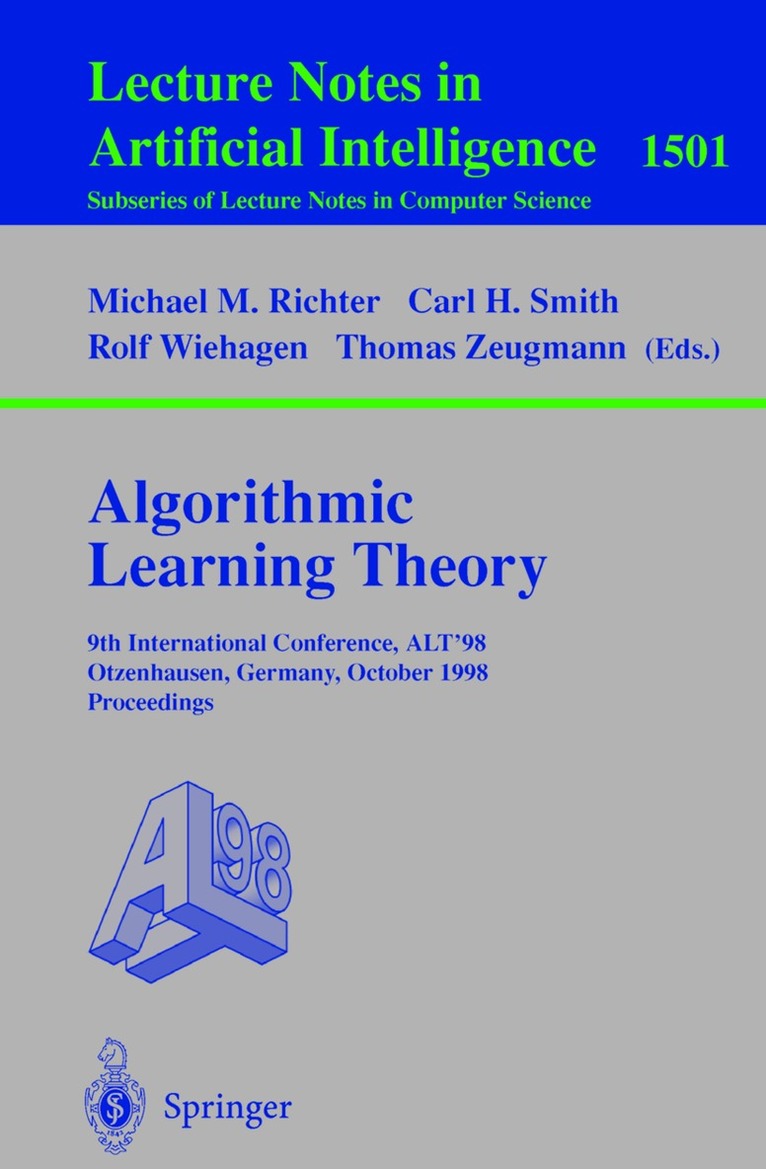
    Algorithmic Learning Theory

    9th International Conference, ALT’98, Otzenhausen, Germany, October 8–10, 1998 Proceedings

    AvMichael M. Richter,Carl H. Smith

    Häftad, Engelska, 1998

    Del i serien Lecture Notes in Computer Science

    559 kr

    Beställningsvara. Skickas inom 10-15 vardagar. Fri frakt över 249 kr.

    Beskrivning

    This volume contains all the papers presented at the Ninth International Con- rence on Algorithmic Learning Theory (ALT’98), held at the European education centre Europ¨aisches Bildungszentrum (ebz) Otzenhausen, Germany, October 8{ 10, 1998. The Conference was sponsored by the Japanese Society for Arti cial Intelligence (JSAI) and the University of Kaiserslautern. Thirty-four papers on all aspects of algorithmic learning theory and related areas were submitted, all electronically. Twenty-six papers were accepted by the program committee based on originality, quality, and relevance to the theory of machine learning. Additionally, three invited talks presented by Akira Maruoka of Tohoku University, Arun Sharma of the University of New South Wales, and Stefan Wrobel from GMD, respectively, were featured at the conference. We would like to express our sincere gratitude to our invited speakers for sharing with us their insights on new and exciting developments in their areas of research. This conference is the ninth in a series of annual meetings established in 1990. The ALT series focuses on all areas related to algorithmic learning theory including (but not limited to): the theory of machine learning, the design and analysis of learning algorithms, computational logic of/for machine discovery, inductive inference of recursive functions and recursively enumerable languages, learning via queries, learning by arti cial and biological neural networks, pattern recognition, learning by analogy, statistical learning, Bayesian/MDL estimation, inductive logic programming, robotics, application of learning to databases, and gene analyses.

    Produktinformation

    • Utgivningsdatum:1998-09-23
    • Mått:155 x 235 x 25 mm
    • Vikt:692 g
    • Format:Häftad
    • Språk:Engelska
    • Serie:Lecture Notes in Computer Science
    • Antal sidor:444
    • Förlag:Springer-Verlag Berlin and Heidelberg GmbH & Co. KG
    • ISBN:9783540650133

    Utforska kategorier

    • Systemvetenskap och AI inom Data och IT
    • Artificiell intelligens inom Data och IT

    Innehållsförteckning

    • Editors’ Introduction.- Editors’ Introduction.- Inductive Logic Programming and Data Mining.- Scalability Issues in Inductive Logic Programming.- Inductive Inference.- Learning to Win Process-Control Games Watching Game-Masters.- Closedness Properties in EX-Identification of Recursive Functions.- Learning via Queries.- Lower Bounds for the Complexity of Learning Half-Spaces with Membership Queries.- Cryptographic Limitations on Parallelizing Membership and Equivalence Queries with Applications to Random Self-Reductions.- Learning Unary Output Two-Tape Automata from Multiplicity and Equivalence Queries.- Computational Aspects of Parallel Attribute-Efficient Learning.- PAC Learning from Positive Statistical Queries.- Prediction Algorithns.- Structured Weight-Based Prediction Algorithms.- Inductive Logic Programming.- Learning from Entailment of Logic Programs with Local Variables.- Logical Aspects of Several Bottom-Up Fittings.- Learnability of Translations from Positive Examples.- Analysis of Case-Based Representability of Boolean Functions by Monotone Theory.- Learning Formal Languages.- Locality, Reversibility, and Beyond: Learning Languages from Positive Data.- Synthesizing Learners Tolerating Computable Noisy Data.- Characteristic Sets for Unions of Regular Pattern Languages and Compactness.- Finding a One-Variable Pattern from Incomplete Data.- A Fast Algorithm for Discovering Optimal String Patterns in Large Text Databases.- Inductive Inference.- A Comparison of Identification Criteria for Inductive Inference of Recursive Real-Valued Functions.- Predictive Learning Models for Concept Drift.- Learning with Refutation.- Comparing the Power of Probabilistic Learning and Oracle Identification Under Monotonicity Constraints.- Learning Algebraic Structures from TextUsing Semantical Knowledge.- Inductive Logic Programming.- Lime: A System for Learning Relations.- Miscellaneous.- On the Sample Complexity for Neural Trees.- Learning Sub-classes of Monotone DNF on the Uniform Distribution.- Using Attribute Grammars for Description of Inductive Inference Search Space.- Towards the Validation of Inductive Learning Systems.- Consistent Polynomial Identification in the Limit.