• Fri frakt över 249 kr
  • •
  • Snabba leveranser
  • •
  • Billiga böcker
Kundservice

Du är på sajten för privatpersoner.

Företag, bibliotek eller offentlig verksamhet?

Du handlar på classic.bokus.com, där alla dina funktioner finns intakta.
Till classic.bokus.com
Bokus logotyp. Gå till startsidan.
  • Erbjudanden
  • Student
  • Topplistor
  • Barn & ungdom
  • Bokus Play
  • E-böcker
  • Ljudböcker
  • Pocketböcker
  • Spel och pussel

Pocketfynda! Hundratals böcker för 49 kr/st →

Sidfot

Mina sidor

    Hjälp

    • Kundservice
    • Vanliga frågor och svar
    • Frakt och leverans
    • Retur vid ångerrätt
    • Reklamera vara
    • Betalning
    • Köpvillkor
    • Allmänna villkor
    • Information om webbplatsens tillgänglighet

    Om Bokus

    • Om oss
    • Pressrum
    • För studenter
    • För företag
    • För bibliotek och offentlig verksamhet
    • För leverantörer
    • Hållbarhet

    Populärt

    • Aktuella erbjudanden
    • Presentkort
    • Studentlitteratur
    • Nya böcker
    • Topplistor
    • Signerade böcker
    • Engelska böcker

    Inspiration

    • Boktips
    • BookTok
    • Barnbokskaraktärer
    • Populära författare
    Logotyp för Bokus
    Följ oss på Facebook (extern länk)Följ oss på Instagram (extern länk)Följ oss på YouTube (extern länk)Följ oss på TikTok (extern länk)
    bokus @ CookiesAnpassa cookiesIntegritetspolicyKöpvillkor
    Till Citymail hemsida (extern länk)Till Budbee hemsida (extern länk)Till Postnord hemsida (extern länk)Till Schenker hemsida (extern länk)Till Early Bird hemsida (extern länk)Till Walleys hemsida (extern länk)
    1. Naturvetenskap och teknik
    2. Matematik och naturvetenskap
    3. Matematik
    4. Matematisk statistik

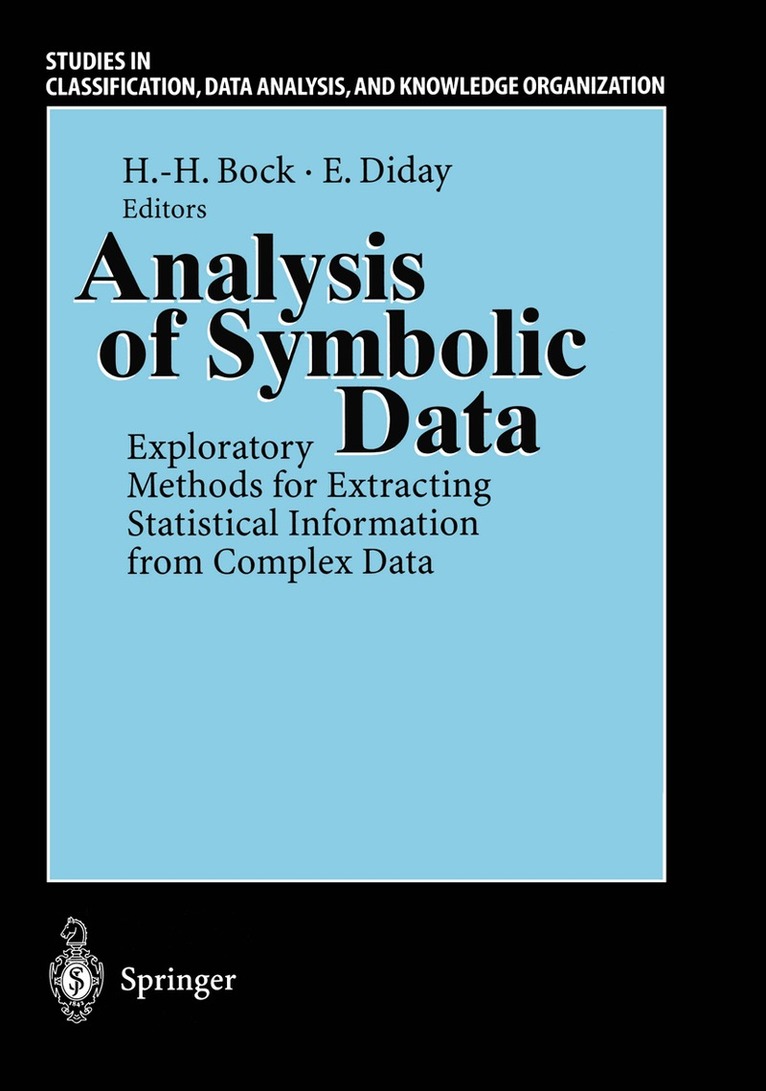
    Analysis of Symbolic Data

    Exploratory Methods for Extracting Statistical Information from Complex Data

    AvHans-Hermann Bock,Edwin Diday

    Häftad, Engelska, 1999

    Del i serien Studies in Classification, Data Analysis, and Knowledge Organization

    1 078 kr

    Beställningsvara. Skickas inom 10-15 vardagar. Fri frakt över 249 kr.

    Beskrivning

    Raymond Bisdorff CRP-GL, Luxembourg The development of the SODAS software based on symbolic data analysis was extensively described in the previous chapters of this book. It was accompanied by a series of benchmark activities involving some official statistical institutes throughout Europe. Partners in these benchmark activities were the National Statistical Institute (INE) of Portugal, the Instituto Vasco de Estadistica Euskal (EUSTAT) from Spain, the Office For National Statistics (ONS) from the United Kingdom, the Inspection Generale de la Securite Sociale (IGSS) from Luxembourg 1 and marginally the University of Athens . The principal goal of these benchmark activities was to demonstrate the usefulness of symbolic data analysis for practical statistical exploitation and analysis of official statistical data. This chapter aims to report briefly on these activities by presenting some signifi­ cant insights into practical results obtained by the benchmark partners in using the SODAS software package as described in chapter 14 below.

    Produktinformation

    • Utgivningsdatum:1999-12-21
    • Mått:170 x 242 x 25 mm
    • Vikt:761 g
    • Format:Häftad
    • Språk:Engelska
    • Serie:Studies in Classification, Data Analysis, and Knowledge Organization
    • Antal sidor:425
    • Upplaga:2000
    • Förlag:Springer-Verlag Berlin and Heidelberg GmbH & Co. KG
    • ISBN:9783540666196

    Utforska kategorier

    • Matematisk statistik inom Naturvetenskap och teknik
    • Databaser inom Data och IT
    • Affärsförhandlingar inom Ekonomi och Ledarskap

    Innehållsförteckning

    • Symbolic Data Analysis and the SODAS Project: Purpose, History, Perspective.- 1.1 Introduction.- 1.2 Symbolic Data Tables and Symbolic Objects.- 1.3 Tools and Operations for Symbolic Objects.- 1.4 History and Evolution of SDA.- 1.5 The Content of the SODAS Project.- 1.6 Philosophical Background: Concepts and Symbolic Objects.- 1.7 Advantages of Using Symbolic Data Analysis.- 1.8 The Future Development of SODAS.- 2 The Classical Data Situation.- 2.1 Introduction.- 2.2 Variables as Input Data.- 2.3 Quantitative Variables.- 2.4 Qualitative Variables.- 2.5 Data Vectors and the Data Matrix.- 2.6 Dependent Variables.- 2.7 Missing Values.- 3 Symbolic Data.- 3.1 Three Introductory Examples.- 3.2 Multi-Valued and Interval Variables.- 3.3 Modal Variables.- 3.4 A Synthesis of Symbolic Data Types.- 3.5 The Symbolic Data Array.- 4 Symbolic Objects.- 4.1 Introduction and Examples.- 4.2 Relations and Descriptions.- 4.3 Events and Assertion Objects.- 4.4 Boolean Symbolic Objects as Triples.- 4.5 Modal Symbolic Objects.- 5 Generation of Symbolic Objects from Relational Databases.- 5.1 Introduction to Relational Databases.- 5.2 Principles of Symbolic Object Acquisition from Relational Databases.- 5.3 Interaction with the Database.- 5.4 A Generalization Operator.- 5.5 Further Operations on Generated Assertions.- 6 Descriptive Statistics for Symbolic Data.- 6.1 Descriptive Statistics for a Classical Numerical Variable.- 6.2 The Observed Symbolic Data Set.- 6.3 The Case of Multi-Valued Variables.- 6.4 The Case of an Interval-Valued Variable.- 7 Visualizing and Editing Symbolic Objects.- 7.1 The Zoom Star Representation.- 7.2 Editing Symbolic Objects.- 8 Similarity and Dissimilarity.- 8.1 Classical Resemblance Measures.- 8.2 Dissimilarity Measures for Probability Distributions.- 8.3 Dissimilarity Measures for Symbolic Objects.- 8.4 Matching Symbolic Objects.- 9 Symbolic Factor Analysis.- 9.1 Classical Principal Component Analysis.- 9.2 Symbolic Principal Component Analysis.- 9.3 Factorial Discriminant Analysis on Symbolic Objects.- 10 Discrimination: Assigning Symbolic Objects to Classes.- 10.1 Classical Methods of Discrimination.- 10.2 Symbolic Kernel Discriminant Analysis.- 10.3 Symbolic Discrimination Rules.- 10.4 Segmentation Trees for Stratified Data.- 11 Clustering Methods for Symbolic Objects.- 11.1 Clustering Problem, Clustering Methods for Classical Data.- 11.2 Criterion-Based Divisive Clustering for Symbolic Data.- 11.3 Hierarchical and Pyramidal Clustering with Complete Symbolic Objects.- 11.4 Pyramidal Classification for Interval Data Using Galois Lattice Reduction.- 12 Symbolic Approaches for Three-way Data.- 12.1 Introduction.- 12.2 The Input and Output Data.- 12.3 Processing Temporal Data.- 12.4 Interpretation of Outcomes from Processing of Temporal Changes.- 12.5 Real-Case Examples.- 13 Illustrative Benchmark Analyses.- 13.1. Introduction.- 13.2 Professional Careers of Retired Working Persons.- 13.3 Comparing European Labour Force Survey Results from the Basque Country and Portugal.- 13.4 Processing Census Data from ONS.- 13.5 General Conclusion.- 14 The SODAS Software Package.- 14.1 Short Introduction to the SODAS Software.- 14.2 Short Processing of a Chaining.- 14.3 Short List of Methods in SODAS Software.- Notations and Abbreviations.- Addresses of Contributors to this Volume.