• Fri frakt över 249 kr
  • •
  • Snabba leveranser
  • •
  • Billiga böcker
Kundservice

Du är på sajten för privatpersoner.

Företag, bibliotek eller offentlig verksamhet?

Du handlar på classic.bokus.com, där alla dina funktioner finns intakta.
Till classic.bokus.com
Bokus logotyp. Gå till startsidan.
  • Erbjudanden
  • Nyheter
  • Student
  • Topplistor
  • Barn & ungdom
  • Bokus Play
  • E-böcker
  • Pocketböcker
  • Spel & pussel

10% rabatt på allt med kod NYSTART10 →

Sidfot

Mina sidor

    Hjälp

    • Kundservice
    • Vanliga frågor och svar
    • Frakt och leverans
    • Retur vid ångerrätt
    • Reklamera vara
    • Betalning
    • Köpvillkor
    • Allmänna villkor
    • Information om webbplatsens tillgänglighet

    Om Bokus

    • Om oss
    • Pressrum
    • För studenter
    • För företag
    • För bibliotek och offentlig verksamhet
    • För leverantörer
    • Hållbarhet

    Populärt

    • Aktuella erbjudanden
    • Presentkort
    • Studentlitteratur
    • Nya böcker
    • Topplistor
    • Signerade böcker
    • Engelska böcker

    Inspiration

    • Boktips
    • BookTok
    • Populära bokserier
    • Barnbokskaraktärer
    • Populära författare
    Logotyp för Bokus
    Följ oss på Facebook (extern länk)Följ oss på Instagram (extern länk)Följ oss på YouTube (extern länk)Följ oss på TikTok (extern länk)
    bokus @ CookiesAnpassa cookiesIntegritetspolicyKöpvillkor
    Till Citymail hemsida (extern länk)Till Budbee hemsida (extern länk)Till Postnord hemsida (extern länk)Till Schenker hemsida (extern länk)Till Early Bird hemsida (extern länk)Till Walleys hemsida (extern länk)
    1. Ekonomi och Ledarskap
    2. Ledarskapsböcker

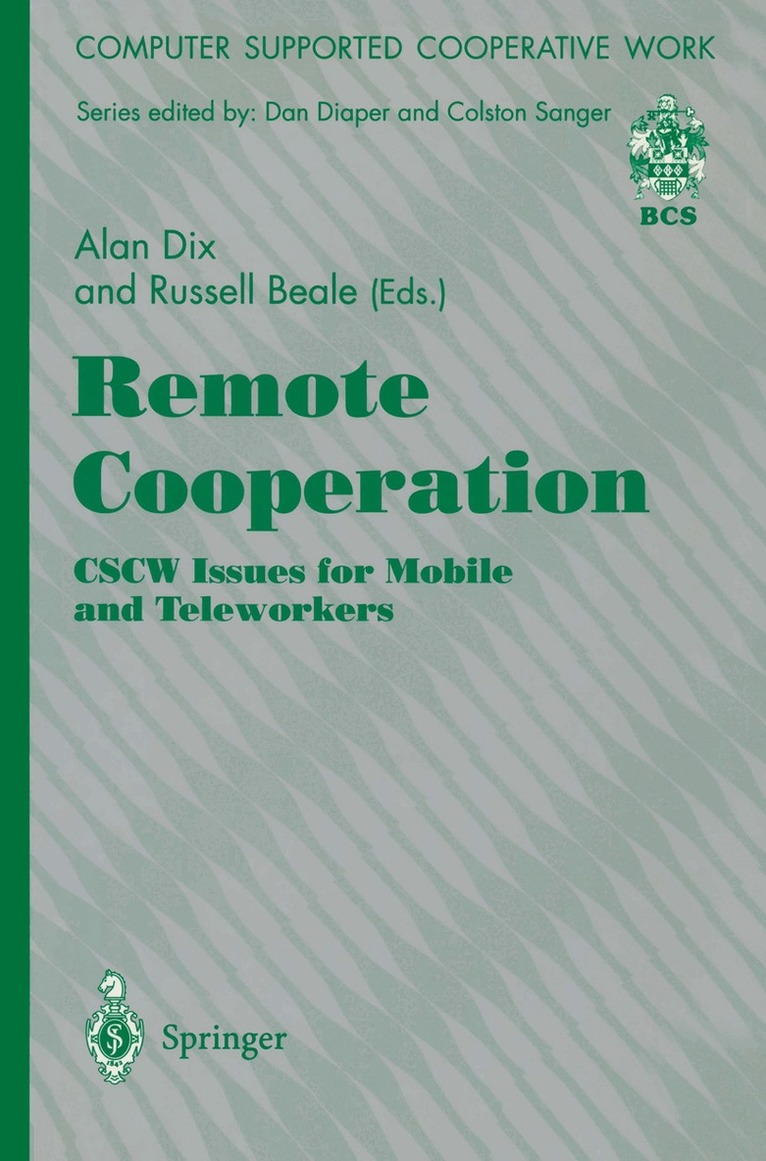
    Remote Cooperation: CSCW Issues for Mobile and Teleworkers

    AvAlan J. Dix,Russell Beale

    Häftad, Engelska, 1996

    Del i serien Computer Supported Cooperative Work

    1 117 kr

    Beställningsvara. Skickas inom 10-15 vardagar. Fri frakt över 249 kr.

    Beskrivning

    Computer supported work is increasingly being done out of the traditional office environment, for example whilst travelling or at home and there is a growing need to support the cooperative aspects of such work. Remote Cooperation looks at ways of improving the available communications, through the use of packet radio and compression techniques, in order to reduce the imbalance between office-based and mobile workers. It also assesses how the effectiveness of the existing communications infrastructure can be improved, by providing cooperative applications which fit within its limitations. Broadly divided into five sections - social and economic context, application domains, software technology and infrastructure, communications technology and infrastructure, working and learning from home - this volume contains contributions from both the research community and industry.

    Produktinformation

    • Utgivningsdatum:1996-10-18
    • Mått:155 x 235 x 15 mm
    • Vikt:394 g
    • Format:Häftad
    • Språk:Engelska
    • Serie:Computer Supported Cooperative Work
    • Antal sidor:236
    • Upplaga:96001
    • Förlag:Springer-Verlag Berlin and Heidelberg GmbH & Co. KG
    • ISBN:9783540760351

    Utforska kategorier

    • Ledarskapsböcker inom Ekonomi och Ledarskap
    • Människa – datorinteraktion inom Data och IT
    • Affärsförhandlingar inom Ekonomi och Ledarskap

    Innehållsförteckning

    • So Near Yet So Far.- The Structure of this Book.- Framing the Problem.- Future Directions and Further Information.- 1 Working in the Virtual Office.- 1.1 Introduction.- 1.2 Why Are People Working in Virtual Offices?.- 1.3 Technology for the Virtual Office.- 1.4 Advantages of Working in a Virtual Office.- 1.5 Disadvantages of Working in a Virtual Office.- 1.6 Addressing the Disadvantages of the Virtual Office.- 2 CSCW for the Mobile Teleworker.- 2.1 Introduction.- 2.2 How Telework Concepts Affect Field Based Mobile Workers.- 2.3 How Telework Concepts Affect Intrinsically Mobile Workers.- 2.4 The Basic Technology for Mobile Telework.- 2.5 The Role of CSCW.- 2.6 The Basic Technology of CSCW for Mobile Workers.- 2.7 The Interaction Between CSCW and Telework.- 2.8 Teamworking Across Enterprise Boundaries.- 3 The Electronic Hard Hat: CSCW on the Construction Site.- 3.1 Introduction.- 3.2 Review of Past Work.- 3.3 Available Technology.- 3.4 CSCW on the Construction Site: a Possible Scenario.- 3.5 The Electronic Hard Hat.- 3.6 Future Scenarios.- 3.7 Conclusion: A Plea to Communications Companies.- 4 Support for Community Care.- 4.1 Introduction.- 4.2 Community Health Services and Community Care Workers.- 4.3 Community Care Systems.- 4.4 The Field Trial of System B.- 4.5 Some Results of the Evaluation Exercise.- 4.6 Comparison with System A.- 4.7 Conclusion.- 5 The’ salesman’s Promise’: CSCW in Sales.- 5.1 Introduction.- 5.2 The Cell Based Factory.- 5.3 Sales Scenarios.- 5.4 Product Advisor.- 5.5 Conclusions.- 6 Observations on Practically Perfect CSCW.- 6.1 Introduction.- 6.2 General Requirements.- 6.3 Toward Observational Properties.- 6.4 Using the Model.- 6.5 Toward Practically Perfect CSCW.- 6.6 Conclusions.- Acknowledgements.- 7 Personal Information Management in theContext of Collaborative Work.- 7.1 Introduction.- 7.2 Personal Information Management and the Representational Focus.- 7.3 Time Management: A Case for CSCW?.- 7.4 Personal Information Management and CSCW.- 8 Activity Coordination in Decentralized Working Environments.- 8.1 Introduction.- 8.2 Some Aspects of Activity Coordination.- 8.3 The Task Manager: An Example for Activity Coordination.- 8.4 Consistency in an Asynchronous Environment.- 8.5 Conflict Handling.- 8.6 Mobility and Activity Coordination.- 8.7 Summary.- 8.8 Outlook.- 9 Information Requirements of Distributed Workers.- 9.1 Introduction.- 9.2 Background — The Workers and the Technology.- 9.3 Principal Topics.- 9.4 Retrieval and Caching.- 9.5 Synchronization.- 9.6 Other Areas and Future Work.- 9.7 Summary.- 10 Mobile Open Systems Technology for the Utilities Industries.- 10.1 Introduction.- 10.2 Requirements of Mobile Utilities Workers.- 10.3 Integration Technologies.- 10.4 Mobile Computing Technologies.- 10.5 The Impact of Mobility on Distributed Systems Platforms.- 10.6 The MOST Approach.- 10.7 Concluding Remarks.- 11 The Distributed Home Environment and the New Oikos.- 11.1 Introduction.- 11.2 The Oikos Concept.- 11.3 The Distributed Home and Telework.- 11.4 The Homelink Project.- 11.5 Future Directions.- 11.6 Summary.- 12 Teaching, Learning and Collaborating at a Virtual Summer School.- 12.1 Introduction.- 12.2 Design Issues.- 12.3 Teaching and Learning at a VSS.- 12.4 Evaluation and Discussion.- 12.5 Discussion and Conclusions.- Appendix: A Detailed Profile of the VSS Students.- References.- Name Index.