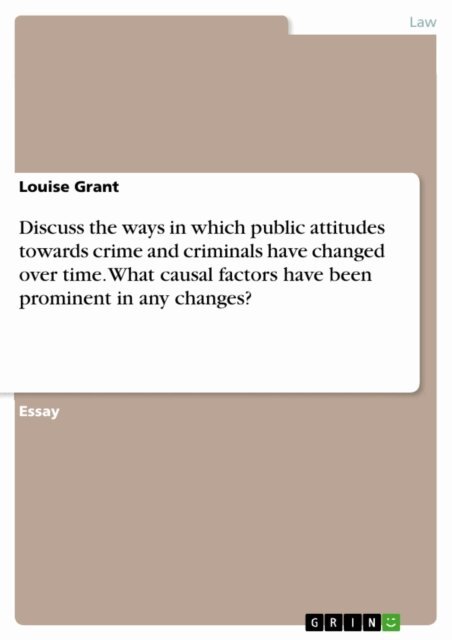
E-bok, Engelska, 2011
Discuss the ways in which public attitudes towards crime and criminals have changed over time. What causal factors have been prominent in any changes?
Av Louise Grant
14 kr
Läs direkt i Bokus Reader – eller ladda ned till din enhet (PDF kräver ofta zoom och scroll på små skärmar).
Beskrivning
Essay from the year 2009 in the subject Law - Criminal process, Criminology, Law Enforcement, grade: 2:2, University of Portsmouth, language: English, abstract: Over time there have been a lot of changes in public attitudes towards crime and criminals however, of course what has not changed is the fact that the majority believe criminals should be punished for their actions and crime is still viewed in a negative light. However ways in which criminals are treated and viewed has changed overtime. For example, at present in England the majority who commit a crime will gain a prison sentence or a punishments such as community service. However, in the past the majority who committed a crime would be sentenced to the death penalty, for example under the Bloody Code in the 19th Century two hundred crimes were punishable by capital punishment (Briggs, Harrison, McInnes & Vincent, 1996, p. 157). Along with this the way the public view why criminals are criminals has changed over time. For example in Elizabethan times they blamed the parents of the criminal whilst at the start of the 20th century it began to be believed that there was a criminal gene and therefore it was not an individual's fault (Briggs, Harrison, McInnes & Vincent, 1996, p. 248). The view of what and what not is a crime has also changed over time. For example from 2003 it became illegal to "e;hold a mobile phone while driving in mainland Britain"e; (Rochford District Council). This has lead to the public disapproving of others driving whist using their mobile phone as they now see it as dangerous whilst, before 2003 it was expectable to hold a mobile phone while driving.[...]
Produktinformation
- Utgivningsdatum: 2011-04-08
- Språk: Engelska
- Filformat: PDF
- Kopieringsskydd: LCP
- ISBN: 9783640888085
- Förlag: GRIN Verlag
Utforska kategorier
Betyg & recensioner
0 recensioner
Inga recensioner tillgängliga.