• Fri frakt över 249 kr
  • •
  • Snabba leveranser
  • •
  • Billiga böcker
Kundservice

Du är på sajten för privatpersoner.

Företag, bibliotek eller offentlig verksamhet?

Du handlar på classic.bokus.com, där alla dina funktioner finns intakta.
Till classic.bokus.com
Bokus logotyp. Gå till startsidan.
  • Erbjudanden
  • Nyheter
  • Student
  • Topplistor
  • Barn & ungdom
  • Bokus Play
  • E-böcker
  • Pocketböcker
  • Spel & pussel

10% rabatt på allt med kod: NYSTART10 →

Sidfot

Mina sidor

    Hjälp

    • Kundservice
    • Vanliga frågor och svar
    • Frakt och leverans
    • Retur vid ångerrätt
    • Reklamera vara
    • Betalning
    • Köpvillkor
    • Allmänna villkor
    • Information om webbplatsens tillgänglighet

    Om Bokus

    • Om oss
    • Pressrum
    • För studenter
    • För företag
    • För bibliotek och offentlig verksamhet
    • För leverantörer
    • Hållbarhet

    Populärt

    • Aktuella erbjudanden
    • Presentkort
    • Studentlitteratur
    • Nya böcker
    • Topplistor
    • Signerade böcker
    • Engelska böcker

    Inspiration

    • Boktips
    • BookTok
    • Populära bokserier
    • Barnbokskaraktärer
    • Populära författare
    Logotyp för Bokus
    Följ oss på Facebook (extern länk)Följ oss på Instagram (extern länk)Följ oss på YouTube (extern länk)Följ oss på TikTok (extern länk)
    bokus @ CookiesAnpassa cookiesIntegritetspolicyKöpvillkor
    Till Citymail hemsida (extern länk)Till Budbee hemsida (extern länk)Till Postnord hemsida (extern länk)Till Schenker hemsida (extern länk)Till Early Bird hemsida (extern länk)Till Walleys hemsida (extern länk)
    1. Data och IT
    2. Systemvetenskap och AI

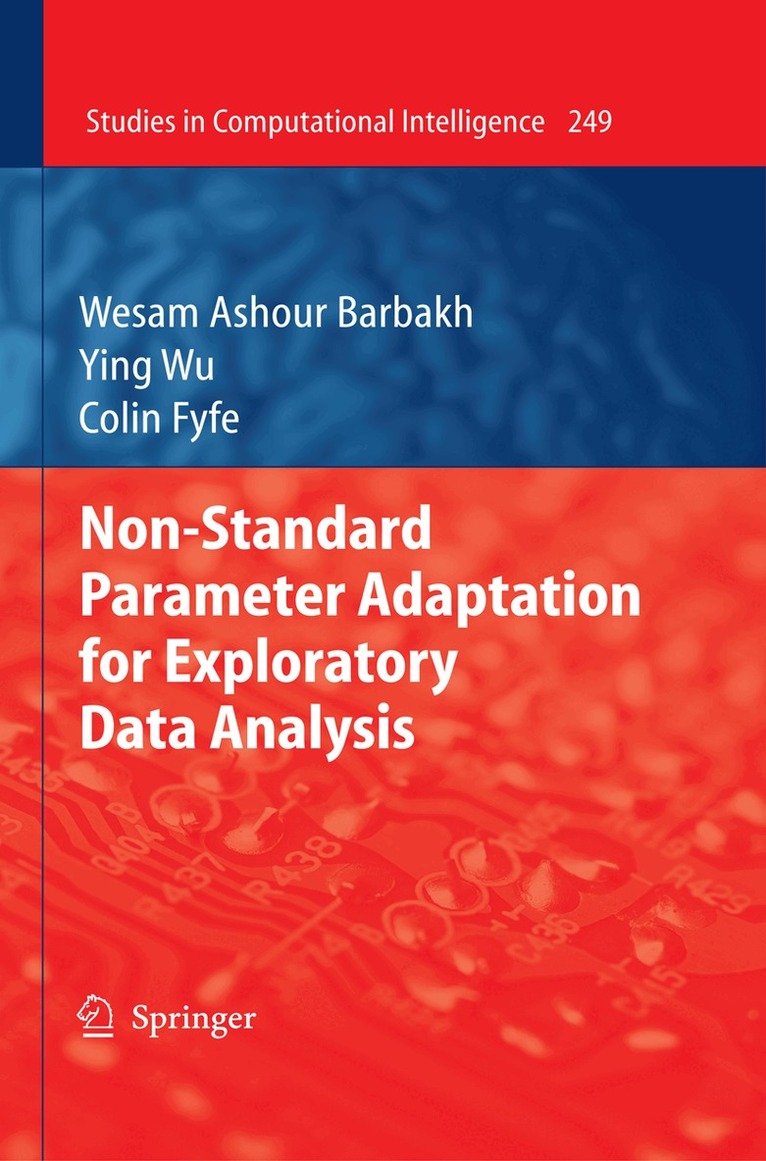
    Non-Standard Parameter Adaptation for Exploratory Data Analysis

    AvWesam Ashour Barbakh,Ying Wu

    Inbunden, Engelska, 2009

    Del i serien Studies in Computational Intelligence

    1 086 kr

    Beställningsvara. Skickas inom 10-15 vardagar. Fri frakt över 249 kr.

    Fler format och utgåvor

    Häftad

    1 086 kr

    Beskrivning

    Exploratory data analysis, also known as data mining or knowledge discovery from databases, is typically based on the optimisation of a specific function of a dataset. Such optimisation is often performed with gradient descent or variations thereof. In this book, we first lay the groundwork by reviewing some standard clustering algorithms and projection algorithms before presenting various non-standard criteria for clustering. The family of algorithms developed are shown to perform better than the standard clustering algorithms on a variety of datasets.We then consider extensions of the basic mappings which maintain some topology of the original data space. Finally we show how reinforcement learning can be used as a clustering mechanism before turning to projection methods. We show that several varieties of reinforcement learning may also be used to define optimal projections for example for principal component analysis, exploratory projection pursuit and canonical correlation analysis. The new method of cross entropy adaptation is then introduced and used as a means of optimising projections. Finally an artificial immune system is used to create optimal projections and combinations of these three methods are shown to outperform the individual methods of optimisation.

    Produktinformation

    • Utgivningsdatum:2009-09-28
    • Mått:155 x 235 x undefined mm
    • Format:Inbunden
    • Språk:Engelska
    • Serie:Studies in Computational Intelligence
    • Antal sidor:223
    • Förlag:Springer-Verlag Berlin and Heidelberg GmbH & Co. KG
    • ISBN:9783642040047

    Utforska kategorier

    • Systemvetenskap och AI inom Data och IT
    • Teknik: allmänt inom Naturvetenskap och teknik
    • Databaser inom Data och IT

    Innehållsförteckning

    • Review of Clustering Algorithms.- Review of Linear Projection Methods.- Non-standard Clustering Criteria.- Topographic Mappings and Kernel Clustering.- Online Clustering Algorithms and Reinforcement Learning.- Connectivity Graphs and Clustering with Similarity Functions.- Reinforcement Learning of Projections.- Cross Entropy Methods.- Artificial Immune Systems.- Conclusions.