• Fri frakt över 249 kr
  • •
  • Snabba leveranser
  • •
  • Billiga böcker
Kundservice

Du är på sajten för privatpersoner.

Företag, bibliotek eller offentlig verksamhet?

Du handlar på classic.bokus.com, där alla dina funktioner finns intakta.
Till classic.bokus.com
Bokus logotyp. Gå till startsidan.
  • Erbjudanden
  • Student
  • Topplistor
  • Barn & ungdom
  • Bokus Play
  • E-böcker
  • Ljudböcker
  • Pocketböcker
  • Spel och pussel

5% studentrabatt – använd koden KURSBOK27 →

Sidfot

Mina sidor

    Hjälp

    • Kundservice
    • Vanliga frågor och svar
    • Frakt och leverans
    • Retur vid ångerrätt
    • Reklamera vara
    • Betalning
    • Köpvillkor
    • Allmänna villkor
    • Information om webbplatsens tillgänglighet

    Om Bokus

    • Om oss
    • Pressrum
    • För studenter
    • För företag
    • För bibliotek och offentlig verksamhet
    • För leverantörer
    • Hållbarhet

    Populärt

    • Aktuella erbjudanden
    • Presentkort
    • Studentlitteratur
    • Nya böcker
    • Topplistor
    • Signerade böcker
    • Engelska böcker

    Inspiration

    • Boktips
    • BookTok
    • Barnbokskaraktärer
    • Populära författare
    Logotyp för Bokus
    Följ oss på Facebook (extern länk)Följ oss på Instagram (extern länk)Följ oss på YouTube (extern länk)Följ oss på TikTok (extern länk)
    bokus @ CookiesAnpassa cookiesIntegritetspolicyKöpvillkor
    Till Citymail hemsida (extern länk)Till Budbee hemsida (extern länk)Till Postnord hemsida (extern länk)Till Schenker hemsida (extern länk)Till Early Bird hemsida (extern länk)Till Walleys hemsida (extern länk)
    1. Ekonomi och Ledarskap
    2. Ledarskapsböcker

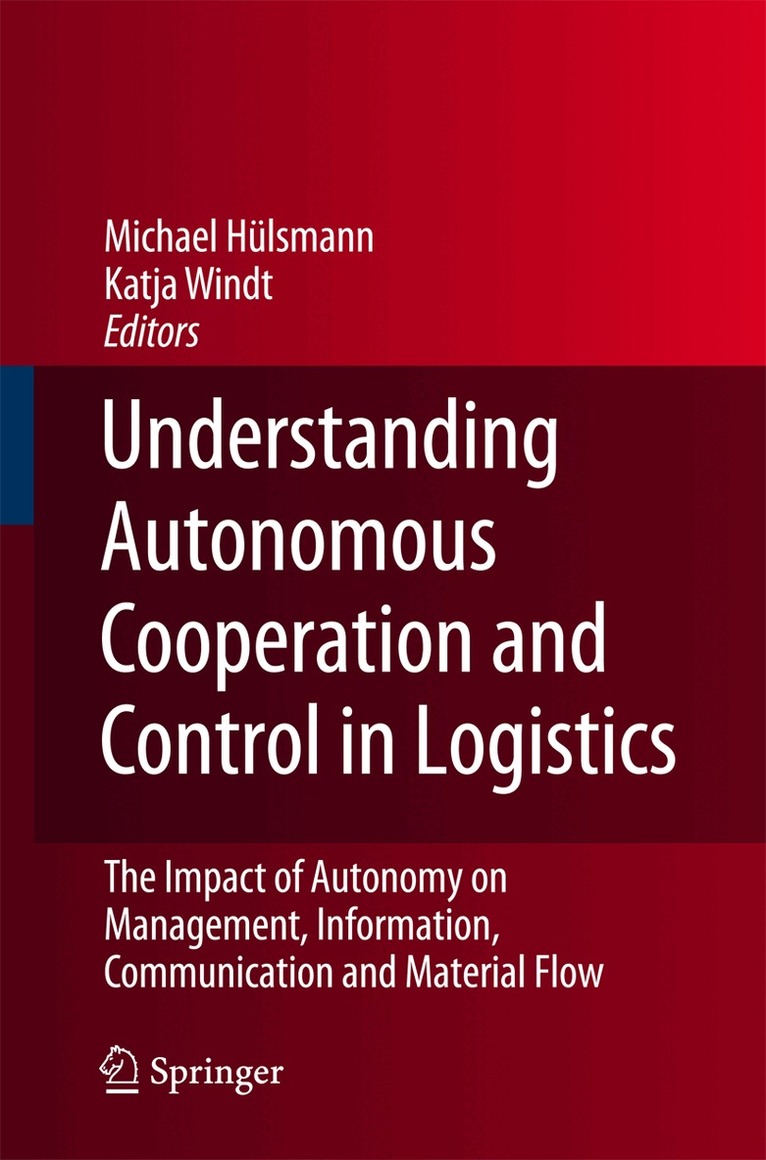
    Understanding Autonomous Cooperation and Control in Logistics

    The Impact of Autonomy on Management, Information, Communication and Material Flow

    AvMichael Hülsmann,Katja Windt

    Häftad, Engelska, 2010

    1 614 kr

    Beställningsvara. Skickas inom 10-15 vardagar. Fri frakt över 249 kr.

    Beskrivning

    One of the great challenges in flexible production and supply chains is the availability of necessary information at any time and any place. As a result of increasing dynamical and structural complexity of structures and processes in production it is often impossible to make all necessary information available to a central instance in real time and to perform appropriate measures of control in terms of a defined target system. A fast and flexible adaptation to changing basic conditions ought to be achieved by establishing autonomous logistics processes.In this context several fundamental questions concerning autonomous cooperating logistics processes were investigated:The identification problem: What are autonomous logistics processes and how do they differ from conventionally managed processes?The description problem: Which changes will autonomy cause in order processing?One of the first results is a definition for the term autonomy for applications in engineering science. The constituent characteristics of this definition were considered within the development of the catalogue of criteria in order to describe autonomous logistic processes. Regarding the modelling of autonomous processes, first requirements for modelling methods were specified. To validate the research results, a production-logistic shop-floor scenario and a practical scenario based on the real business processes of an automobile terminal were developed. Simulation studies concerning autonomously controlled allocation of parking areas document comprehensive opportunities for improvement.

    Produktinformation

    • Utgivningsdatum:2010-10-14
    • Mått:155 x 235 x 25 mm
    • Vikt:674 g
    • Format:Häftad
    • Språk:Engelska
    • Antal sidor:417
    • Förlag:Springer-Verlag Berlin and Heidelberg GmbH & Co. KG
    • ISBN:9783642079962

    Utforska kategorier

    • Ledarskapsböcker inom Ekonomi och Ledarskap
    • Teknik: allmänt inom Naturvetenskap och teknik
    • Projektledning inom Ekonomi och Ledarskap

    Mer om författaren

    Dr.-Ing. Katja Windt is leader of the sub-department "Intelligent Planning and Control Methods for Logistic Systems" within the Bremen Institute of Industrial Technology and Applied Work Sciences (BIBA) at the University of Bremen. She supervises one sub-project ("Process-Orientated Basic Studies for Autonomous Cooperation and Control") of the Collaborative Research Center named "Autonomous Cooperating Logistic Processes - A Paradigm Shift and its Limitations" which is supported by the German Research Foundation. In July 2004 she became member of die Junge Akademie (The Young Academie) in Germany and is elected as speaker of the plenum for a one year period in 2006/2007. In her research she focuses on planning and control methods for production and logistic systems. Prof. Dr. Michael Hulsmann is head of the unit "Management of Sustainable System Development" and academic director of the SCOUT-Institute for Strategic Competence Management in the Faculty for Business Studies and Economics at the University of Bremen. Additionally, he is member of the board of the Collaborative Research Centre 637 "Autonomous Cooperating Logistic Processes - A Paradigm Shift and its Limitations", which is supported by the German Research Foundation. In his research he focuses on strategic management and organisation theory, especially for logistics.

    Innehållsförteckning

    • Changing Paradigms in Logistics — Understanding the Shift from Conventional Control to Autonomous Cooperation and Control.- Changing Paradigms in Logistics — Understanding the Shift from Conventional Control to Autonomous Cooperation and Control.- Fundamental Basics and Concepts of Autonomous Control and Cooperation.- Perspectives on Initial Ideas and Conceptual Components of Autonomous Cooperation and Control.- Prologue to Autonomous Cooperation — the Idea of Self-Organisation as its Basic Concepts.- Historical Development of the Idea of Self-Organisation in Information and Communication Technology.- Catalogue of Criteria for Autonomous Control in Logistics.- Business Process Modelling of Autonomously Controlled Production Systems.- Strategic Decisions for Autonomous Logistics Systems.- Autonomous Units: Basic Concepts and Semantic Foundation.- Mathematical Models of Autonomous Logistic Processes.- Autonomous Decision Model Adaptation and the Vehicle Routing Problem with Time Windows and Uncertain Demand.- Autonomous Control Methods for the Managment, Information and Communication Layer.- Approaches to Methods of Autonomous Cooperation and Control for the Management-, Information- and Communication-Layer of Logistics.- Self-Organization in Management Science.- Autonomous Cooperation — A Way to Vitalize Organizations?.- Self-Organization Concepts for the Information- and Communication Layer of Autonomous Logistic Processes.- Distributed Knowledge Management in Dynamic Environments.- Proactive Knowledge-Based Risk Management.- Autonomy in Software Systems.- Specifying Adaptive Business Processes within the Production Logistics Domain — A new Modelling Concept and its Challenges.- Autonomous Control Methods and Examples for the Material Flow Layer.- Approachesto Methods of Autonomous Cooperation and Control and Examples for the Material Flow Layer.- Evaluation of Autonomous Logistic Processes — Analysis of the Influence of Structural Complexity.- Autonomous Control by Means of Distributed Routing.- Dynamic Transport Reference Scenarios.- Autonomously Controlled Storage Allocation on an Automobile Terminal.- Intelligent Containers and Sensor Networks Approaches to apply Autonomous Cooperation on Systems with limited Resources.- Transport Scenario for the Intelligent Container.