• Fri frakt över 249 kr
  • •
  • Snabba leveranser
  • •
  • Billiga böcker
Kundservice

Du är på sajten för privatpersoner.

Företag, bibliotek eller offentlig verksamhet?

Du handlar på classic.bokus.com, där alla dina funktioner finns intakta.
Till classic.bokus.com
Bokus logotyp. Gå till startsidan.
  • Erbjudanden
  • Nyheter
  • Student
  • Topplistor
  • Barn & ungdom
  • Bokus Play
  • E-böcker
  • Pocketböcker
  • Spel & pussel

10% rabatt på allt med kod NYSTART10 →

Sidfot

Mina sidor

    Hjälp

    • Kundservice
    • Vanliga frågor och svar
    • Frakt och leverans
    • Retur vid ångerrätt
    • Reklamera vara
    • Betalning
    • Köpvillkor
    • Allmänna villkor
    • Information om webbplatsens tillgänglighet

    Om Bokus

    • Om oss
    • Pressrum
    • För studenter
    • För företag
    • För bibliotek och offentlig verksamhet
    • För leverantörer
    • Hållbarhet

    Populärt

    • Aktuella erbjudanden
    • Presentkort
    • Studentlitteratur
    • Nya böcker
    • Topplistor
    • Signerade böcker
    • Engelska böcker

    Inspiration

    • Boktips
    • BookTok
    • Populära bokserier
    • Barnbokskaraktärer
    • Populära författare
    Logotyp för Bokus
    Följ oss på Facebook (extern länk)Följ oss på Instagram (extern länk)Följ oss på YouTube (extern länk)Följ oss på TikTok (extern länk)
    bokus @ CookiesAnpassa cookiesIntegritetspolicyKöpvillkor
    Till Citymail hemsida (extern länk)Till Budbee hemsida (extern länk)Till Postnord hemsida (extern länk)Till Schenker hemsida (extern länk)Till Early Bird hemsida (extern länk)Till Walleys hemsida (extern länk)
    1. Ekonomi och Ledarskap
    2. Ledarskapsböcker

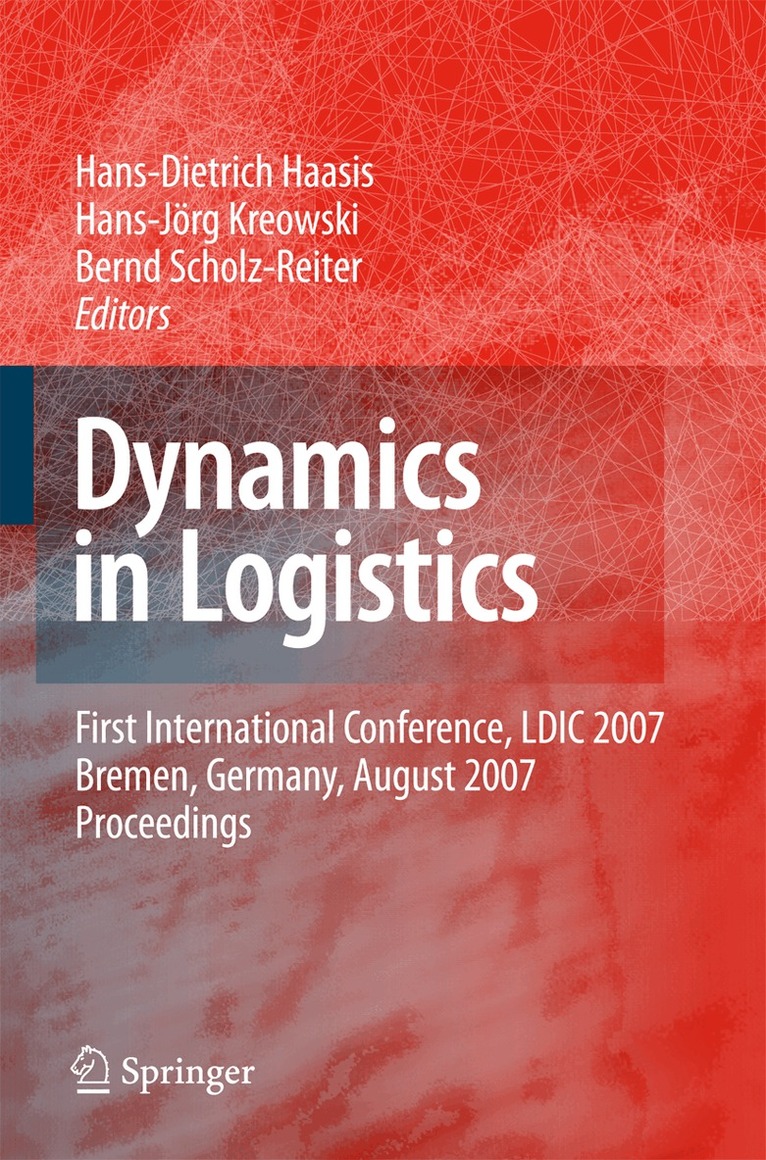
    Dynamics in Logistics

    First International Conference, LDIC 2007, Bremen, Germany, August 2007. Proceedings

    AvHans-Dietrich Haasis,Hans-Jörg Kreowski

    Häftad, Engelska, 2010

    2 162 kr

    Beställningsvara. Skickas inom 10-15 vardagar. Fri frakt över 249 kr.

    Beskrivning

    Logistic problems can rarely be solved satisfyingly within one single scientific discipline. This cross-sectional character is taken into account by the Research Cluster for Dynamics in Logistics with a combination of economical, information and production technical and enterprise-oriented research approaches. In doing so, the interdisciplinary cooperation between university, research institutes and enterprises for the solution of logistic problems is encouraged. This book comprises the edited proceedings of the first International Conference on Dynamics in Logistics LDIC 2007. The scope of the conference was concerned with the identification, analysis, and description of the dynamics of logistic processes and networks. The spectrum reached from the planning and modelling of processes over innovative methods like autonomous control and knowledge management to the new technologies provided by radio frequency identification, mobile communication, and networking.Two invited papers and of 42 contributed papers on various subjects give an state-of-art overview on dynamics in logistics. They include routing in dynamic logistic networks, RFID in logistics and manufacturing networks, supply chain control policies, sustainable collaboration, knowledge management and service models in logistics, container logistics, autonomous control in logistics, and logistic process modelling.

    Produktinformation

    • Utgivningsdatum:2010-10-19
    • Mått:155 x 235 x 27 mm
    • Vikt:733 g
    • Format:Häftad
    • Språk:Engelska
    • Antal sidor:466
    • Förlag:Springer-Verlag Berlin and Heidelberg GmbH & Co. KG
    • ISBN:9783642095559

    Utforska kategorier

    • Ledarskapsböcker inom Ekonomi och Ledarskap
    • Teknik: allmänt inom Naturvetenskap och teknik
    • Projektledning inom Ekonomi och Ledarskap

    Mer om författaren

    Hans-Dietrich Haasis is full professor for Business Administration, Production Management and Industrial Economics at the University of Bremen and chairman of Business Administration, Production-Management and Industrial Economics, University of Bremen, and director of the ISL - Institute of Shipping Economics and Logistics, Bremen. He held lectures at the Ecole Nationale Superieure de Petrole et des Moteurs, Paris Rueil-Malmaison, at the University Eichstatt-Ingolstadt, and at the Private University Witten-Herdecke. He also was invited to give lectures at the St. Petersburg State University of Economics and Finance, and the Technical University of Changcha, China. Hans-Jorg Kreowski is professor for Theoretical Computer Science at the University of Bremen. His main research topics are graph transformation, formal modelling and their applications in computer science and logistics. He (co)-authored and (co)-edited 15 books and published more than 120 scientific papers. Bernd Scholz-Reiter was founder and head of the Fraunhofer Application Center for Logistics Systems Planning and Information Systems at Cottbus. Since November 2000 he is a full professor and chair holder of the chair of Planning and Control of Production Systems (PSPS) at the University of Bremen where he also serves as director of the Bremen Institute of Industrial Technology and Applied Work Science (BIBA). He was initiator and vice-speaker of the research group on Autonomous Control of Logistic Processes, speaker of the Bremen Research Cluster for Dynamics in Logistics as well as speaker of the International Graduate School for Dynamics in Logistics. Scholz-Reiter is an ordinary member of the Berlin-Brandenburg Academy of Sciences and Humanities, an ordinary member of acatech, the Council for Engineering Sciences at the Union of the German Academies of Sciences and Humanities; BESIDE OTHER NATIONAL MEMBERSHIIPS he is a member of CIRP, the International Institution for Production Engineering Research, a fellow of the European Academy of Industrial Management (AIM) and an Advisory Board member of the Schlesinger Laboratory at TECHNION - Israel Institute of Technology, Haifa, Israel, as well as a member of the Scientific Advisory Board of the German Logistics Association (BVL). Professor Scholz-Reiter serves as vice president of the German Research Foundation (Deutsche Forschungsgemeinschaft, DFG). He is editor of the professional journals Industrie-Management and PPS-Management and member of the editorial board of the scientific International Journal Production Planning & Control. He is author and co-author of more than 250 scientific publications.

    Innehållsförteckning

    • Invited Papers.- Challenges in Design of Heterarchical Controls for Dynamic Logistic Systems.- Making the Business Case for RFID.- General Aspects of Dynamics in Logistics.- Review of Trends in Production and Logistic Networks and Supply Chain Evaluation.- Dynamic Data Mining for Improved Forecasting in Logistics and Supply Chain Management.- Introducing Bounded Rationality into Self-Organization-Based Semiconductor Manufacturing.- Routing in Dynamic Logistics Networks.- Travel Time Estimation and Deadlock-free Routing of an AGV System.- Integration of Routing and Resource Allocation in Dynamic Logistic Networks.- Dynamic Vehicle Routing with Drivers’ Working Hours.- RFID in Logistics and Manufacturing Networks.- A Survey of RFID Awareness and Use in the UK Logistics Industry.- RFID-Based Intelligent Logistics for Distributed Production Networks.- Methodology for Development and Objective Comparison of Architectures for Networked RFID.- Supply Chain Control Policies.- Determining Optimal Control Policies for Supply Networks Under Uncertainty.- Adaptive Production and Inventory Control in Supply Chains against Changing Demand Uncertainty.- A Framework of Adaptive Control for Complex Production and Logistics Networks.- Mechanisms of Instability in Small-Scale Manufacturing Networks.- Decentralized Decision-making in Supply Chains.- Aspects of Agent Based Planning in the Demand Driven Railcab Scenario.- Merging Time of Random Mobile Agents.- Dynamic Decision Making on Embedded Platforms in Transport Logistics – A Case Study.- The Global RF Lab Alliance: Research and Applications.- The Value of RF Based Information.- Reengineering and Simulation of an RFID Manufacturing System.- LIT Middleware: Design and Implementation of RFID Middleware Based on the EPC NetworkArchitecture.- Shelf Life Prediction by Intelligent RFID – Technical Limits of Model Accuracy.- Sustainable Collaboration.- Effects of Autonomous Cooperation on the Robustness of International Supply Networks – Contributions and Limitations for the Management of External Dynamics in Complex Systems.- Sustainability and Effectiveness in Global Supply Chains: Toward an Approach Based on a Long-term Learning Process.- Risk Management in Dynamic Logistic Systems by Agent Based Autonomous Objects.- Knowledge Management and Service Models in Logistics.- Knowledge Management in Intermodal Logistics Networks.- Knowledge Management in Food Supply Chains.- Service Models for a Small-sized Logistics Service Provider – A Case Study from Finland.- Container Logistics.- A Framework for Integrating Planning Activities in Container Terminals.- Electronic Seals for Efficient Container Logistics.- Towards Autonomous Logistics: Conceptual, Spatial and Temporal Criteria for Container Cooperation.- Distributed Process Control by Smart Containers.- Autonomous Control in Logistics.- Autonomous Units for Communication-based Dynamic Scheduling.- Autonomously Controlled Adaptation of Formal Decision Models – Comparison of Generic Approaches.- Clustering in Autonomous Cooperating Logistic Processes.- Application of Small Gain Type Theorems in Logistics of Autonomous Processes.- Next Generation Supply Chain Concepts.- Web-service Based Integration of Multi-organizational Logistic Process.- An Approach for the Integration of Data Within Complex Logistics Systems.- Developing a Measurement Instrument for Supply Chain Event Management-Adoption.- Developing a Security Event Management System for Intermodal Transport.- Logistic Processes Modelling.- Autonomous Control of a Shop Floor Based onBee’s Foraging Behaviour.- Proof Principles of CSP – CSP-Prover in Practice.- Application of Markov Drift Processes to Logistical Systems Modeling.- Analysis of Decentral Order-picking Control Concepts.