• Fri frakt över 249 kr
  • •
  • Snabba leveranser
  • •
  • Billiga böcker
Kundservice

Du är på sajten för privatpersoner.

Företag, bibliotek eller offentlig verksamhet?

Du handlar på classic.bokus.com, där alla dina funktioner finns intakta.
Till classic.bokus.com
Bokus logotyp. Gå till startsidan.
  • Erbjudanden
  • Student
  • Topplistor
  • Barn & ungdom
  • Bokus Play
  • E-böcker
  • Ljudböcker
  • Pocketböcker
  • Spel & pussel

10% rabatt på allt med kod NYSTART10 →

Sidfot

Mina sidor

    Hjälp

    • Kundservice
    • Vanliga frågor och svar
    • Frakt och leverans
    • Retur vid ångerrätt
    • Reklamera vara
    • Betalning
    • Köpvillkor
    • Allmänna villkor
    • Information om webbplatsens tillgänglighet

    Om Bokus

    • Om oss
    • Pressrum
    • För studenter
    • För företag
    • För bibliotek och offentlig verksamhet
    • För leverantörer
    • Hållbarhet

    Populärt

    • Aktuella erbjudanden
    • Presentkort
    • Studentlitteratur
    • Nya böcker
    • Topplistor
    • Signerade böcker
    • Engelska böcker

    Inspiration

    • Boktips
    • BookTok
    • Populära bokserier
    • Barnbokskaraktärer
    • Populära författare
    Logotyp för Bokus
    Följ oss på Facebook (extern länk)Följ oss på Instagram (extern länk)Följ oss på YouTube (extern länk)Följ oss på TikTok (extern länk)
    bokus @ CookiesAnpassa cookiesIntegritetspolicyKöpvillkor
    Till Citymail hemsida (extern länk)Till Budbee hemsida (extern länk)Till Postnord hemsida (extern länk)Till Schenker hemsida (extern länk)Till Early Bird hemsida (extern länk)Till Walleys hemsida (extern länk)
    1. Psykologi och pedagogik
    2. Pedagogik
    3. Material och digital teknik i undervisningen

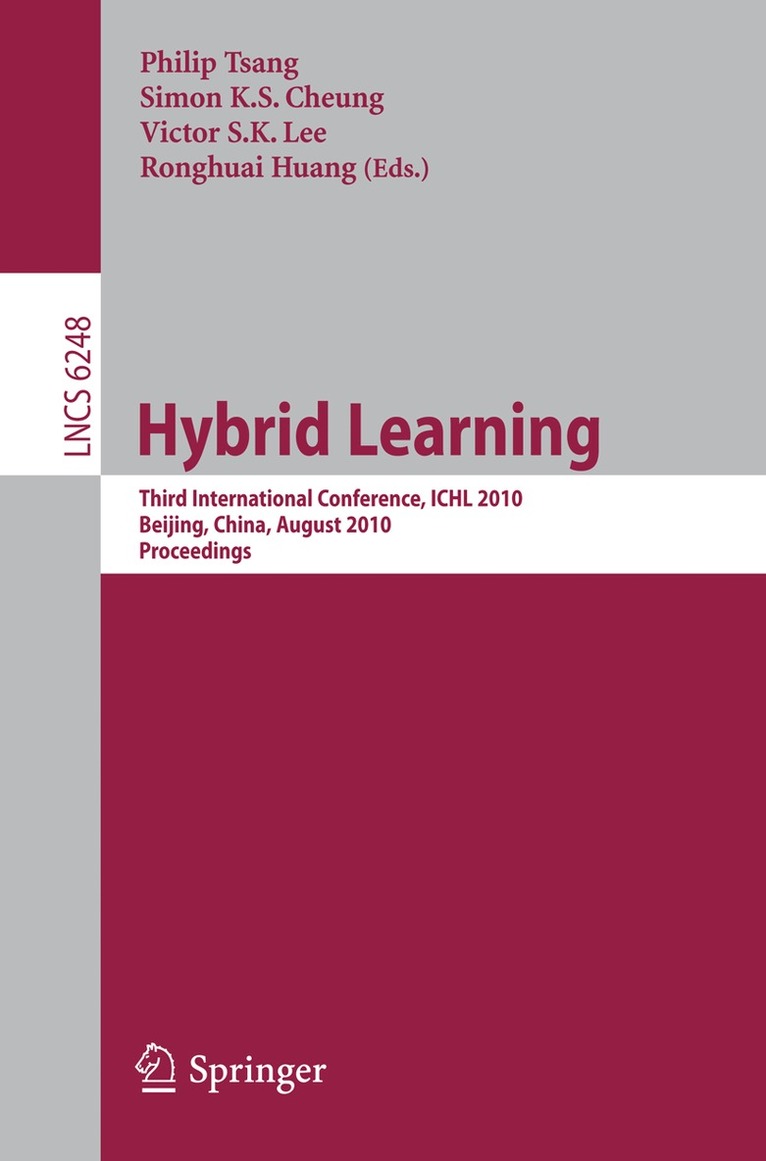
    Hybrid Learning

    Third International Conference, ICHL 2010, Beijing, China, August 16-18, 2010, Proceedings

    AvPhilip Tsang,Simon K.S. Cheung

    Häftad, Engelska, 2010

    Del i serien Lecture Notes in Computer Science

    1 054 kr

    Beställningsvara. Skickas inom 10-15 vardagar. Fri frakt över 249 kr.

    Beskrivning

    The Third International Conference on Hybrid Learning (ICHL 2010) was organized by the School of Continuing and Professional Studies of The Chinese University of Hong Kong, Beijing Normal University, Goethe-Institut China, Caritas Francis Hsu College, and Caritas Bianchi College of Careers. ICHL 2010 provided a platform for knowledge exchange on hybrid learning among educators, researchers and computer scientists, who share a common goal to enhance the quality of learning and teaching in this fast-changing knowledge world, with the support of technology innovation. Hybrid learning has been an ongoing trend for a number of years. It is not merely a simple combination of face-to-face and technology-mediated instruction, but also encompasses different learning strategies for teaching and learning. It places emphasis on outcome-based teaching and learning, and provides a diversified learning envir- ment. Hybrid learning is probably the most efficient learning mode in the present age of globalization, when learning has to be borderless and dynamic in order to address the diverse learning needs of students. Students are given more opportunities to - velop into active independent learners, and to practice practical skills for work and study. It was our pleasure to have three keynote speakers for the ICHL 2010. They were Rebecca Launer from Goethe-Institut, Germany, Bebo White from Stanford Univ- sity, and Yan Ji Chang from Tsinghua University, all of whom shared with us their valuable insights in the hybrid learning field.

    Produktinformation

    • Utgivningsdatum:2010-07-30
    • Format:Häftad
    • Språk:Engelska
    • Serie:Lecture Notes in Computer Science
    • Antal sidor:534
    • Förlag:Springer-Verlag Berlin and Heidelberg GmbH & Co. KG
    • ISBN:9783642146565

    Utforska kategorier

    • Material och digital teknik i undervisningen inom Psykologi och pedagogik

    Innehållsförteckning

    • Keynote.- Alternative Worlds as Teaching and Learning Environments.- Five Assumptions on Blended Learning: What Is Important to Make Blended Learning a Successful Concept?.- Interactive Hybrid Learning Systems.- Learning Performance Support System for Adult Learning.- E-Learning: Developing a Simple Web-Based Intelligent Tutoring System Using Cognitive Diagnostic Assessment and Adaptive Testing Technology.- Hybrid Learning Systems: Meeting the Challenges of Graduate Management Education.- An E-Class Teaching Management System (ECTMS): Strategy and Application.- Facebook – Education with Social Networking Websites for Teaching and Learning.- Content Management for Hybrid Learning.- Building Teachers’ TPACK through WebQuest Development and Blended Learning Process.- Hybrid Learning:“Neither Fish Nor Fowl” or “The Golden Mean”.- Techniques for Enhancing Hybrid Learning of Physical Education.- Using New Web Technologies in Teaching Demography.- Pedagogical and Psychological Issues.- Best Practices in Teaching Online or Hybrid Courses: A Synthesis of Principles.- Students’ Attitudes towards Web Searching.- Knowledge Structure of Elementary School Teacher Training Based on Educational Technology: Focus on Classroom Teaching.- A Qualitative Analysis of Sub-degree Students Commentary Styles and Patterns in the Context of Gender and Peer e-Feedback.- Outcome-Based Teaching and Learning.- Hybrid Learning Curriculum Development Using the ReProTool – Lessons from Ancient Philosophy.- Investigating Hong Kong Form 6 Students’ Perceptions towards Their Development of Critical Thinking Skills with Narrative Analysis Activities with Film.- ROAD-MAP for Educational Simulations and Serious Games.- Enhancing Blended Courses to Facilitate Student Achievement of LearningOutcomes.- Instructional Design Issues.- Building an Online Course Based on Semantic Wiki for Hybrid Learning.- A Hybrid Learning Compiler Course.- Understanding Online Knowledge Sharing: An Exploratory Theoretical Framework.- The Effects of “Facilitating” in an Online Asynchronous Teachers Training Course.- Developing a Mulitmedia Learning Model Based on Hands-On Learning: A Cognitive Apprenticeship Approach.- Experiences in Hybrid Learning.- Hybrid Learning of Physical Education Using National Elaborate Course Resources.- Key Factors of Effecting Blended Learning Satisfaction: A Study on Peking University Students.- Experience of Blended Learning in School Education: Knowledge about Perimeter of Closed Shapes.- A Review of Mobile Learning in the Mobile Age.- Hybrid Learning Mode for Industrial Engineering Specialized Courses in China.- Improved Flexibility of Learning Processes.- A Practical Approach to the Teaching of Internet Programming and Multimedia Technologies.- Use of Open Educational Resources: Challenges and Strategies.- The Use of Virtual Classroom in Library and Information Management Courses.- 3D Virtual Classroom Based on Multi-agent.- Computer Supported Collaborative Learning.- Learning in CALL Environments: An Exploration of the Effects of Self-regulated Learning Constructs on Chinese Students’ Academic Performance.- Automatic Support for the Analysis of Online Collaborative Learning Chat Conversations.- Knowledge Construction through Discussion Forum in a Blended Learning Environment.- On-Line Learning Community Based on Curricular.- Assessment Strategies for Hybrid Learning.- Comparison of Students’ Satisfaction and Dissatisfaction Factors in Different Classroom Types in Higher Education.- Cognitive Load Theory Based Effectiveness Evaluationon Dynamic Math Teaching.- Impact of 3D/VR Action Video Games on Players’ Cognition, Problem Solving and Its Implications in Simulation Training.- Implementing Institutional Online Assessment – Addressing the Challenges.- Organisational Frameworks and Institutional Policies.- Hybrid Learning: Teaching for Quality Learning at University.- The Diminishing Influence of Age and Gender on e-Learning Readiness of Teachers in Hong Kong.- Effectiveness of E-Learning at Secondary Schools in Hong Kong.- Competency Model for Chinese Distance Education in Higher Education.- Hybrid Learning and New Development of “IT in Education” Theory.