• Fri frakt över 249 kr
  • •
  • Snabba leveranser
  • •
  • Billiga böcker
Kundservice

Du är på sajten för privatpersoner.

Företag, bibliotek eller offentlig verksamhet?

Du handlar på classic.bokus.com, där alla dina funktioner finns intakta.
Till classic.bokus.com
Bokus logotyp. Gå till startsidan.
  • Erbjudanden
  • Nyheter
  • Student
  • Topplistor
  • Barn & ungdom
  • Bokus Play
  • E-böcker
  • Pocketböcker
  • Spel & pussel

10% rabatt på allt med kod NYSTART10 →

Sidfot

Mina sidor

    Hjälp

    • Kundservice
    • Vanliga frågor och svar
    • Frakt och leverans
    • Retur vid ångerrätt
    • Reklamera vara
    • Betalning
    • Köpvillkor
    • Allmänna villkor
    • Information om webbplatsens tillgänglighet

    Om Bokus

    • Om oss
    • Pressrum
    • För studenter
    • För företag
    • För bibliotek och offentlig verksamhet
    • För leverantörer
    • Hållbarhet

    Populärt

    • Aktuella erbjudanden
    • Presentkort
    • Studentlitteratur
    • Nya böcker
    • Topplistor
    • Signerade böcker
    • Engelska böcker

    Inspiration

    • Boktips
    • BookTok
    • Populära bokserier
    • Barnbokskaraktärer
    • Populära författare
    Logotyp för Bokus
    Följ oss på Facebook (extern länk)Följ oss på Instagram (extern länk)Följ oss på YouTube (extern länk)Följ oss på TikTok (extern länk)
    bokus @ CookiesAnpassa cookiesIntegritetspolicyKöpvillkor
    Till Citymail hemsida (extern länk)Till Budbee hemsida (extern länk)Till Postnord hemsida (extern länk)Till Schenker hemsida (extern länk)Till Early Bird hemsida (extern länk)Till Walleys hemsida (extern länk)
    1. Data och IT
    2. Systemvetenskap och AI
    3. Artificiell intelligens

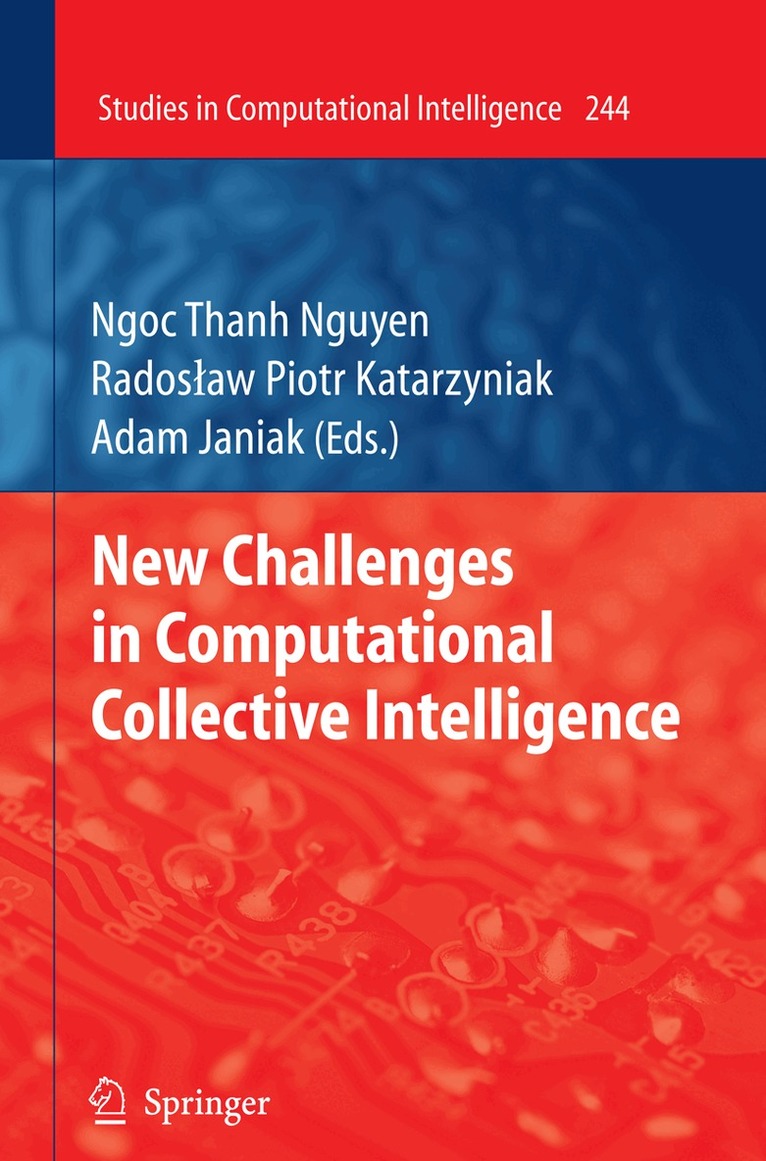
    New Challenges in Computational Collective Intelligence

    AvRadoslaw Katarzyniak,Adam Janiak

    Häftad, Engelska, 2012

    Del 244 i serien Studies in Computational Intelligence

    1 672 kr

    Beställningsvara. Skickas inom 10-15 vardagar. Fri frakt över 249 kr.

    Beskrivning

    Collective intelligence has become one of major research issues studied by today’s and future computer science. Computational collective intelligence is understood as this form of group intellectual activity that emerges from collaboration and compe- tion of many artificial individuals. Robotics, artificial intelligence, artificial cognition and group working try to create efficient models for collective intelligence in which it emerges from sets of actions carried out by more or less intelligent individuals. The major methodological, theoretical and practical aspects underlying computational collective intelligence are group decision making, collective action coordination, collective competition and knowledge description, transfer and integration. Obviously, the application of multiple computational technologies such as fuzzy systems, evo- tionary computation, neural systems, consensus theory, knowledge representation etc. is necessary to create new forms of computational collective intelligence and support existing ones. Three subfields of application of computational technologies to support forms of collective intelligence are of special attention to us. The first one is semantic web treated as an advanced tool that increases the collective intelligence in networking environments. The second one covers social networks modeling and analysis, where social networks are this area of in which various forms of computational collective intelligence emerges in a natural way. The third subfield relates us to agent and mul- agent systems understood as this computational and modeling paradigm which is especially tailored to capture the nature of computational collective intelligence in populations of autonomous individuals.

    Produktinformation

    • Utgivningsdatum:2012-03-14
    • Mått:155 x 235 x 20 mm
    • Vikt:546 g
    • Format:Häftad
    • Språk:Engelska
    • Serie:Studies in Computational Intelligence
    • Antal sidor:349
    • Upplaga:2009
    • Förlag:Springer-Verlag Berlin and Heidelberg GmbH & Co. KG
    • ISBN:9783642269288

    Utforska kategorier

    • Artificiell intelligens inom Data och IT

    Innehållsförteckning

    • Semantic Web.- Web Services Composition Framework with Petri Net Based Schemas.- Proposal of a New Rule-Based Inference Scheme for the Semantic Web Applications.- Applying Caching Capabilities to Inference Applications Based on Semantic Web.- Semantic Web System for Automatic Plan Scheduling.- Knowledge and Data Processing in a Process of Website Quality Evaluation.- Ontology Management and Applications.- Syntactic Modular Decomposition of Large Ontologies with Relational Database.- Relational Database as an Ontology Framework.- The Knowledge Generation about an Enterprise in the KBS-AE (Knowledge-Based System - Acts of Explanation).- Information Retrieval in the Geodetic and Cartographic Documentation Centers.- Visualization Framework of Information Map in Blog Using Ontology.- Semantic Data Integration in the Domain of Medicine.- Social Networks.- Analysis of Social Network’s Structural Properties in Huge Community Portal.- Efficient Construction of (d+1,3d)-Ruling Set in Wireless Ad Hoc Networks.- A Case Study of Building Social Network for Mobile Carriers.- Modelling Dynamics of Social Support Networks for Mutual Support in Coping with Stress.- Data Portability across Social Networks.- Agent and Multiagent Systems.- A Novel Formalism to Represent Collective Intelligence in Multi-agent Systems.- A Formal Model for Epistemic Interactions.- Issues on Aligning the Meaning of Symbols in Multiagent Systems.- Artificial Evolution and the EVM Architecture.- On Multi-agent Petri Net Models for Computing Extensive Finite Games.- Multi-agent Verification of RFID System.- An Action Selection Architecture for Autonomous Virtual Agents.- Agent Architecture for Criminal Mobile Devices Identification Systems.- A Trading Mechanism Based on Interpersonal Relationship in Agent-BasedElectronic Commerce.- Agent Based Architecture for Pricing the Services in Dynamic User/Network Environment.- Other Applications.- Accuracy in Predicting Secondary Structure of Ionic Channels.- Secure Information Splitting Using Grammar Schemes.- Comparative Analysis of Neural Network Models for Premises Valuation Using SAS Enterprise Miner.