• Fri frakt över 249 kr
  • •
  • Snabba leveranser
  • •
  • Billiga böcker
Kundservice

Du är på sajten för privatpersoner.

Företag, bibliotek eller offentlig verksamhet?

Du handlar på classic.bokus.com, där alla dina funktioner finns intakta.
Till classic.bokus.com
Bokus logotyp. Gå till startsidan.
  • Erbjudanden
  • Student
  • Topplistor
  • Barn & ungdom
  • Bokus Play
  • E-böcker
  • Ljudböcker
  • Pocketböcker
  • Spel & pussel

10% rabatt på allt med kod NYSTART10 →

Sidfot

Mina sidor

    Hjälp

    • Kundservice
    • Vanliga frågor och svar
    • Frakt och leverans
    • Retur vid ångerrätt
    • Reklamera vara
    • Betalning
    • Köpvillkor
    • Allmänna villkor
    • Information om webbplatsens tillgänglighet

    Om Bokus

    • Om oss
    • Pressrum
    • För studenter
    • För företag
    • För bibliotek och offentlig verksamhet
    • För leverantörer
    • Hållbarhet

    Populärt

    • Aktuella erbjudanden
    • Presentkort
    • Studentlitteratur
    • Nya böcker
    • Topplistor
    • Signerade böcker
    • Engelska böcker

    Inspiration

    • Boktips
    • BookTok
    • Populära bokserier
    • Barnbokskaraktärer
    • Populära författare
    Logotyp för Bokus
    Följ oss på Facebook (extern länk)Följ oss på Instagram (extern länk)Följ oss på YouTube (extern länk)Följ oss på TikTok (extern länk)
    bokus @ CookiesAnpassa cookiesIntegritetspolicyKöpvillkor
    Till Citymail hemsida (extern länk)Till Budbee hemsida (extern länk)Till Postnord hemsida (extern länk)Till Schenker hemsida (extern länk)Till Early Bird hemsida (extern länk)Till Walleys hemsida (extern länk)
    1. Data och IT
    2. Systemvetenskap och AI

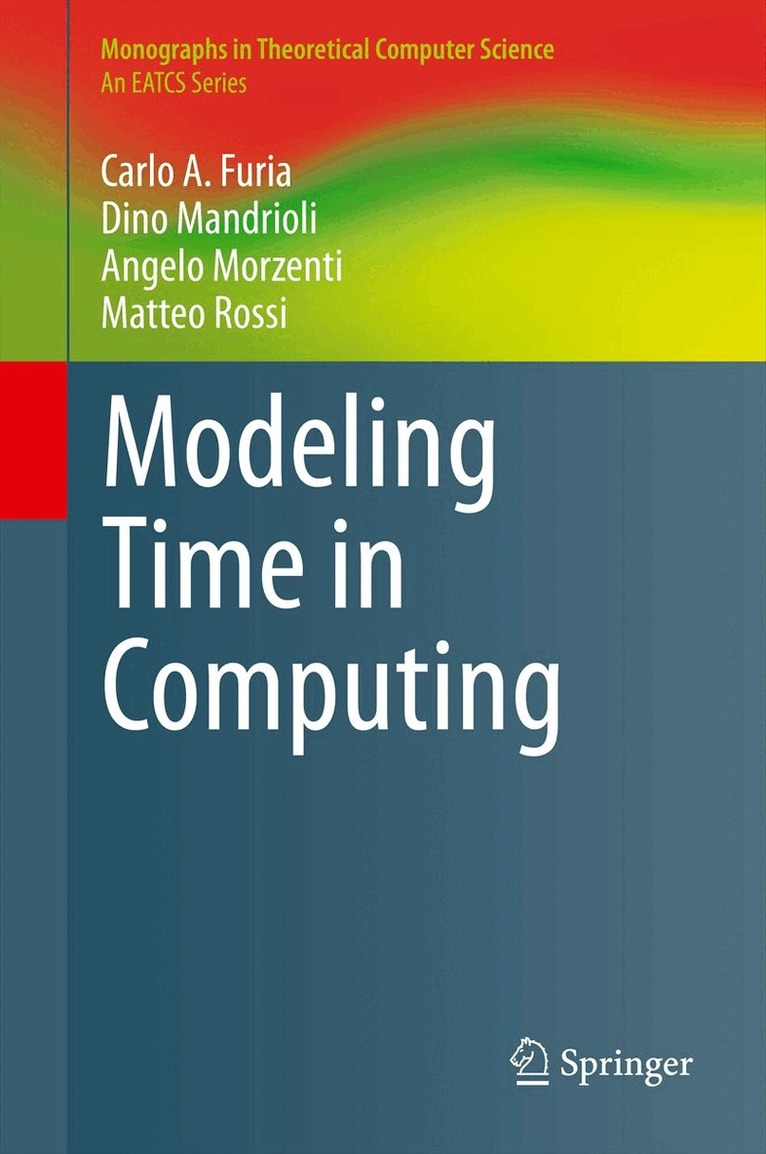
    Modeling Time in Computing

    AvCarlo A. Furia,Dino Mandrioli

    Häftad, Engelska, 2014

    Del i serien Monographs in Theoretical Computer Science. An EATCS Series

    562 kr

    Beställningsvara. Skickas inom 10-15 vardagar. Fri frakt över 249 kr.

    Fler format och utgåvor

    Inbunden

    562 kr

    Beskrivning

    Models that include a notion of time are ubiquitous in disciplines such as the natural sciences, engineering, philosophy, and linguistics, but in computing the abstractions provided by the traditional models are problematic and the discipline has spawned many novel models. This book is a systematic thorough presentation of the results of several decades of research on developing, analyzing, and applying time models to computing and engineering.After an opening motivation introducing the topics, structure and goals, the authors introduce the notions of formalism and model in general terms along with some of their fundamental classification criteria. In doing so they present the fundamentals of propositional and predicate logic, and essential issues that arise when modeling time across all types of system. Part I is a summary of the models that are traditional in engineering and the natural sciences, including fundamental computer science: dynamical systems and control theory; hardware design; and software algorithmic and complexity analysis. Part II covers advanced and specialized formalisms dealing with time modeling in heterogeneous software-intensive systems: formalisms that share finite state machines as common “ancestors”; Petri nets in many variants; notations based on mathematical logic, such as temporal logic; process algebras; and “dual-language approaches” combining two notations with different characteristics to model and verify complex systems, e.g., model-checking frameworks. Finally, the book concludes with summarizing remarks and hints towards future developments and open challenges. The presentation uses a rigorous, yet not overly technical, style, appropriate for readers with heterogeneous backgrounds, and each chapter is supplemented with detailed bibliographic remarks and carefully chosen exercises of varying difficulty and scope. The book is aimed at graduate students and researchers in computer science, whileresearchers and practitioners in other scientific and engineering disciplines interested in time modeling with a computational flavor will also find the book of value, and the comparative and conceptual approach makes this a valuable introduction for non-experts. The authors assume a basic knowledge of calculus, probability theory, algorithms, and programming, while a more advanced knowledge of automata, formal languages, and mathematical logic is useful.

    Produktinformation

    • Utgivningsdatum:2014-11-09
    • Mått:155 x 235 x 24 mm
    • Vikt:663 g
    • Format:Häftad
    • Språk:Engelska
    • Serie:Monographs in Theoretical Computer Science. An EATCS Series
    • Antal sidor:424
    • Upplaga:2012
    • Förlag:Springer-Verlag Berlin and Heidelberg GmbH & Co. KG
    • ISBN:9783642431364

    Utforska kategorier

    • Systemvetenskap och AI inom Data och IT
    • Artificiell intelligens inom Data och IT
    • Hårdvara inom Data och IT

    Mer om författaren

    Dr. Carlo A. Furia is a lecturer and researcher in the software engineering at ETH Zürich; his main research interests are within the area of formal methods for software engineering, including approaches to improving the quality, reliability, and correctness of software and software-intensive systems. Prof. Dino Mandrioli has been a professor of theoretical computer science at the Politecnico di Milano since 1992; his research interests are mainly in the field of theoretical computer science, software engineering and systems in real time. Prof. Angelo Morzenti is a professor at the Politecnico di Milano; his research interests are centered on languages, methods and tools for the specification, analysis, validation, verification and design of critical, real-time, distributed, embedded computer-based systems. Dr. Matteo Rossi is an assistant professor at the Politecnico di Milano; his research interests are in the area of formal methods for industrial safety-critical systems.

    Recensioner i media

    From the reviews: "All aspects of modeling time in computing are presented in this book, but that's not all it offers. Each of the chapters can be read as an independent text, allowing a very customized experience with the book. ... Part 1 is extremely useful for readers at an early level of computer science learning, as it presents aspects that can be easily understood by an undergraduate student. These chapters also offer the bonus of some exercises that help readers assess their ability to understand the concepts discussed. Part 2, I think, is harder to follow because it deals with a higher level of abstraction. However, these chapters are very well written and allow a complete understanding of the issues of simulating time. After the closing chapter, the authors provide an extensive set of references and a useful index. The authors have succeeded in writing a very complete text, which is fairly easy to read and to follow ... This book is now one of my favorite sources on this topic. " [Nuno M. Garcia, Computing Reviews, 2013] "The book is well written, the details are given in a rigorous manner, the bibliography seems to be adequate and well explained. ... I consider the book to be a nice presentation of a large range of results regarding time modeling in computer science, complemented by a considerable number of pointers towards further readings. In fewer words: a good starting point both for students and researchers interested in this topic." [Florin Manea, Zentralblatt MATH, Vol. 1260, 2013] "... Next to its admirably comparative and conceptual approach, the highlight of this book are its numerous examples and its many excellent, albeit challenging, exercises ... its brilliantly written first part revisits the approaches adopted by physics and engineering for describing dynamic systems ... this is a successful monograph on the diverse and difficult topic of modeling time. I highly recommend it to engineers and practitioners who need to apply modern computer science techniques to developing and analyzing complex, software-intensive systems. " [G. Luttgen, AMS Mathematical Reviews, MR3185244, 2015]

    Innehållsförteckning

    • Chap. 1 It's About Time.- Chap. 2 Languages and Interpretations.- Chap. 3 Dimensions of the Time Modeling Problem.- Chap. 4 Dynamical Systems.- Chap. 5 Time in Hardware Modeling and Design.- Chap. 6 Time in the Analysis of Algorithms.- Chap. 7 Synchronous Abstract Machines.- Chap. 8 Asynchronous Abstract Machines: Petri Nets.- Chap. 9 Logic-Based Formalisms.- Chap. 10 Algebraic Formalisms.- Chap. 11 Dual-Language Approaches.- Chap. 12 Time Is up.- References.- Index.