Dino Mandrioli - Böcker
Visar alla böcker från författaren Dino Mandrioli. Handla med fri frakt och snabb leverans.
3 produkter
3 produkter
2 696 kr
Skickas inom 7-10 vardagar
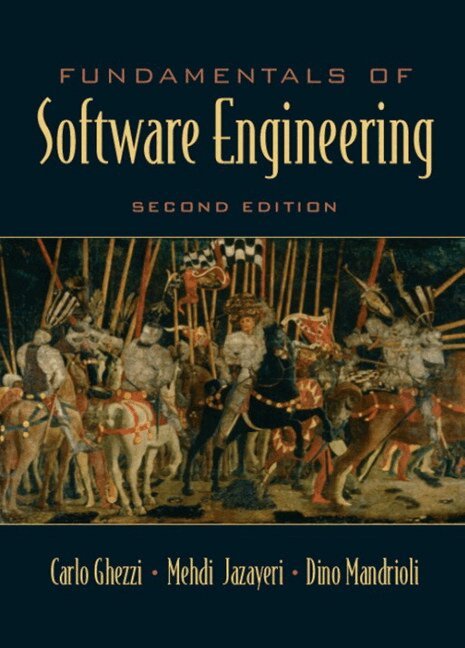
Appropriate for both undergraduate and graduate introductory software engineering courses found in Computer Science and Computer Engineering departments. This text provides selective, in-depth coverage of the fundamentals of software engineering by stressing principles and methods through rigorous formal and informal approaches. The authors emphasize, identify, and apply fundamental principles that are applicable throughout the software lifecycle, in contrast to other texts which are based in the lifecycle model of software development. This emphasis enables students to respond to the rapid changes in technology that are common today.
552 kr
Skickas inom 10-15 vardagar
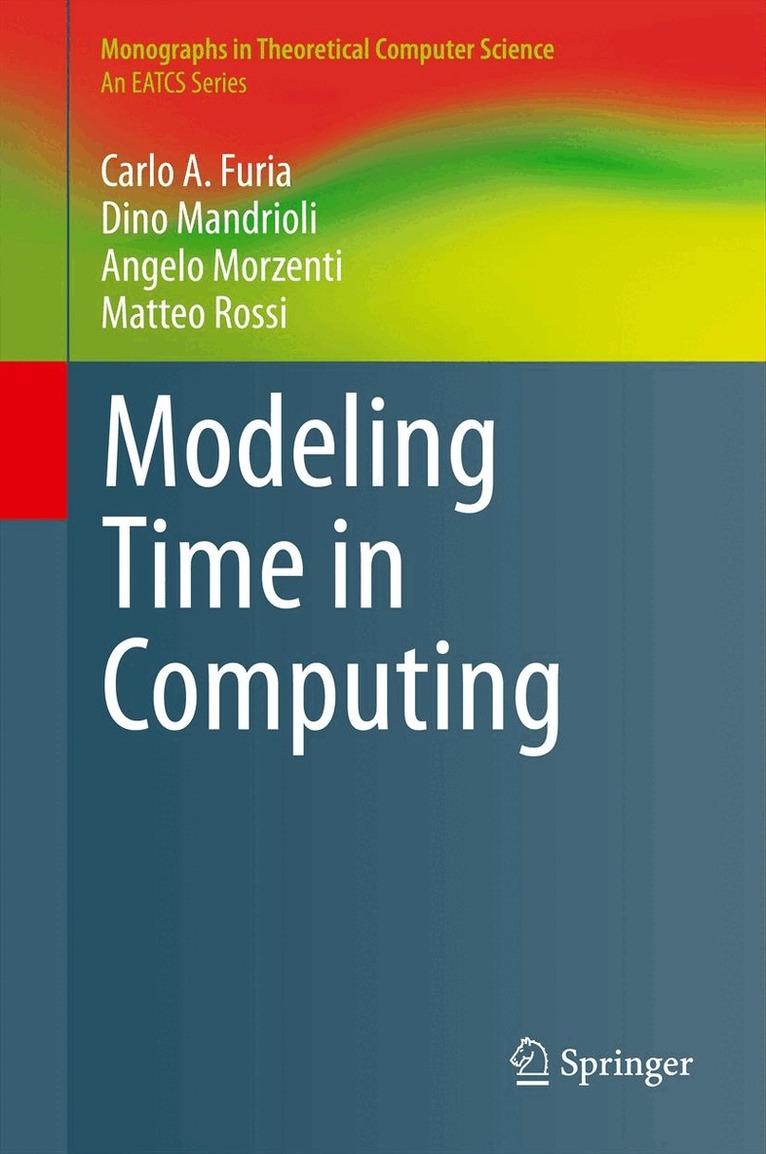
Models that include a notion of time are ubiquitous in disciplines such as the natural sciences, engineering, philosophy, and linguistics, but in computing the abstractions provided by the traditional models are problematic and the discipline has spawned many novel models. This book is a systematic thorough presentation of the results of several decades of research on developing, analyzing, and applying time models to computing and engineering.After an opening motivation introducing the topics, structure and goals, the authors introduce the notions of formalism and model in general terms along with some of their fundamental classification criteria. In doing so they present the fundamentals of propositional and predicate logic, and essential issues that arise when modeling time across all types of system. Part I is a summary of the models that are traditional in engineering and the natural sciences, including fundamental computer science: dynamical systems and control theory; hardware design; and software algorithmic and complexity analysis. Part II covers advanced and specialized formalisms dealing with time modeling in heterogeneous software-intensive systems: formalisms that share finite state machines as common “ancestors”; Petri nets in many variants; notations based on mathematical logic, such as temporal logic; process algebras; and “dual-language approaches” combining two notations with different characteristics to model and verify complex systems, e.g., model-checking frameworks. Finally, the book concludes with summarizing remarks and hints towards future developments and open challenges. The presentation uses a rigorous, yet not overly technical, style, appropriate for readers with heterogeneous backgrounds, and each chapter is supplemented with detailed bibliographic remarks and carefully chosen exercises of varying difficulty and scope. The book is aimed at graduate students and researchers in computer science, whileresearchers and practitioners in other scientific and engineering disciplines interested in time modeling with a computational flavor will also find the book of value, and the comparative and conceptual approach makes this a valuable introduction for non-experts. The authors assume a basic knowledge of calculus, probability theory, algorithms, and programming, while a more advanced knowledge of automata, formal languages, and mathematical logic is useful.
552 kr
Skickas inom 10-15 vardagar
Models that include a notion of time are ubiquitous in disciplines such as the natural sciences, engineering, philosophy, and linguistics, but in computing the abstractions provided by the traditional models are problematic and the discipline has spawned many novel models. This book is a systematic thorough presentation of the results of several decades of research on developing, analyzing, and applying time models to computing and engineering.After an opening motivation introducing the topics, structure and goals, the authors introduce the notions of formalism and model in general terms along with some of their fundamental classification criteria. In doing so they present the fundamentals of propositional and predicate logic, and essential issues that arise when modeling time across all types of system. Part I is a summary of the models that are traditional in engineering and the natural sciences, including fundamental computer science: dynamical systems and control theory; hardware design; and software algorithmic and complexity analysis. Part II covers advanced and specialized formalisms dealing with time modeling in heterogeneous software-intensive systems: formalisms that share finite state machines as common “ancestors”; Petri nets in many variants; notations based on mathematical logic, such as temporal logic; process algebras; and “dual-language approaches” combining two notations with different characteristics to model and verify complex systems, e.g., model-checking frameworks. Finally, the book concludes with summarizing remarks and hints towards future developments and open challenges. The presentation uses a rigorous, yet not overly technical, style, appropriate for readers with heterogeneous backgrounds, and each chapter is supplemented with detailed bibliographic remarks and carefully chosen exercises of varying difficulty and scope. The book is aimed at graduate students and researchers in computer science, whileresearchers and practitioners in other scientific and engineering disciplines interested in time modeling with a computational flavor will also find the book of value, and the comparative and conceptual approach makes this a valuable introduction for non-experts. The authors assume a basic knowledge of calculus, probability theory, algorithms, and programming, while a more advanced knowledge of automata, formal languages, and mathematical logic is useful.