• Fri frakt över 249 kr
  • •
  • Snabba leveranser
  • •
  • Billiga böcker
Kundservice

Du är på sajten för privatpersoner.

Företag, bibliotek eller offentlig verksamhet?

Du handlar på classic.bokus.com, där alla dina funktioner finns intakta.
Till classic.bokus.com
Bokus logotyp. Gå till startsidan.
  • Erbjudanden
  • Student
  • Topplistor
  • Barn & ungdom
  • Bokus Play
  • E-böcker
  • Ljudböcker
  • Pocketböcker
  • Spel och pussel

Pocketfynda! Hundratals böcker för 49 kr/st →

Sidfot

Mina sidor

    Hjälp

    • Kundservice
    • Vanliga frågor och svar
    • Frakt och leverans
    • Retur vid ångerrätt
    • Reklamera vara
    • Betalning
    • Köpvillkor
    • Allmänna villkor
    • Information om webbplatsens tillgänglighet

    Om Bokus

    • Om oss
    • Pressrum
    • För studenter
    • För företag
    • För bibliotek och offentlig verksamhet
    • För leverantörer
    • Hållbarhet

    Populärt

    • Aktuella erbjudanden
    • Presentkort
    • Studentlitteratur
    • Nya böcker
    • Topplistor
    • Signerade böcker
    • Engelska böcker

    Inspiration

    • Boktips
    • BookTok
    • Barnbokskaraktärer
    • Populära författare
    Logotyp för Bokus
    Följ oss på Facebook (extern länk)Följ oss på Instagram (extern länk)Följ oss på YouTube (extern länk)Följ oss på TikTok (extern länk)
    bokus @ CookiesAnpassa cookiesIntegritetspolicyKöpvillkor
    Till Citymail hemsida (extern länk)Till Budbee hemsida (extern länk)Till Postnord hemsida (extern länk)Till Schenker hemsida (extern länk)Till Early Bird hemsida (extern länk)Till Walleys hemsida (extern länk)
    1. Ekonomi och Ledarskap
    2. Nationalekonomi
    3. Mikroekonomi

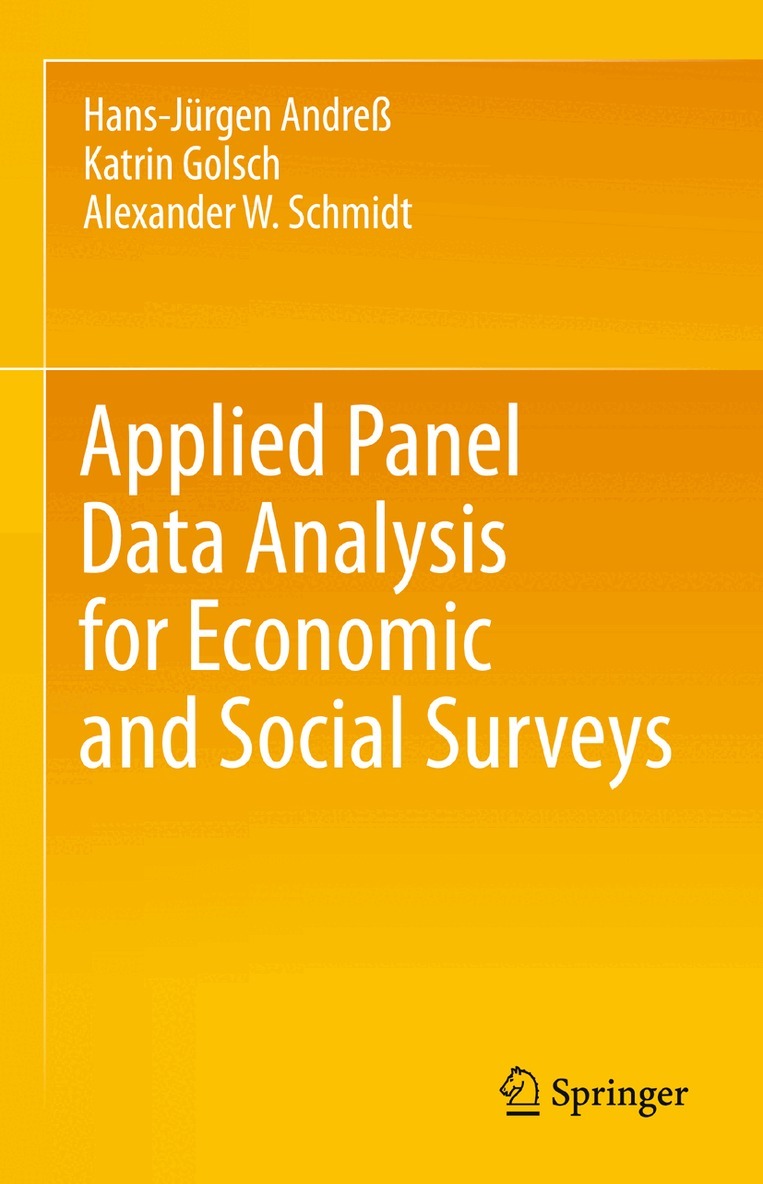
    Applied Panel Data Analysis for Economic and Social Surveys

    AvHans-Jürgen Andreß,Katrin Golsch

    Häftad, Engelska, 2015

    971 kr

    Beställningsvara. Skickas inom 10-15 vardagar. Fri frakt över 249 kr.

    Fler format och utgåvor

    Inbunden

    1 399 kr

    Beskrivning

    Many economic and social surveys are designed as panel studies, which provide important data for describing social changes and testing causal relations between social phenomena. This textbook shows how to manage, describe, and model these kinds of data. It presents models for continuous and categorical dependent variables, focusing either on the level of these variables at different points in time or on their change over time. It covers fixed and random effects models, models for change scores and event history models. All statistical methods are explained in an application-centered style using research examples from scholarly journals, which can be replicated by the reader through data provided on the accompanying website. As all models are compared to each other, it provides valuable assistance with choosing the right model in applied research. The textbook is directed at master and doctoral students as well as applied researchers in the social sciences, psychology, business administration and economics. Readers should be familiar with linear regression and have a good understanding of ordinary least squares estimation.​

    Produktinformation

    • Utgivningsdatum:2015-07-01
    • Mått:155 x 235 x 23 mm
    • Vikt:528 g
    • Format:Häftad
    • Språk:Engelska
    • Antal sidor:327
    • Upplaga:2013
    • Förlag:Springer-Verlag Berlin and Heidelberg GmbH & Co. KG
    • ISBN:9783642434174

    Utforska kategorier

    • Mikroekonomi inom Ekonomi och Ledarskap
    • Sociologi inom Samhälle och politik

    Mer om författaren

    Hans-Jürgen Andreß a is Full Professor in Empirical Social and Economic Research at the Faculty of Business Administration, Economics and Social Sciences at the University of Cologne. His research interests include statistics and multivariate methods; labor market research; social and family policy. Katrin Golsch is a senior researcher at the Department of Sociology at Bielefeld University, Germany. Her core interests include statistical methods for the analysis of survey data and longitudinal data analysis in particular, life-course analysis, social structure, labor market research and comparative sociological research. Alexander Schmidt is a PhD candidate at the Research Training Group SOCLIFE, funded by the Germany Science Foundation. He teaches computer assisted data analysis and survey research at the Chair of Empirical Social and Economic Research at the Faculty of Business Administration, Economics and Social Sciences at the University of Cologne. His research focuses on social mobility and comparative welfare state analysis.

    Recensioner i media

    From the reviews: "This book is written for applied researchers in the social fields. The level of the book refers to users with some theoretical background in statistics and econometrics, but no sound knowledge is required to read the book." (Herbert S. Buscher, zbMATH, Vol. 1276, 2014)

    Innehållsförteckning

    • Introduction: Benefits and challenges of the panel design.- Outline of the book.- Audience and prerequisites.- Acknowledgements.- Managing panel data: The nature of panel data.- The basics of panel data management.- Three case studies on poverty in Germany.- How to represent a population with panel data?- Conclusion and further reading.- Describing and modeling panel data: Some basic terminology.- Measurements over time are not independent.- Describing the dependent variable.-  Explaining the dependent variable over time: typical explanatory variables.- Modeling panel data.-  Estimating models for panel data.- Overview of subsequent chapters.- Panel analysis of continuous variables: Modeling the level of Y.- Modeling the change of Y.-  Conclusion and further reading.-  Panel analysis of categorical variables: Modeling the level of Y: Discrete response models for panel data.- Modeling the change of Y: Discrete-time event history models for panel data.- Conclusion and further reading.- Conclusion: How to do your own panel analysis.-  A: Functions of random variables.- B: Estimation and testing:  Ordinary least squares.- How to compute a regression model fitting the data?- Sampling and sampling errors.- How to choose between different estimation methods?- How to estimate the parameters of an unknown population with a sample of data?- How to test parameters of an unknown population with a sample of data?- Maximum likelihood .- C: Web site of the textbook.- Bibliography.- Index.