• Fri frakt över 249 kr
  • •
  • Snabba leveranser
  • •
  • Billiga böcker
Kundservice

Du är på sajten för privatpersoner.

Företag, bibliotek eller offentlig verksamhet?

Du handlar på classic.bokus.com, där alla dina funktioner finns intakta.
Till classic.bokus.com
Bokus logotyp. Gå till startsidan.
  • Erbjudanden
  • Student
  • Topplistor
  • Barn & ungdom
  • Bokus Play
  • E-böcker
  • Ljudböcker
  • Pocketböcker
  • Spel och pussel

5% studentrabatt – använd koden KURSBOK27 →

Sidfot

Mina sidor

    Hjälp

    • Kundservice
    • Vanliga frågor och svar
    • Frakt och leverans
    • Retur vid ångerrätt
    • Reklamera vara
    • Betalning
    • Köpvillkor
    • Allmänna villkor
    • Information om webbplatsens tillgänglighet

    Om Bokus

    • Om oss
    • Pressrum
    • För studenter
    • För företag
    • För bibliotek och offentlig verksamhet
    • För leverantörer
    • Hållbarhet

    Populärt

    • Aktuella erbjudanden
    • Presentkort
    • Studentlitteratur
    • Nya böcker
    • Topplistor
    • Signerade böcker
    • Engelska böcker

    Inspiration

    • Boktips
    • BookTok
    • Barnbokskaraktärer
    • Populära författare
    Logotyp för Bokus
    Följ oss på Facebook (extern länk)Följ oss på Instagram (extern länk)Följ oss på YouTube (extern länk)Följ oss på TikTok (extern länk)
    bokus @ CookiesAnpassa cookiesIntegritetspolicyKöpvillkor
    Till Citymail hemsida (extern länk)Till Budbee hemsida (extern länk)Till Postnord hemsida (extern länk)Till Schenker hemsida (extern länk)Till Early Bird hemsida (extern länk)Till Walleys hemsida (extern länk)
    1. Data och IT
    2. Grafik och bildbehandling
    3. CAD-program

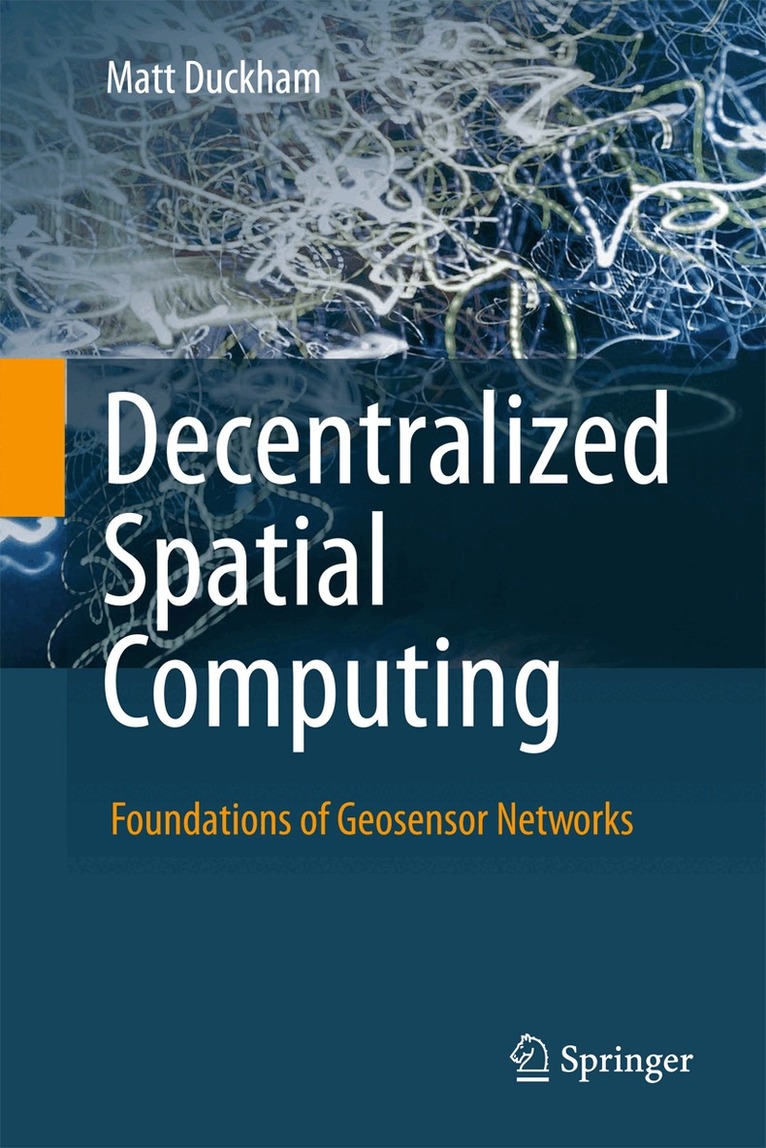
    Decentralized Spatial Computing

    Foundations of Geosensor Networks

    AvMatt Duckham

    Häftad, Engelska, 2014

    543 kr

    Beställningsvara. Skickas inom 10-15 vardagar. Fri frakt över 249 kr.

    Fler format och utgåvor

    Inbunden

    543 kr

    E-bok

    712 kr

    Beskrivning

    Computing increasingly happens somewhere, with that geographic location important to the computational process itself. Many new and evolving spatial technologies, such as geosensor networks and smartphones, embody this trend. Conventional approaches to spatial computing are centralized, and do not account for the inherently decentralized nature of "computing somewhere": the limited, local knowledge of individual system components, and the interaction between those components at different locations. On the other hand, despite being an established topic in distributed systems, decentralized computing is not concerned with geographical constraints to the generation and movement of information. In this context, of (centralized) spatial computing and decentralized (non-spatial) computing, the key question becomes: "What makes decentralized spatial computing special?"In Part I of the book the author covers the foundational concepts, structures, and design techniques for decentralized computing with spatial and spatiotemporal information. In Part II he applies those concepts and techniques to the development of algorithms for decentralized spatial computing, stepping through a suite of increasingly sophisticated algorithms: from algorithms with minimal spatial information about their neighborhoods; to algorithms with access to more detailed spatial information, such as direction, distance, or coordinate location; to truly spatiotemporal algorithms that monitor environments that are dynamic, even using networks that are mobile or volatile. Finally, in Part III the author shows how decentralized spatial and spatiotemporal algorithms designed using the techniques explored in Part II can be simulated and tested. In particular, he investigates empirically the important properties of a decentralized spatial algorithm: its computational efficiency and its robustness to unavoidable uncertainty. Part III concludes with a survey of the opportunities for connecting decentralized spatial computing to ongoing research and emerging hot topics in related fields, such as biologically inspired computing, geovisualization, and stream computing.The book is written for students and researchers of computer science and geographic information science. Throughout the book the author's style is characterized by a focus on the broader message, explaining the process of decentralized spatial algorithm design rather than the technical details. Each chapter ends with review questions designed to test the reader's understanding of the material and to point to further work or research. The book includes short appendices on discrete mathematics and SQL. Simulation models written in NetLogo and associated source code for all the algorithms presented in the book can be found on the author's accompanying website.

    Produktinformation

    • Utgivningsdatum:2014-08-09
    • Mått:155 x 235 x 19 mm
    • Vikt:522 g
    • Format:Häftad
    • Språk:Engelska
    • Antal sidor:322
    • Upplaga:2013
    • Förlag:Springer-Verlag Berlin and Heidelberg GmbH & Co. KG
    • ISBN:9783642441301

    Utforska kategorier

    • CAD-program inom Data och IT
    • Artificiell intelligens inom Data och IT
    • Geografi inom Naturvetenskap och teknik

    Mer om författaren

    Dr. Duckham is a Senior Lecturer at the Department of Geomatics, University of Melbourne, Australia. He also currently (2012) holds a prestigious Australian Research Council research fellowship, an ARC Future Fellowship, for research into ambient spatial intelligence. Previously he worked at the National Center for Geographic Information and Analysis (NCGIA) at the University of Maine, USA, as well as in the UK (Universities of Edinburgh, Leicester, Glasgow, and Keele). He is a coauthor with Prof. Mike Worboys of the significant advanced undergraduate/postgraduate textbook “GIS: A Computing Perspective" (2nd ed., CRC Press). He has many further related journal and book publications, and he is the Editor‐in-Chief of the Journal of Spatial Information Science (JOSIS).

    Recensioner i media

    "This book is an excellent summary on the topic of distributed spatial planning. ... This book provides valuable insight in terms of working with sensor networks which are now arising around the world. ... the concepts and discussions are useful and valuable to a wide ranging auidence. For this reason, anyone working with geosensors today will find this book well worth the read." (Jeff Thurston, 3dvisworld.com, December, 2014)

    Innehållsförteckning

    • Part I Foundations of Decentralized Spatial Computing.- Chap. 1 When Computing Happens Somewhere.- Chap. 2 Formal foundations.- Chap. 3 Algorithmic foundations.- Part II Algorithms for Decentralized Spatial Computing.- Chap. 4 Neighborhood-Based Algorithms.- Chap. 5 Location-Based Algorithms.- Chap. 6 Monitoring Spatial Change Over Time.- Part III Simulating Decentralized Spatial Algorithms.- Chap. 7 Simulating Scalable Decentralized Spatial Algorithms.- Chap. 8 Simulating Robust Decentralized Spatial Algorithms.- Chap. 9 Further Topics and Technologies.- References.- App. A Discrete Mathematics PrimerApp. B Relational Database and SQL Primer.- Index.