• Fri frakt över 249 kr
  • •
  • Snabba leveranser
  • •
  • Billiga böcker
Kundservice

Du är på sajten för privatpersoner.

Företag, bibliotek eller offentlig verksamhet?

Du handlar på classic.bokus.com, där alla dina funktioner finns intakta.
Till classic.bokus.com
Bokus logotyp. Gå till startsidan.
  • Erbjudanden
  • Nyheter
  • Student
  • Topplistor
  • Barn & ungdom
  • Bokus Play
  • E-böcker
  • Pocketböcker
  • Spel & pussel

10% rabatt på allt med kod NYSTART10 →

Sidfot

Mina sidor

    Hjälp

    • Kundservice
    • Vanliga frågor och svar
    • Frakt och leverans
    • Retur vid ångerrätt
    • Reklamera vara
    • Betalning
    • Köpvillkor
    • Allmänna villkor
    • Information om webbplatsens tillgänglighet

    Om Bokus

    • Om oss
    • Pressrum
    • För studenter
    • För företag
    • För bibliotek och offentlig verksamhet
    • För leverantörer
    • Hållbarhet

    Populärt

    • Aktuella erbjudanden
    • Presentkort
    • Studentlitteratur
    • Nya böcker
    • Topplistor
    • Signerade böcker
    • Engelska böcker

    Inspiration

    • Boktips
    • BookTok
    • Populära bokserier
    • Barnbokskaraktärer
    • Populära författare
    Logotyp för Bokus
    Följ oss på Facebook (extern länk)Följ oss på Instagram (extern länk)Följ oss på YouTube (extern länk)Följ oss på TikTok (extern länk)
    bokus @ CookiesAnpassa cookiesIntegritetspolicyKöpvillkor
    Till Citymail hemsida (extern länk)Till Budbee hemsida (extern länk)Till Postnord hemsida (extern länk)Till Schenker hemsida (extern länk)Till Early Bird hemsida (extern länk)Till Walleys hemsida (extern länk)
    1. Ekonomi och Ledarskap
    2. Nationalekonomi

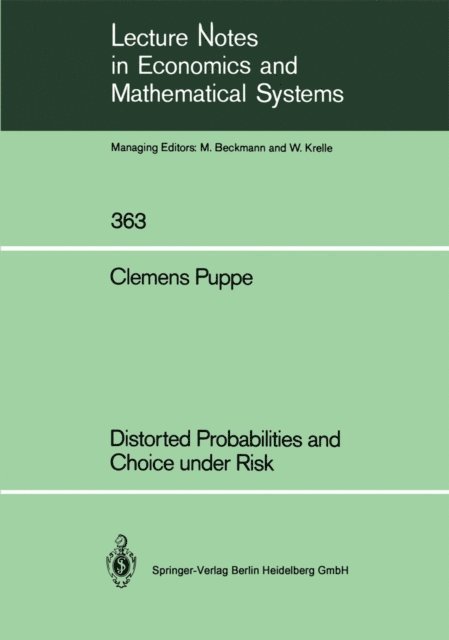
    Distorted Probabilities and Choice under Risk

    AvClemens Puppe

    E-bok
    PDF, Engelska, 2012

    732 kr

    Läs direkt i Bokus Reader – eller ladda ned till din enhet (PDF kräver ofta zoom och scroll på små skärmar).

    Fler format och utgåvor

    Häftad

    546 kr

    Beskrivning

    During the development of modern probability theory in the 17th cen­ tury it was commonly held that the attractiveness of a gamble offering the payoffs :1:17 ••• ,:l: with probabilities Pl, . . . , Pn is given by its expected n value L:~ :l:iPi. Accordingly, the decision problem of choosing among different such gambles - which will be called prospects or lotteries in the sequel-was thought to be solved by maximizing the corresponding expected values. The famous St. Petersburg paradox posed by Nicholas Bernoulli in 1728, however, conclusively demonstrated the fact that individuals l consider more than just the expected value. The resolution of the St. Petersburg paradox was proposed independently by Gabriel Cramer and Nicholas''s cousin Daniel Bernoulli [BERNOULLI 1738/1954]. Their argument was that in a gamble with payoffs :l:i the decisive factors are not the payoffs themselves but their subjective values u( :l:i)'' According to this argument gambles are evaluated on the basis of the expression L:~ U(Xi)pi. This hypothesis -with a somewhat different interpretation of the function u - has been given a solid axiomatic foundation in 1944 by v. Neumann and Morgenstern and is now known as the expected utility hypothesis. The resulting model has served for a long time as the preeminent theory of choice under risk, especially in its economic applications.

    Produktinformation

    • Utgivningsdatum:2012-12-06
    • Språk:Engelska
    • Filformat:PDF
    • Kopieringsskydd:LCP
    • ISBN:9783642582035
    • Förlag:Springer Berlin Heidelberg

    Utforska kategorier

    • Nationalekonomi inom Ekonomi och Ledarskap
    • Ledarskap och motivation inom Ekonomi och Ledarskap
    • Företagsekonomi inom Ekonomi och Ledarskap