• Fri frakt över 249 kr
  • •
  • Snabba leveranser
  • •
  • Billiga böcker
Kundservice

Du är på sajten för privatpersoner.

Företag, bibliotek eller offentlig verksamhet?

Du handlar på classic.bokus.com, där alla dina funktioner finns intakta.
Till classic.bokus.com
Bokus logotyp. Gå till startsidan.
  • Erbjudanden
  • Nyheter
  • Student
  • Topplistor
  • Barn & ungdom
  • Bokus Play
  • E-böcker
  • Pocketböcker
  • Spel & pussel

10% rabatt på allt med kod: NYSTART10 →

Sidfot

Mina sidor

    Hjälp

    • Kundservice
    • Vanliga frågor och svar
    • Frakt och leverans
    • Retur vid ångerrätt
    • Reklamera vara
    • Betalning
    • Köpvillkor
    • Allmänna villkor
    • Information om webbplatsens tillgänglighet

    Om Bokus

    • Om oss
    • Pressrum
    • För studenter
    • För företag
    • För bibliotek och offentlig verksamhet
    • För leverantörer
    • Hållbarhet

    Populärt

    • Aktuella erbjudanden
    • Presentkort
    • Studentlitteratur
    • Nya böcker
    • Topplistor
    • Signerade böcker
    • Engelska böcker

    Inspiration

    • Boktips
    • BookTok
    • Populära bokserier
    • Barnbokskaraktärer
    • Populära författare
    Logotyp för Bokus
    Följ oss på Facebook (extern länk)Följ oss på Instagram (extern länk)Följ oss på YouTube (extern länk)Följ oss på TikTok (extern länk)
    bokus @ CookiesAnpassa cookiesIntegritetspolicyKöpvillkor
    Till Citymail hemsida (extern länk)Till Budbee hemsida (extern länk)Till Postnord hemsida (extern länk)Till Schenker hemsida (extern länk)Till Early Bird hemsida (extern länk)Till Walleys hemsida (extern länk)
    1. Djur och Natur
    2. Naturböcker
    3. Växtböcker

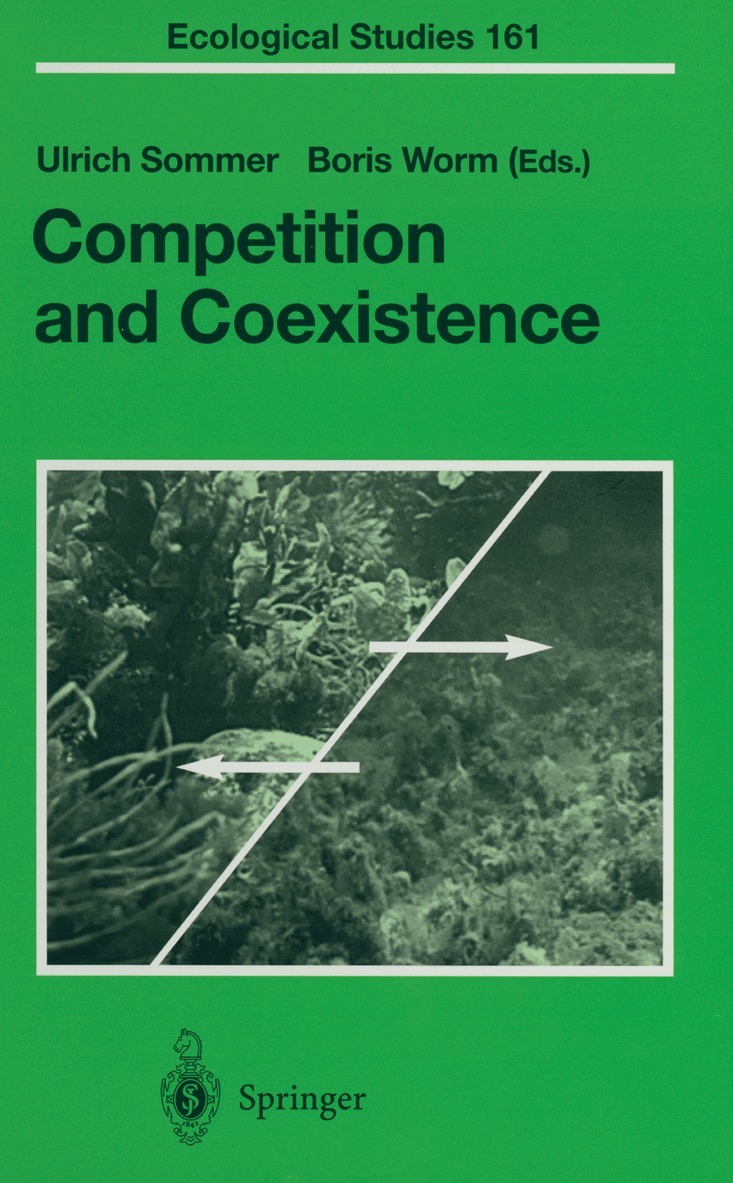
    Competition and Coexistence

    AvUlrich Sommer,Boris Worm

    Häftad, Engelska, 2012

    Del i serien Ecological Studies

    1 086 kr

    Beställningsvara. Skickas inom 10-15 vardagar. Fri frakt över 249 kr.

    Beskrivning

    The question "Why are there so many species?" has puzzled ecologist for a long time. Initially, an academic question, it has gained practical interest by the recent awareness of global biodiversity loss. Species diversity in local ecosystems has always been discussed in relation to the problem of competi­ tive exclusion and the apparent contradiction between the competitive exclu­ sion principle and the overwhelming richness of species found in nature. Competition as a mechanism structuring ecological communities has never been uncontroversial. Not only its importance but even its existence have been debated. On the one extreme, some ecologists have taken competi­ tion for granted and have used it as an explanation by default if the distribu­ tion of a species was more restricted than could be explained by physiology and dispersal history. For decades, competition has been a core mechanism behind popular concepts like ecological niche, succession, limiting similarity, and character displacement, among others. For some, competition has almost become synonymous with the Darwinian "struggle for existence", although simple plausibility should tell us that organisms have to struggle against much more than competitors, e.g. predators, parasites, pathogens, and envi­ ronmental harshness.

    Produktinformation

    • Utgivningsdatum:2012-10-28
    • Mått:155 x 235 x 14 mm
    • Vikt:371 g
    • Format:Häftad
    • Språk:Engelska
    • Serie:Ecological Studies
    • Antal sidor:223
    • Förlag:Springer-Verlag Berlin and Heidelberg GmbH & Co. KG
    • ISBN:9783642628009

    Utforska kategorier

    • Växtböcker inom Djur och Natur
    • Botanik inom Naturvetenskap och teknik
    • Miljövetenskap och miljöpolitik inom Naturvetenskap och teknik

    Recensioner i media

    From the reviews: "... I found this book easy to read, with a concise and consistent style across chapters. Figures were clearly presented and effectively described. I would recommend this as a good introduction to current models and empirical studies of the role of competition in structuring communities for those not already familiar with the topic." (Ethology) "Plant ecologists working on traditional problems of vegetation composition and tradeoffs among component species for limiting resources will derive a great deal from the book. It comprises a convenient and approachable primer on the theory of competition and coexistence and its real-life applications, and it would make for an excellent graduate-level seminar." (Plant Systematics and Evolution) "This volume is an attempt to review and synthesize recent research on competition-coexistence relationships ... . Overall, I found this book easy to read, with a concise and consistent style across chapters. Figures were clearly presented and effectively described. I would recommend this as a good introduction to current models and empirical studies of the role of competition in structuring communities for those not already familiar with this topic." (Tad Theimer, Ethology, Issue 12, 2003)

    Innehållsförteckning

    • 1 Introduction.- 1.1 The Intellectual Debate Until 1990.- 1.2 Progress During the Last Decade.- 1.3 Consequences for the Structure of the Book.- References.- 2 Competition in Well-Mixed Habitats: From Competitive Exclusion to Competitive Chaos.- 2.1 Introduction.- 2.2 Competition for a Single Abiotic Resource.- 2.3 Resource Storage.- 2.4 Competition for a Single Biotic Resource.- 2.5 Competition for Two Resources.- 2.6 Competition for Three Resources.- 2.7 Discussion.- References.- 3 Spatial Models of Competition.- 3.1 Introduction.- 3.2 Implicitly Spatial Models.- 3.3 Explicitly Spatial Models.- 3.4 Comparing and Connecting Methods.- 3.5 Underlying Spatial Heterogeneity.- 3.6 Competition and Coexistence.- 3.7 Future Directions.- References.- 4 Competition and Coexistence in Plankton Communities.- 4.1 Introduction.- 4.2 Competition Experiments in Laboratory Microcosms.- 4.3 Experiments in Field Mesocosms.- 4.4 Tests of the Intermediate Disturbance Hypothesis by Field Data.- 4.5 Herbivory and Diversity.- 4.6 The Role of Abundance and of Seasonality.- 4.7 Conclusions.- References.- 5 Competition and Coexistence in Mobile Animals.- 5.1 Introduction.- 5.2 Competition Among Mobile Animals.- 5.3 Heterogeneity, Trade-Offs, and Competition.- 5.4 Scale and Heterogeneity.- 5.5 New Challenges.- References.- 6 Competition, Coexistence and Diversity on Rocky Shores.- 6.1 Introduction.- 6.2 Disruption of Competitive Exclusion: The Non-Equilibrium View.- 6.3 Coexistence Through Trade-Offs: The Equilibrium View.- 6.4 Synthesis: Integrating the Effects of Competition, Consumption and Disturbance.- 6.5 Conclusion.- References.- 7 Competition and Coexistence in Terrestrial Plants.- 7.1 Introduction.- 7.2 Competition.- 7.3 Coexistence.- 7.4 Conclusion.- References.- 8 Synthesis: Back to Santa Rosalia, or No Wonder There Are So Many Species.- 8.1 Trade-Offs.- 8.2 Disturbance, Predation and Competition.- 8.3 The Spatial Dimension.- 8.4 Self-Generated Heterogeneity.- 8.5 Exclusive Resources.- 8.6 Slow Exclusion.- 8.7 Equilibrium vs. Non-Equilibrium Concepts.- 8.8 Future Challenges.- References.