• Fri frakt över 249 kr
  • •
  • Snabba leveranser
  • •
  • Billiga böcker
Kundservice

Du är på sajten för privatpersoner.

Företag, bibliotek eller offentlig verksamhet?

Du handlar på classic.bokus.com, där alla dina funktioner finns intakta.
Till classic.bokus.com
Bokus logotyp. Gå till startsidan.
  • Erbjudanden
  • Nyheter
  • Student
  • Topplistor
  • Barn & ungdom
  • Bokus Play
  • E-böcker
  • Pocketböcker
  • Spel & pussel

10% rabatt på allt med kod NYSTART10 →

Sidfot

Mina sidor

    Hjälp

    • Kundservice
    • Vanliga frågor och svar
    • Frakt och leverans
    • Retur vid ångerrätt
    • Reklamera vara
    • Betalning
    • Köpvillkor
    • Allmänna villkor
    • Information om webbplatsens tillgänglighet

    Om Bokus

    • Om oss
    • Pressrum
    • För studenter
    • För företag
    • För bibliotek och offentlig verksamhet
    • För leverantörer
    • Hållbarhet

    Populärt

    • Aktuella erbjudanden
    • Presentkort
    • Studentlitteratur
    • Nya böcker
    • Topplistor
    • Signerade böcker
    • Engelska böcker

    Inspiration

    • Boktips
    • BookTok
    • Populära bokserier
    • Barnbokskaraktärer
    • Populära författare
    Logotyp för Bokus
    Följ oss på Facebook (extern länk)Följ oss på Instagram (extern länk)Följ oss på YouTube (extern länk)Följ oss på TikTok (extern länk)
    bokus @ CookiesAnpassa cookiesIntegritetspolicyKöpvillkor
    Till Citymail hemsida (extern länk)Till Budbee hemsida (extern länk)Till Postnord hemsida (extern länk)Till Schenker hemsida (extern länk)Till Early Bird hemsida (extern länk)Till Walleys hemsida (extern länk)
    1. Medicin
    2. Klinisk medicin och internmedicin
    3. Sjukdomar och rubbningar
    4. Onkologi

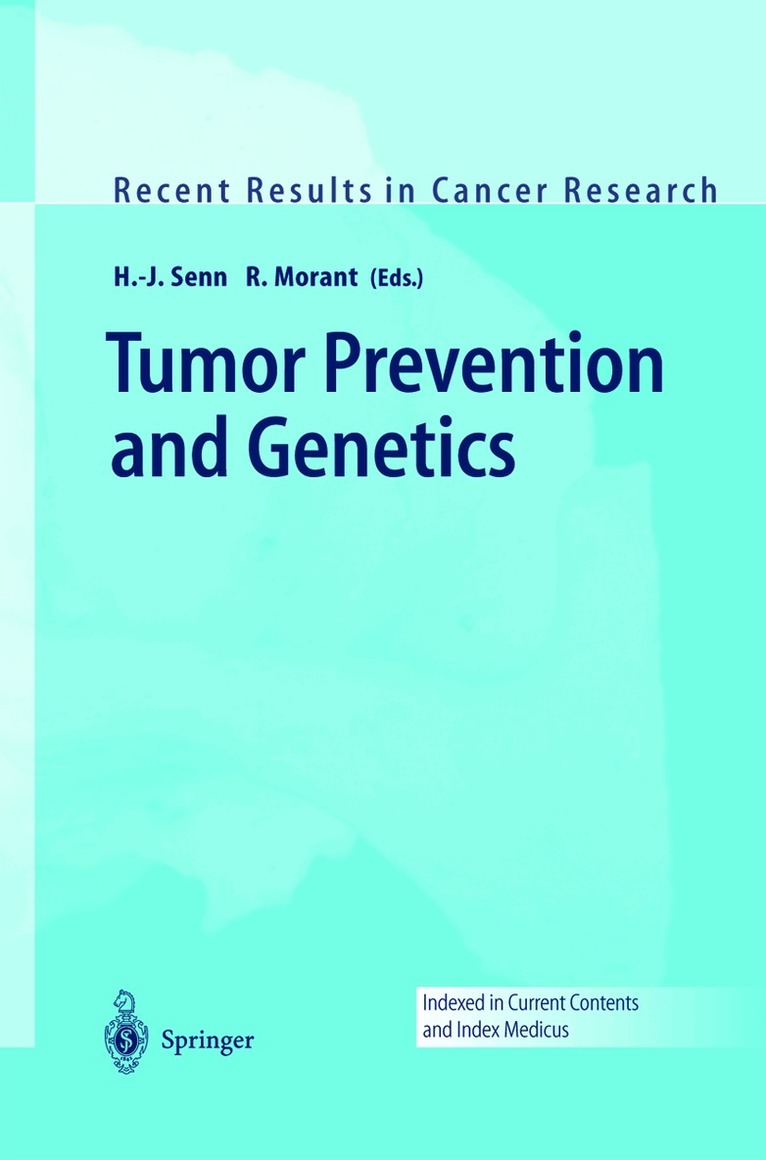
    Tumor Prevention and Genetics

    AvHans-Jörg Senn,Rudolf Morant

    Häftad, Engelska, 2012

    Del 163 i serien Recent Results in Cancer Research

    563 kr

    Beställningsvara. Skickas inom 10-15 vardagar. Fri frakt över 249 kr.

    Beskrivning

    Hans-Jorg Senn H.-J. Senn (~) Center for Tumor Detection and Prevention, Rorschacherstr. 150, CH-9006 St. Gallen, Switzerland Clinical oncology has centered mainly on developing new strategies and a multitude of new drugs for fighting relapsing and progressive cancer during the last two decades. Furthermore, it has done this with respectable success in quite a number of neoplastic diseases such as acute leukemias and sarcomas in pediatric patients and certain types of aggressive lymphomas, as well as se­ lected solid tumors such as testicular cancer and choriocarcinoma in adult age. Curatively intended adjuvant chemo-and endocrine-therapies of several "main killers" among prevalent cancer types, especially breast and colon can­ cer, have also become successful and health-politically meaningful therapeutic targets [1, 2]. However, the net gain in "cure" of these (mostly pharmacologic) therapeu­ tic approaches has to be realistically judged as having a moderate impact on the cancer problem as a whole, and the mortality rate of the most frequent tu­ mor types, which are prevalent in adult life, has with very few exceptions not been substantially decreased over the past two to three decades. Increasingly, health politicians, epidemiologists, and medical journal editors are asking for alternative strategies of lowering cancer incidence and increasing survival, ventilating new and hitherto mostly neglected areas of research such as pri­ mary and secondary cancer prevention.

    Produktinformation

    • Utgivningsdatum:2012-10-08
    • Mått:155 x 235 x 16 mm
    • Vikt:429 g
    • Format:Häftad
    • Språk:Engelska
    • Serie:Recent Results in Cancer Research
    • Antal sidor:266
    • Förlag:Springer-Verlag Berlin and Heidelberg GmbH & Co. KG
    • ISBN:9783642628924

    Utforska kategorier

    • Onkologi inom Medicin
    • Medicinsk genetik inom Medicin

    Innehållsförteckning

    • 1 Latest News in Cancer Genetics.- Genetic Susceptibility, Predicting Risk and Preventing Cancer.- Novel Approaches to Identify Low Penetrance Cancer Susceptibility Genes Using Mouse Models.- 2 Assessing New Cancer Susceptibility Genes.- Development of Novel Selective Cell Ablation in the Mammary Gland and Brain to Study Cell-Cell Interactions and Chemoprevention.- Mouse Skin as a Model for Cancer Chemoprevention by Nonsteroidal Anti-Inflammatory Drugs Friedrich Marks, Gerhard Fürstenberger; Gitta Neufang,.- Preclinical Models for Chemoprevention of Colon Cancer.- New Cancer Biomarkers Deriving from the NCI Early Detection Research.- 3 Update in Chemoprevention of Breast Cancer.- Tamoxifen’s Impact as a Preventive Agent in Clinical Practice and an Update on the STAR Trial.- Aromatase Inhibitors in Prevention — Data from the ATAC (Arimidex, Tamoxifen Alone orin Combination) Trial and the Design of IBIS-II (The Second International Breast Cancer Intervention Study).- HRT Opposed by Low Dose Tamoxifen (HOT Study). Rationale and Design.- 4 Secondary Prevention of Breast Cancer: The Mammography Controversy.- Is Mammography Screening for Breast Cancer Really Not Justifiable?.- How Reliable is the Evidence for Screening Mammography?.- Political Interpretation of Scientific Evidence — Case Study of Breast Cancer Screening Policies Around the World.- 5 Chemoprevention of Skin and Lung Cancer.- Skin Cancer Chemoprevention: Strategies to Save our Skin.- Chemoprevention of Non-Melanoma Skin Cancer: Experience with a Polyphenol from Green Tea.- Chemoprevention of Lung Cancer: New Directions.- Key Issues in Lung Cancer Chemoprevention Trials of New Agents.- 6 Prevention and Screening of Prostate Cancer.- Prevention of Prostate Cancer.- Clinical Models for TestingChemopreventative Agents in Prostate Cancer and Overview of SELECT: The Selenium and Vitamin ECancer Prevention Trial.- Problems with Prostate Specific Antigen Screening: A Critical Review.- 7 Prevention and Screening of Colorectal Cancer.- Genetic Predisposition as a Basis for Chemoprevention, Surgical and Other Interventions in Colorectal Cancer.- Fecal Occult Blood (FOB) Screening — Trial Evidence, Practice and Beyond Gad Rennert.- Is FOB-Screening Really the Answer for Lowering Mortality in Colorectal Cancer?.- Summary and Conclusions.