• Fri frakt över 249 kr
  • •
  • Snabba leveranser
  • •
  • Billiga böcker
Kundservice

Du är på sajten för privatpersoner.

Företag, bibliotek eller offentlig verksamhet?

Du handlar på classic.bokus.com, där alla dina funktioner finns intakta.
Till classic.bokus.com
Bokus logotyp. Gå till startsidan.
  • Erbjudanden
  • Nyheter
  • Student
  • Topplistor
  • Barn & ungdom
  • Bokus Play
  • E-böcker
  • Pocketböcker
  • Spel & pussel

Må bättre, för mindre! Upp till 50% rabatt på hälsoböcker

Sidfot

Mina sidor

    Hjälp

    • Kundservice
    • Vanliga frågor och svar
    • Frakt och leverans
    • Retur vid ångerrätt
    • Reklamera vara
    • Betalning
    • Köpvillkor
    • Allmänna villkor
    • Information om webbplatsens tillgänglighet

    Om Bokus

    • Om oss
    • Pressrum
    • För studenter
    • För företag
    • För bibliotek och offentlig verksamhet
    • För leverantörer
    • Hållbarhet

    Populärt

    • Aktuella erbjudanden
    • Presentkort
    • Studentlitteratur
    • Nya böcker
    • Topplistor
    • Signerade böcker
    • Engelska böcker

    Inspiration

    • Boktips
    • BookTok
    • Populära bokserier
    • Barnbokskaraktärer
    • Populära författare
    Logotyp för Bokus
    Följ oss på Facebook (extern länk)Följ oss på Instagram (extern länk)Följ oss på YouTube (extern länk)Följ oss på TikTok (extern länk)
    bokus @ CookiesAnpassa cookiesIntegritetspolicyKöpvillkor
    Till Citymail hemsida (extern länk)Till Budbee hemsida (extern länk)Till Postnord hemsida (extern länk)Till Schenker hemsida (extern länk)Till Early Bird hemsida (extern länk)Till Walleys hemsida (extern länk)
    1. Naturvetenskap och teknik
    2. Matematik och naturvetenskap
    3. Biologi
    4. Zoologi

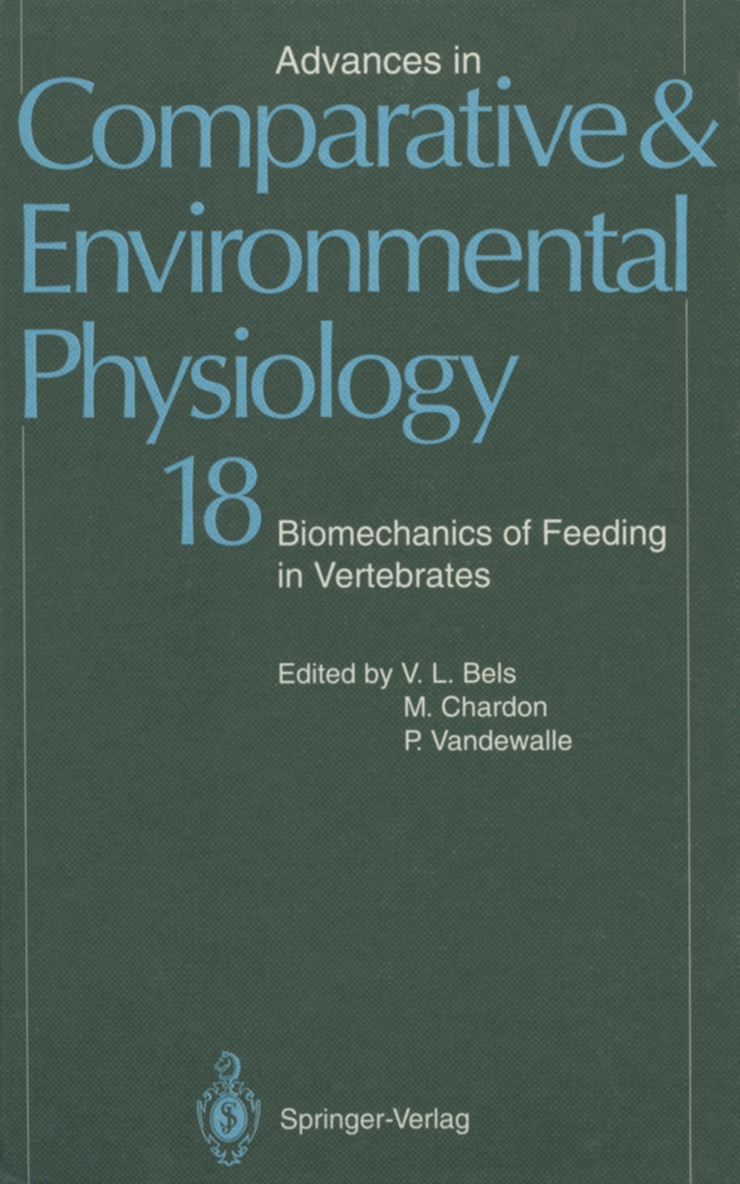
    Biomechanics of Feeding in Vertebrates

    Häftad, Engelska, 2012

    Del 18 i serien Advances in Comparative and Environmental Physiology

    547 kr

    Beställningsvara. Skickas inom 10-15 vardagar. Fri frakt över 249 kr.

    Beskrivning

    Although feeding is not yet been thoroughly studied in manyvertebrates taxa, and different conceptual andmethodological approaches of the concerned scientists make asynthesis difficult, the aim of the editors is to provide acomprehensive overview of the feeding design in aquatic andterrestrial vertebrates with a detailed description of itsfunctional properties. The book emphasizes the constantinteraction between function and form, behaviour andmorphology in the course of evolution of the feedingapparatus and way of feeding both complementary andbasically related to survival interspecific competition,adaptation to environmental changes and adaptive radiations.Special stress is drawn onquantification of theobservational and experimental data on the morphology andbiomechanics of the feeding design and its element jaws,teeth, hyoidean apparatus, tongue, in order to allow presentand further comparisons in an evolutionary perspective.

    Produktinformation

    • Utgivningsdatum:2012-11-01
    • Mått:155 x 235 x 21 mm
    • Vikt:569 g
    • Format:Häftad
    • Språk:Engelska
    • Serie:Advances in Comparative and Environmental Physiology
    • Antal sidor:363
    • Förlag:Springer-Verlag Berlin and Heidelberg GmbH & Co. KG
    • ISBN:9783642633997

    Utforska kategorier

    • Zoologi inom Naturvetenskap och teknik
    • Djurböcker inom Djur och Natur

    Innehållsförteckning

    • 1 Functional Properties of the Feeding Musculature.- 1 Introduction.- 2 Functional Properties of Individual Muscle Fibers.- 3 Fiber Types and Contractile Properties in Vertebrate Feeding Muscles.- References.- 2 Feeding Mechanisms in Sharks and Other Elasmobranchs T.H Frazzetta.- 1 Chondrichthyian Fishes.- 2 Elasmobranchs.- 3 The Shark Jaw Apparatus.- 4 Feeding behavior.- 5 Morphomechanics and function.- 6 Other Elasmobranchs.- 7 Conclusions.- References.- 3 The Pharyngeal Apparatus in Teleost Feeding.- 1 Introduction.- 2 Morphology.- 3 Role of the Pharyngeal Apparatus in Food Processing.- 4 Development of the Pharyngeal Jaws.- 5 Polymorphism and Plasticity of the Pharyngeal Jaw Apparatus.- 6 Concluding Remarks.- References.- 4 Feeding in Tetrapods.- 1 Introduction.- 2 Problems and Solutions for Terrestrial Feeding.- 3 Amphibians: Conflict and Prey Ingestion.- 4 Reptilian and Mammalian Prey Ingestion.- 5 Teeth, Crushing and Mastication.- 6 The Adductor Muscles and Their Action Patterns.- 7 Cycles.- 8 Overview.- References.- 5 Sensorimotor Processes That Underlie Feeding Behavior in Tetrapods.- 1 Behavior Patterns Related to Feeding.- 2 Definitions Referring to “Sensori-”, “Motor-”, and “Command-”.- 3 The Motor Part of Prey Snapping in Toads.- 4 The Feature-Analyzing Part of Prey Catching.- 5 A Concept of a Neuronal Circuit for the Tongue Flip.- References.- 6 Amphibian Feeding Behavior: Comparative Biomechanics and Evolution.- 1 Introduction.- 2 Overview of Feeding Mechanics in Fishes.- 3 Salamander Feeding Mechanics.- 4 Frog Feeding Mechanics.- 5 Comparative Analysis of Amphibian Feeding.- 6 Recommendations and Future Directions.- References.- 7 Biomechanics of the Hyolingual System in Squamata.- 1 Introduction.- 2 Functional and Biomechanical Studies ofthe Hyolingual System.- 3 Evolutionary Comparison of Hyolingual Biomechanics 234 References.- 8 Behavioral Mechanisms of Avian Feeding.- 1 Introduction.- 2 General Food Acquisition Mechanism: Pecking.- 3 Specific Food-Handling Mechanisms: Husking and Storage.- 4 Specific Food Acquisition Mechanisms.- 5 Sensory Control and Motor Patterning.- 6 Principles of Avian Food Acquisition.- References.- 9 Evolutionary Approach of Masticatory Motor Patterns in Mammals W.A Weijs.- 1 Introduction and Scope.- 2 The Evolutionary Development of the Mammalian Jaw Apparatus.- 3 Mammalian Jaw Muscles and Feeding Cycles: Definitions.- 4 Feeding in Primitive Mammals.- 5 Bats.- 6 Primates.- 7 Carnivores.- 8 Ungulate Grinding Type.- 9 Rodents.- 10 Discussion.- References.- 10 Differential Wear of Enamel: A Mechanism for Maintaining Sharp Cutting Edges A.W Crompton, C.B Wood and D.N Stern.- 1 Introduction.- 2 Material and Methods.- 3 Results.- 4 Discussion.- References.- Conclusion: A General Theory for Feeding Mechanics?.