
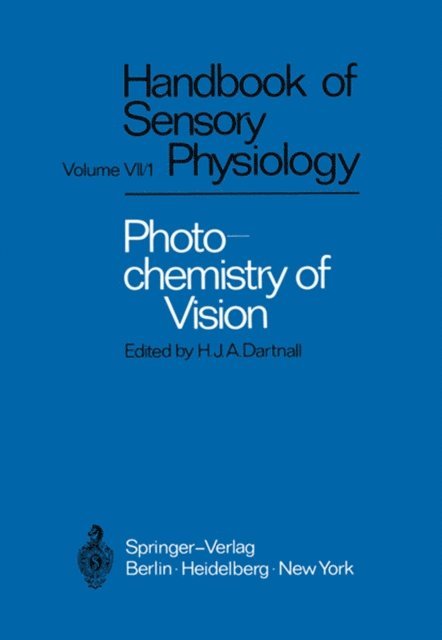
Photochemistry of Vision
1 137 kr
Beställningsvara. Skickas inom 10-15 vardagar. Fri frakt över 249 kr.
Beskrivning
Radiation can only affect matter if absorbed by it. Within the broad range of 300-1000 nm, which we call "the visible", light quanta are energetic enough to produce excited electronic states in the atoms and molecules that absorb them. In these states the molecules may have quite different properties from those in their dormant condition, and reactions that would not otherwise occur become possible. About 80 % of the radiant energy emitted by our sun lies in this fertile band, and so long as the sun's surface temperature is maintained at about 6000° C this state of affairs will continue. This and the transparency of our atmosphere and waters have allowed the generation and evolution of life. Before life began the atmosphere probably also transmitted much of the solar short-wave radiation, but with the rise of vegetation a new product - oxygen - appeared and this, by a photochemical reaction in the upper atmosphere, led to the ozone layer that now protects us from the energetic "short-wave" quanta that once, perhaps, took part in the generation of life-molecules. Light is an ideal sensory stimulus. It travels in straight lines at great speed and, consequently, can be made to form an image from which an animal can make "true", continuous and immediate assessments of present and impending events.
Produktinformation
Utforska kategorier
Innehållsförteckning
Hoppa över listan
Du kanske också är intresserad av
Auditory System
E. de Boer, W. Connor, H. Davis, J.J. Eggermont, R. Galambos, C.D. Geisler, G.M. Gerken, H.E. von Gierke, C.S. Hallpike, E.Jr. Hawkins, S.A. Hillyard, W.D. Keidel, D.E. Parker, T.W. Picton, W. Rudmose, F.B. Simmons, G. Stange, C.R. Steele, J. Tonndorf, M.E. Wigand, F. Zöllner
Häftad, 2011
1 137 kr
Development of Sensory Systems
C. M. Bate, V. McMillan Carr, P. P. C. Graziadei, H. V. B. Hirsch, A. Hughes, D. Ingle, A. G. Leventhal, G. A. Monti Graziadei, E. W. Rubel, R. Saxod, A. B. Scheibel, M. E. Scheibel, J. Silver, M. Jacobson
Häftad, 2011
1 137 kr
Comparative Physiology and Evolution of Vision in Invertebrates
H. Autrum, L.S. Goodman, J.B. Messenger, R. Wehner
Häftad, 2011
1 137 kr
Auditory System
Moshe Abeles, Göran Bredberg, Robert A. Butler, John H. Casseday, John E. Desmedt, Irving T. Diamond, Solomon D. Erulkar, E. F. Evans, Jay M. Goldberg, Moise H. Goldstein, David M. Green, Ivan M. Hunter-Duvar, Lloyd A. Jeffress, William D. Neff, William A. Yost, E. Zwicker
Häftad, 2011
1 137 kr
Auditory System
H. W. Ades, A. Axelsson, I. L. Baird, G. v. Békésy, R. L. Boord, C. B. G. Campbell, O. Densert, D. H. Eldredge, H. Engström, J. Fex, J. M. Harrison, O. W. Henson, M. E. Howe, S. Iurato, A. Michelsen, A. R. Møller, R. R. Pfeiffer, S. Rauch, I. Rauch, E. A. G. Shaw, J. Wersäll, E. G. Wever
Häftad, 2011
1 137 kr
Visual Centers in the Brain
G. Berlucchi, G. S. Brindley, B. Brooks, O. D. Creutzfeldt, E. Dodt, R. W. Doty, H.-J. Freund, C. G. Gross, D. A. Jeffreys, R. Jung, U. Kuhnt, D. M. MacKay, E. Marg, N. Negrão, G. Rizzolatti, J. M. Sprague, G. Székely, J. Szentágothai, D. Whitteridge
Häftad, 2011
1 137 kr