• Fri frakt över 249 kr
  • •
  • Snabba leveranser
  • •
  • Billiga böcker
Kundservice

Du är på sajten för privatpersoner.

Företag, bibliotek eller offentlig verksamhet?

Du handlar på classic.bokus.com, där alla dina funktioner finns intakta.
Till classic.bokus.com
Bokus logotyp. Gå till startsidan.
  • Erbjudanden
  • Nyheter
  • Student
  • Topplistor
  • Barn & ungdom
  • Bokus Play
  • E-böcker
  • Pocketböcker
  • Spel & pussel

10% rabatt på allt med kod: NYSTART10 →

Sidfot

Mina sidor

    Hjälp

    • Kundservice
    • Vanliga frågor och svar
    • Frakt och leverans
    • Retur vid ångerrätt
    • Reklamera vara
    • Betalning
    • Köpvillkor
    • Allmänna villkor
    • Information om webbplatsens tillgänglighet

    Om Bokus

    • Om oss
    • Pressrum
    • För studenter
    • För företag
    • För bibliotek och offentlig verksamhet
    • För leverantörer
    • Hållbarhet

    Populärt

    • Aktuella erbjudanden
    • Presentkort
    • Studentlitteratur
    • Nya böcker
    • Topplistor
    • Signerade böcker
    • Engelska böcker

    Inspiration

    • Boktips
    • BookTok
    • Populära bokserier
    • Barnbokskaraktärer
    • Populära författare
    Logotyp för Bokus
    Följ oss på Facebook (extern länk)Följ oss på Instagram (extern länk)Följ oss på YouTube (extern länk)Följ oss på TikTok (extern länk)
    bokus @ CookiesAnpassa cookiesIntegritetspolicyKöpvillkor
    Till Citymail hemsida (extern länk)Till Budbee hemsida (extern länk)Till Postnord hemsida (extern länk)Till Schenker hemsida (extern länk)Till Early Bird hemsida (extern länk)Till Walleys hemsida (extern länk)
    1. Naturvetenskap och teknik
    2. Matematik och naturvetenskap
    3. Kemi
    4. Analytisk kemi

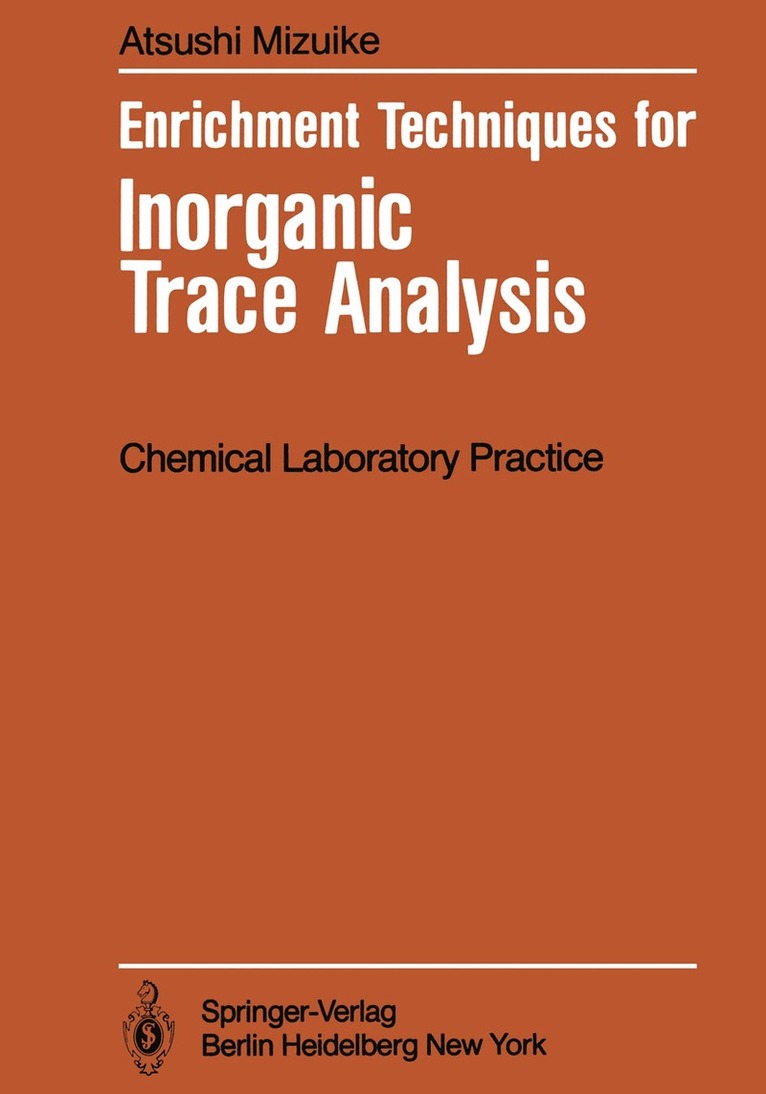
    Enrichment Techniques for Inorganic Trace Analysis

    AvAtsushi Mizuike

    Häftad, Engelska, 2011

    Del 19 i serien Anleitungen für die chemische Laboratoriumspraxis

    547 kr

    Beställningsvara. Skickas inom 10-15 vardagar. Fri frakt över 249 kr.

    Beskrivning

    6 9 The significant role of trace elements present at the Jlgfg (10- gig), ngfg (10- gig) 12 and pgfg (10- gig) levels in geological, biological, environmental and industrial materials has increasingly been recognized in science and technology. To detect and determine trace elements, we usually use modern optical, electrochemical and nuclear analytical techniques. Althouih most of them are highly sensitive and selective, preliminary enrichment techniques are required to extend the detection limits, improve precision and accuracy of analytical results, and to widen the scope of the determina­ tion techniques. About two decades ago, I wrote a chapter "Separations and Pre­ concentrations" in "Trace Analysis: Physical Methods" edited by Prof. G. H. Morrison (Wiley-Interscience, New York, 1965). Since then, the progress in this field has been remarkable. This 'monograph is intended as a laboratory book directly applicable to the practice, but is not a so-called "cookbook" which offers detailed laboratory instruc­ is useful for all analysts solving problems in inorganic trace tions. I hope this book analysis and appreciating the applicability and limitations of enrichment techniques combined with instrumental determination techniques. In three introductory chapters, general aspects and control of contamination and loss are discussed. The following eight chapters deal with enrichment techniques based on volatilization, liquid-liquid extraction, selective dissolution, precipitation, electrochemical deposition and dissolution, sorption, ion exchange, liquid chromato­ graphy, flotation, freezing and zone melting. The final two chapters are devoted to special enrichment techniques used in trace analyses of natural waters and gaseous samples.

    Produktinformation

    • Utgivningsdatum:2011-12-10
    • Mått:170 x 244 x 9 mm
    • Vikt:282 g
    • Format:Häftad
    • Språk:Engelska
    • Serie:Anleitungen für die chemische Laboratoriumspraxis
    • Antal sidor:144
    • Förlag:Springer-Verlag Berlin and Heidelberg GmbH & Co. KG
    • ISBN:9783642688560

    Utforska kategorier

    • Analytisk kemi inom Naturvetenskap och teknik

    Innehållsförteckning

    • 1 Introduction.- 1.1 Inorganic Trace Analysis in Science and Technology.- 1.2 The Role of Enrichment Techniques in Inorganic Trace Analysis.- 2 General Aspects of Enrichment Techniques.- 2.1 Trace Recovery.- 2.2 Enrichment Factor.- 2.3 Contamination.- 2.4 Simplicity and Rapidity.- 2.5 Sample Size.- 3 Control of Contamination and Loss.- 3.1 Airborne Contamination.- 3.2 Contamination and Loss Due to Apparatus.- 3.3 Contamination Due to Reagents.- 3.4 Other Sources of Contamination and Loss.- 4 Volatilization.- 4.1 Volatilization from Solutions.- 4.2 Volatilization from Solid and Molten States.- 5 Liquid-Liquid Extraction.- 5.1 General Procedures.- 5.2 Extraction of Metal Chelates.- 5.3 Extraction of Ion Pairs.- 5.4 Special Extractions.- 6 Selective Dissolution.- 6.1 Selective Dissolution of the Matrix.- 6.2 Selective Dissolution of Trace Elements.- 7 Precipitation.- 7.1 Precipitation of Matrix Elements.- 7.2 Precipitation of Trace Elements.- 8 Electrochemical Deposition and Dissolution.- 8.1 Electrodeposition on Solid Electrodes.- 8.2 Electrodeposition on Mercury Cathodes.- 8.3 Spontaneous Electrochemical Deposition.- 8.4 Anodic Dissolution.- 9 Sorption, Ion Exchange and Liquid Chromatography.- 9.1 General Procedures.- 9.2 Separation with Ion Exchange Resins.- 9.3 Separation with Cellulosic Exchangers.- 9.4 Separation with Polyurethane Foams.- 9.5 Separation with Miscellaneous Organic Sorbents.- 9.6 Separation with Activated Carbon.- 9.7 Inorganic Ion Exchangers.- 10 Flotation.- 10.1 General Procedures.- 10.2 Carrier Precipitation Followed by Flotation.- 10.3 Ion Flotation.- 11 Freezing and Zone Melting.- 11.1 Freeze Concentration of Dilute Aqueous Solutions.- 11.2 Enrichment of Impurities in Solids by Zone Melting.- 12 Enrichment Techniques in Water Analysis.- 12.1 Separation Based on the Particle Size and Density.- 12.2 Separation Based on Chemical Reactivity.- 13 Enrichment Techniques in Gas Analysis.- 13.1 Separation of Particles.- 13.2 Separation of Gaseous Trace Constituents.- Literature.- A.1 Solvents.- A.2 Masking Agents.- A.3 Ion Exchange Data.- Index of Abbreviations and Symbols.