• Fri frakt över 249 kr
  • •
  • Snabba leveranser
  • •
  • Billiga böcker
Kundservice

Du är på sajten för privatpersoner.

Företag, bibliotek eller offentlig verksamhet?

Du handlar på classic.bokus.com, där alla dina funktioner finns intakta.
Till classic.bokus.com
Bokus logotyp. Gå till startsidan.
  • Erbjudanden
  • Nyheter
  • Student
  • Topplistor
  • Barn & ungdom
  • Bokus Play
  • E-böcker
  • Pocketböcker
  • Spel & pussel

10% rabatt på allt med kod NYSTART10 →

Sidfot

Mina sidor

    Hjälp

    • Kundservice
    • Vanliga frågor och svar
    • Frakt och leverans
    • Retur vid ångerrätt
    • Reklamera vara
    • Betalning
    • Köpvillkor
    • Allmänna villkor
    • Information om webbplatsens tillgänglighet

    Om Bokus

    • Om oss
    • Pressrum
    • För studenter
    • För företag
    • För bibliotek och offentlig verksamhet
    • För leverantörer
    • Hållbarhet

    Populärt

    • Aktuella erbjudanden
    • Presentkort
    • Studentlitteratur
    • Nya böcker
    • Topplistor
    • Signerade böcker
    • Engelska böcker

    Inspiration

    • Boktips
    • BookTok
    • Populära bokserier
    • Barnbokskaraktärer
    • Populära författare
    Logotyp för Bokus
    Följ oss på Facebook (extern länk)Följ oss på Instagram (extern länk)Följ oss på YouTube (extern länk)Följ oss på TikTok (extern länk)
    bokus @ CookiesAnpassa cookiesIntegritetspolicyKöpvillkor
    Till Citymail hemsida (extern länk)Till Budbee hemsida (extern länk)Till Postnord hemsida (extern länk)Till Schenker hemsida (extern länk)Till Early Bird hemsida (extern länk)Till Walleys hemsida (extern länk)
    1. Juridik
    2. Särskilda rättsområden
    3. Straffrätt: process och brott

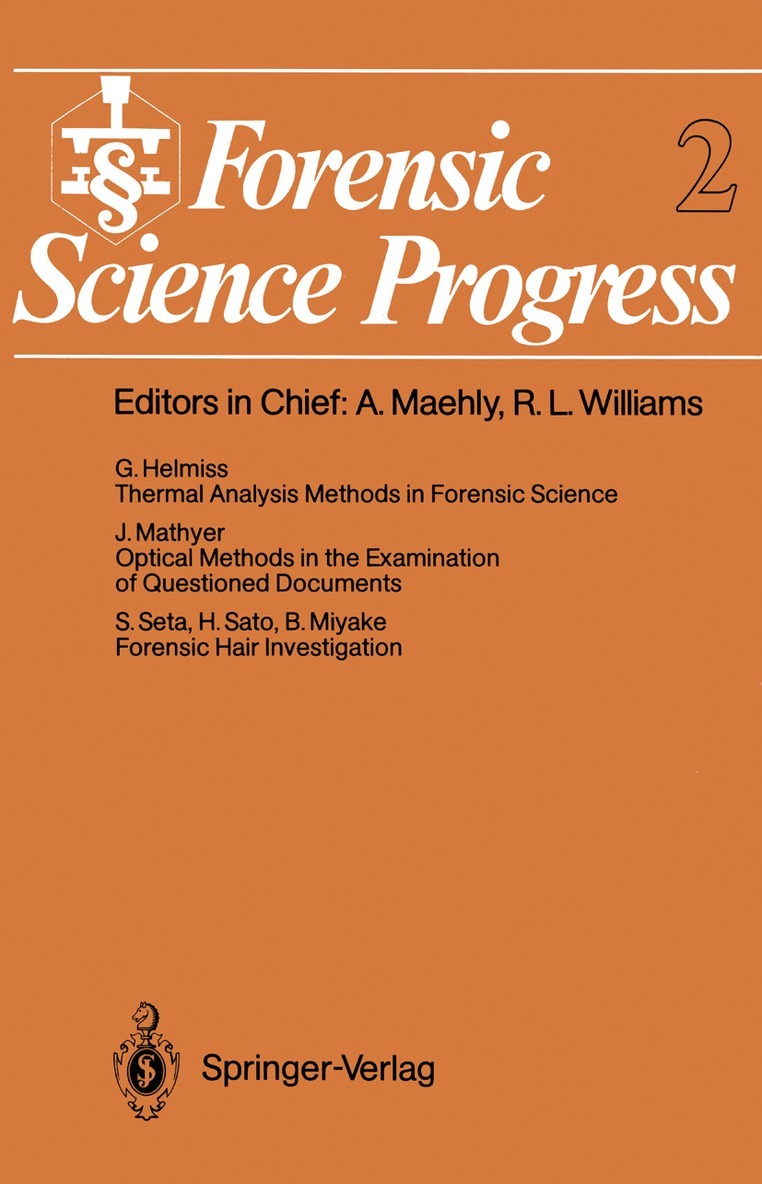
    Forensic Science Progress

    Häftad, Engelska, 2011

    Del i serien Forensic Science Progress

    998 kr

    Beställningsvara. Skickas inom 10-15 vardagar. Fri frakt över 249 kr.

    Beskrivning

    Thermal analysis methods have been introduced into forensic sciences only in recent times. Though thermoanalytical instruments have been available commercially for some decades it was not until the beginning of the seventies that forensic scientists became interested in them. At that time some state forensic science laboratories in the Federal Republic of Germany made use of differential thermal analysis for forensic soil investigations. The forensic science section of the city police of ZUrich, Switzerland, applied an instrument (differential thermal analysis and thermogravimetry) for various purposes. Investigations of fibers by means of differential scanning calorimetry were reported by the Centre of Forensic Sciences at Toronto, Canada, and on the characterization of candle-waxes by differential thermal analysis by the Metropolitan Police Forensic Science Laboratory, London, England. Later on some other insti­ tutions like the Bundeskriminalamt at Wiesbaden, Germany, or the Home Office Central Research Establishment at Aldermaston, England, purchased instruments for one or more of the following thermal analysis methods: differential thermal analysis or differential scanning calorimetry, thermogravimetry, and thermomechanical analysis. . But even now thermoanalytical instruments are not widespread in forensic science institutes and knowledge of their forensic potential seems to be limited. In the following chapters we will give a survey of the most important thermal analysis methods mentioned above, and on current forensic applications and/or fields of actual research efforts.

    Produktinformation

    • Utgivningsdatum:2011-11-19
    • Mått:170 x 244 x 11 mm
    • Vikt:335 g
    • Format:Häftad
    • Språk:Engelska
    • Serie:Forensic Science Progress
    • Antal sidor:173
    • Förlag:Springer-Verlag Berlin and Heidelberg GmbH & Co. KG
    • ISBN:9783642694059

    Utforska kategorier

    • Straffrätt: process och brott inom Juridik
    • Analytisk kemi inom Naturvetenskap och teknik

    Innehållsförteckning

    • Contents/Information: 'Thermal Analysis Methods in Forensic Science' by G. Hellmiss: This contribution first explains the basics of the measuring process and the type of information obtained by the major TA methods, i.e. differential thermal analysis (DTA)/differential scanning calorimetry (DSC), thermogravimetry (TG), thermomechanical analysis (TMA). The next subject covers forensic science applications of TA. 'Optical Methods in the Examination of Questioned Documents' by J. Mathyer: Optical methods of examination include observations made by the naked eye, and microscopic examination with illumination in the visible or invisible range of the spectrum. 'Forensic Hair Investigation' by S. Seta, H. Sato and B. Miyake: The ultimate purpose of forensic hair comparison is to state whether a crime scene hair is of victim origin or of suspect origin. A combination of morphological and analytical data of hair samples, including hair protein and hair root and isoenzyme analysis leads to the enhancement of identification probability.