• Fri frakt över 249 kr
  • •
  • Snabba leveranser
  • •
  • Billiga böcker
Kundservice

Du är på sajten för privatpersoner.

Företag, bibliotek eller offentlig verksamhet?

Du handlar på classic.bokus.com, där alla dina funktioner finns intakta.
Till classic.bokus.com
Bokus logotyp. Gå till startsidan.
  • Erbjudanden
  • Nyheter
  • Student
  • Topplistor
  • Barn & ungdom
  • Bokus Play
  • E-böcker
  • Pocketböcker
  • Spel & pussel

10% studentrabatt med kod TERM26

Sidfot

Mina sidor

    Hjälp

    • Kundservice
    • Vanliga frågor och svar
    • Frakt och leverans
    • Retur vid ångerrätt
    • Reklamera vara
    • Betalning
    • Köpvillkor
    • Allmänna villkor
    • Information om webbplatsens tillgänglighet

    Om Bokus

    • Om oss
    • Pressrum
    • För studenter
    • För företag
    • För bibliotek och offentlig verksamhet
    • För leverantörer
    • Hållbarhet

    Populärt

    • Aktuella erbjudanden
    • Presentkort
    • Studentlitteratur
    • Nya böcker
    • Topplistor
    • Signerade böcker
    • Engelska böcker

    Inspiration

    • Boktips
    • BookTok
    • Populära bokserier
    • Barnbokskaraktärer
    • Populära författare
    Logotyp för Bokus
    Följ oss på Facebook (extern länk)Följ oss på Instagram (extern länk)Följ oss på YouTube (extern länk)Följ oss på TikTok (extern länk)
    bokus @ CookiesAnpassa cookiesIntegritetspolicyKöpvillkor
    Till Citymail hemsida (extern länk)Till Budbee hemsida (extern länk)Till Postnord hemsida (extern länk)Till Schenker hemsida (extern länk)Till Early Bird hemsida (extern länk)Till Walleys hemsida (extern länk)
    1. Medicin
    2. Medicin: icke kliniska discipliner
    3. Fysiologi

    Progress in Sensory Physiology 9

    Häftad, Engelska, 2011

    Del i serien Progress in Sensory Physiology

    1 124 kr

    Beställningsvara. Skickas inom 10-15 vardagar. Fri frakt över 249 kr.

    Beskrivning

    Sympathetic afferent fibers originate from a visceral organ, course in the thoracolumbar rami communicantes, have cell bodies located in dorsal root ganglia, and terminate in the gray matter of the spinal cord. Sympathetic afferent fibers from the heart transmit information about noxious stimuli associated with myocardial ischemia, i. e. angina pectoris. Previous reviews have described the characteristics of cardiovascular sympathetic afferent fibers (Bishop et al. 1983; Malliani 1982). This review summarizes that work and focuses on the neural mechanisms underlying the complexities of angina pectoris. In order to understand anginal pain, cells forming the classical pain pathway, the spinothalamic tract (STn, were chosen for study. These cells were chosen to address questions about anginal pain because they transmit nociceptive informa­ of pain. Antidromic tion to brain regions that are involved in the perception activation of STT cells provided a means of identifying cells involved with trans­ mission of nociceptive information in anesthetized animals. Other ascending pathways may also transmit nociceptive information, but many studies show that the STT plays an important role. Visceral pain is commonly referred to overlying somatic structures. The pain of angina pectoris can be sensed over a wide area of the thorax: in the retrosternal, precordial anterior thoracic, and anterior cervical regions of the chest; in the left or sometimes even the right shoulder, arm, wrist, or hand; or in the jaw and teeth (Harrison and Reeves 1968).

    Produktinformation

    • Utgivningsdatum:2011-12-16
    • Mått:170 x 244 x 13 mm
    • Vikt:415 g
    • Format:Häftad
    • Språk:Engelska
    • Serie:Progress in Sensory Physiology
    • Antal sidor:227
    • Förlag:Springer-Verlag Berlin and Heidelberg GmbH & Co. KG
    • ISBN:9783642740602

    Utforska kategorier

    • Fysiologi inom Medicin
    • Biovetenskap inom Naturvetenskap och teknik
    • Zoologi inom Naturvetenskap och teknik

    Innehållsförteckning

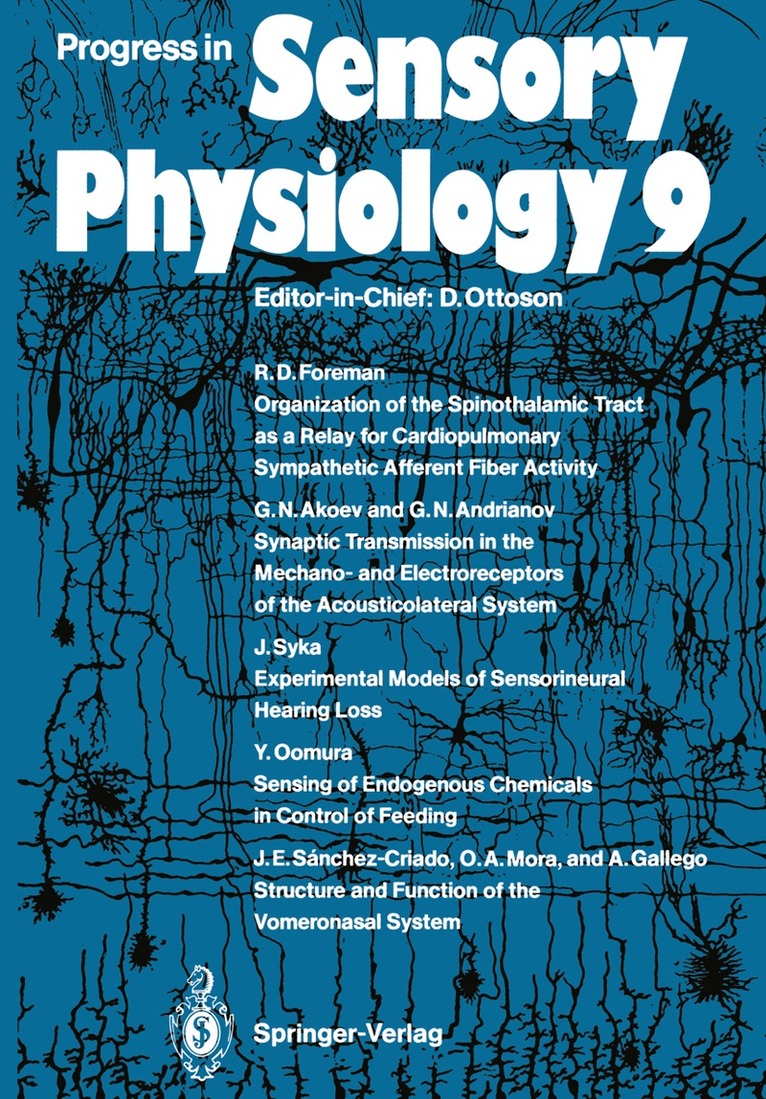
    • Organization of the Spinothalamic Tract as a Relay for Cardiopulmonary Sympathetic Afferent Fiber Activity.- Synaptic Transmission in the Mechano- and Electroreceptors of the Acousticolateral System.- Experimental Models of Sensorineural Hearing Loss — Effects of Noise and Ototoxic Drugs on Hearing.- Sensing of Endogenous Chemicals in Control of Feeding.- Structure and Function of the Vomeronasal System — The Vomeronasal Organ as a Priming Pheromone Receptor in Mammals.