• Fri frakt över 249 kr
  • •
  • Snabba leveranser
  • •
  • Billiga böcker
Kundservice

Du är på sajten för privatpersoner.

Företag, bibliotek eller offentlig verksamhet?

Du handlar på classic.bokus.com, där alla dina funktioner finns intakta.
Till classic.bokus.com
Bokus logotyp. Gå till startsidan.
  • Erbjudanden
  • Nyheter
  • Student
  • Topplistor
  • Barn & ungdom
  • Bokus Play
  • E-böcker
  • Pocketböcker
  • Spel & pussel

10% rabatt på allt med kod: NYSTART10 →

Sidfot

Mina sidor

    Hjälp

    • Kundservice
    • Vanliga frågor och svar
    • Frakt och leverans
    • Retur vid ångerrätt
    • Reklamera vara
    • Betalning
    • Köpvillkor
    • Allmänna villkor
    • Information om webbplatsens tillgänglighet

    Om Bokus

    • Om oss
    • Pressrum
    • För studenter
    • För företag
    • För bibliotek och offentlig verksamhet
    • För leverantörer
    • Hållbarhet

    Populärt

    • Aktuella erbjudanden
    • Presentkort
    • Studentlitteratur
    • Nya böcker
    • Topplistor
    • Signerade böcker
    • Engelska böcker

    Inspiration

    • Boktips
    • BookTok
    • Populära bokserier
    • Barnbokskaraktärer
    • Populära författare
    Logotyp för Bokus
    Följ oss på Facebook (extern länk)Följ oss på Instagram (extern länk)Följ oss på YouTube (extern länk)Följ oss på TikTok (extern länk)
    bokus @ CookiesAnpassa cookiesIntegritetspolicyKöpvillkor
    Till Citymail hemsida (extern länk)Till Budbee hemsida (extern länk)Till Postnord hemsida (extern länk)Till Schenker hemsida (extern länk)Till Early Bird hemsida (extern länk)Till Walleys hemsida (extern länk)
    1. Ekonomi och Ledarskap
    2. Nationalekonomi

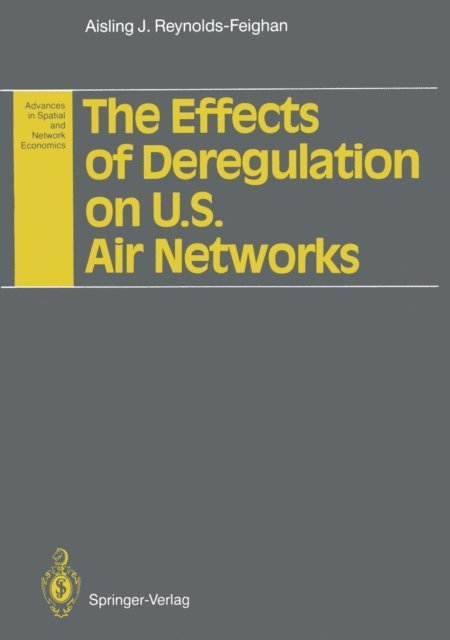
    Effects of Deregulation on U.S. Air Networks

    AvAisling J. Reynolds-Feighan

    Häftad, Engelska, 2011

    Del i serien Advances in Spatial and Network Economics

    547 kr

    Beställningsvara. Skickas inom 10-15 vardagar. Fri frakt över 249 kr.

    Fler format och utgåvor

    E-bok

    734 kr

    Beskrivning

    1. 1 A Brief History of U. S. Commercial Aviation Regulation and Deregulation The U. S. commercial aviation industry was regulated by the government for a period of 40 years, beginning in 1938 with. the passing of the Federal Aviation Act, and ending in October 1978 when President Carter signed into law the Airline Deregulation Act (ADA). There were 16 airlines in existence when the Federal Aviation Act was passed in 1938 (the so-called 'trunk lines'). The Act established the Civil Aeronautics Authority (CAA) as the industry's regulatory body. The Act was passed principally because it was felt that the free market, if allowed to continue unregulated for much longer, would put many of these firms into bankruptcy. It is possible therefore to view the CAA of 1938 (re-organized into the Civil Aeronautics Board (CAB) in 1940) as a response to a potential market failure at the time. In the 1930s, few air traffic markets could have efficiently"supported more than one airline operating in the market [Panzar (1980)]. Competition among the carriers was cut-throat, and it was felt that the near bankruptcy of the airlines in the period was caused principally by the competitive bidding system used by the Post Office in allotting airmail subsidies [Keeler (1972), Caves (1962)].

    Produktinformation

    • Utgivningsdatum:2011-12-06
    • Mått:170 x 242 x 9 mm
    • Vikt:267 g
    • Format:Häftad
    • Språk:Engelska
    • Serie:Advances in Spatial and Network Economics
    • Antal sidor:131
    • Förlag:Springer-Verlag Berlin and Heidelberg GmbH & Co. KG
    • ISBN:9783642770630

    Utforska kategorier

    • Nationalekonomi inom Ekonomi och Ledarskap
    • Referensverk och tvärvetenskap inom Samhälle och politik
    • Matematisk statistik inom Naturvetenskap och teknik

    Innehållsförteckning

    • 1: Introduction.- 1.1. A Brief History of U.S. Commercial Aviation Regulation and Deregulation.- 1.2. Critique of Other Studies.- 1.3. A Production Model of the Airline Firm.- 1.4. Measuring Technical Efficiency in an Airline Network.- 2: Previous Studies on U.S. Airline Deregulation.- 2.1. Economic Research on U.S. Airline Deregulation.- 2.2. Operations Researchers’ and Transport Planners’ View of Airline Operations.- 2.3. Geographical Aspects to U.S. Air Traffic Distribution.- 3: The Setting: Trends in U.S. Commercial Aviation.- 3.1. The National Airways System.- 3.2. Patterns in U.S. Commercial Aviation 1969–88.- 3.3. Measures for Summarizing Airline and Airport Traffic Distributions.- 3.4. U.S. Air Carriers 1969–1988.- 3.5. Continental and American Airlines’ Traffic Patterns, 1969–88.- 4: Development of a Production Model of the Airline Firm.- 4.1. The Airline Network-Defining a Network Variable.- 4.2. The Airline’s Production Function.- 4.3. An Alternative View of the Airline’s Production Process.- 4.4. Functional Form of the Airline Production Function.- 4.5. Frontier Production Functions and the Measurement of Technical Inefficiency.- 5: Data Description and Computation of the Production Variables.- 5.1. Data Provided by Continental Airlines.- 5.2. Computed Input and Output Variables.- 5.3. Principal Components Estimates of the ‘EQUIP’ Variable.- 5.4. Gravity Model Estimates and the Route Attraction Variable.- 6: Production Function Analysis of Continental Airlines.- 6.1. Cobb-Douglas Production Function Estimates for Continental Airlines in 1987/88.- 6.2. Measuring the Efficiency of Continental’s Route System and Exploring the Characteristics of Inefficient Routes.- 7: Conclusions and Recommendations.- 7.1. Network Changes and the Role ofNetwork Organization.- 7.2. Airline Level Analysis and Route Efficiency.- References.- Author Index.