• Fri frakt över 249 kr
  • •
  • Snabba leveranser
  • •
  • Billiga böcker
Kundservice

Du är på sajten för privatpersoner.

Företag, bibliotek eller offentlig verksamhet?

Du handlar på classic.bokus.com, där alla dina funktioner finns intakta.
Till classic.bokus.com
Bokus logotyp. Gå till startsidan.
  • Erbjudanden
  • Nyheter
  • Student
  • Topplistor
  • Barn & ungdom
  • Bokus Play
  • E-böcker
  • Pocketböcker
  • Spel & pussel

10% rabatt på allt med kod NYSTART10 →

Sidfot

Mina sidor

    Hjälp

    • Kundservice
    • Vanliga frågor och svar
    • Frakt och leverans
    • Retur vid ångerrätt
    • Reklamera vara
    • Betalning
    • Köpvillkor
    • Allmänna villkor
    • Information om webbplatsens tillgänglighet

    Om Bokus

    • Om oss
    • Pressrum
    • För studenter
    • För företag
    • För bibliotek och offentlig verksamhet
    • För leverantörer
    • Hållbarhet

    Populärt

    • Aktuella erbjudanden
    • Presentkort
    • Studentlitteratur
    • Nya böcker
    • Topplistor
    • Signerade böcker
    • Engelska böcker

    Inspiration

    • Boktips
    • BookTok
    • Populära bokserier
    • Barnbokskaraktärer
    • Populära författare
    Logotyp för Bokus
    Följ oss på Facebook (extern länk)Följ oss på Instagram (extern länk)Följ oss på YouTube (extern länk)Följ oss på TikTok (extern länk)
    bokus @ CookiesAnpassa cookiesIntegritetspolicyKöpvillkor
    Till Citymail hemsida (extern länk)Till Budbee hemsida (extern länk)Till Postnord hemsida (extern länk)Till Schenker hemsida (extern länk)Till Early Bird hemsida (extern länk)Till Walleys hemsida (extern länk)
    1. Naturvetenskap och teknik
    2. Matematik och naturvetenskap
    3. Kemi
    4. Analytisk kemi

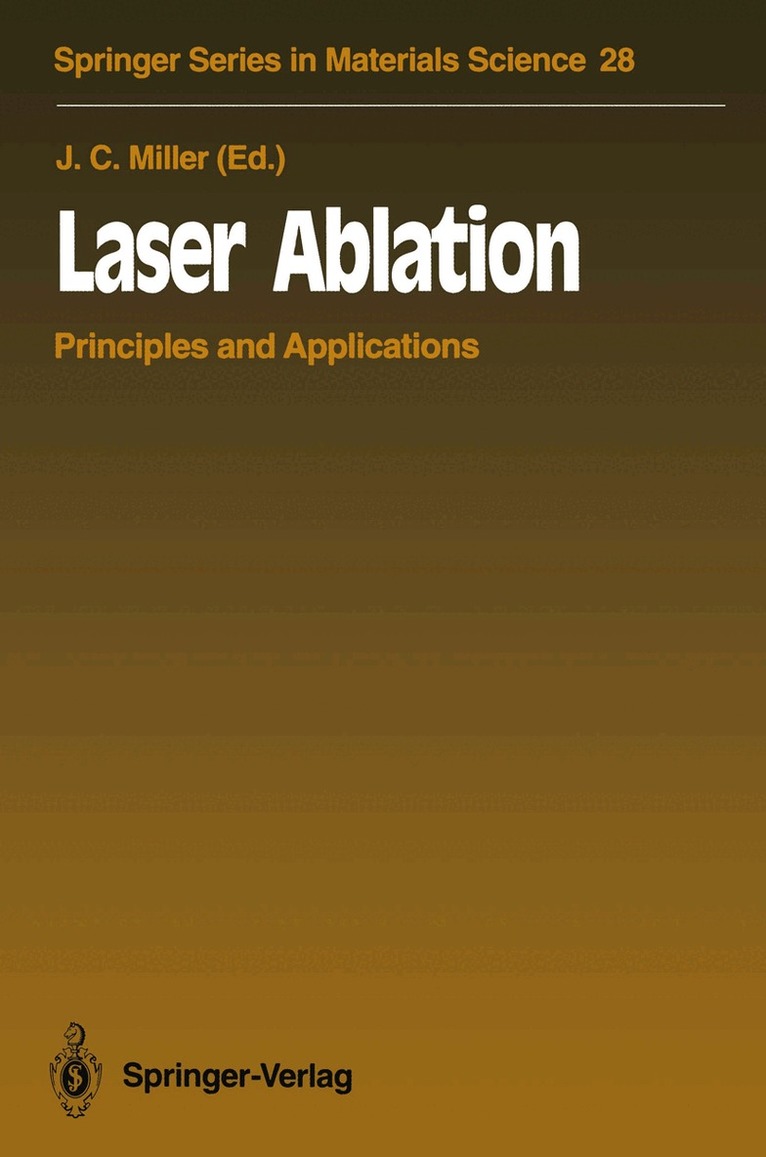
    Laser Ablation

    Principles and Applications

    AvJohn C. Miller

    Häftad, Engelska, 2011

    Del 28 i serien Springer Series in Materials Science

    1 085 kr

    Beställningsvara. Skickas inom 10-15 vardagar. Fri frakt över 249 kr.

    Beskrivning

    Laser Ablation provides a broad picture of the current understanding of laser ablation and its many applications, from the views of key contributors to the field. Discussed are in detail the electronic processes in laser ablation of semiconductors and insulators, the post-ionization of laser-desorbed biomolecules, Fourier-transform mass spectroscopy, the interaction of laser radiation with organic polymers, laser ablation and optical surface damage, laser desorption/ablation with laser detection, and laser ablation of superconducting thin films.

    Produktinformation

    • Utgivningsdatum:2011-12-08
    • Mått:155 x 235 x 12 mm
    • Vikt:318 g
    • Format:Häftad
    • Språk:Engelska
    • Serie:Springer Series in Materials Science
    • Antal sidor:187
    • Förlag:Springer-Verlag Berlin and Heidelberg GmbH & Co. KG
    • ISBN:9783642787225

    Utforska kategorier

    • Analytisk kemi inom Naturvetenskap och teknik
    • Materietillstånd inom Naturvetenskap och teknik
    • Fysik inom Naturvetenskap och teknik

    Innehållsförteckning

    • 1. History, Scope, and the Future of Laser Ablation.- 1.1 Introduction.- 1.2 History of Laser Ablation Studies and Applications.- References.- 2. Electronic Processes in Laser Ablation of Semiconductors and Insulators.- 2.1 Electronic Mechanisms in Desorption and Ablation.- 2.2 Interaction of Photons with Solids.- 2.3 Electron-Lattice Interactions and the Localized Excited State.- 2.4 Creation and De-Excitation of the Localized Excited State.- 2.5 Survey of Experimental Results.- 2.6 Models of Laser-Induced Desorption.- 2.7 Simulation of Laser Ablation.- 2.8 Summary and Conclusions.- References.- 3. Laser Ablation and Optical Surface Damage.- 3.1 Introductory Remarks.- 3.2 Characteristics of Optical Surface Damage.- 3.3 Possible Causes of Optical Damage.- 3.4 Investigation of Optical Surface Damage Mechanisms.- 3.5 Concluding Remarks.- References.- 4. Pulsed-Laser Deposition of High-Temperature Superconducting Thin Films.- 4.1 Advantages of Pulsed-Laser Deposition.- 4.2 Materials Base.- 4.3 Laser-Beam-Target Interaction.- 4.4 Dynamics of the Laser-Produced Plume.- 4.5 Evaporant-Substrate Interaction.- 4.6 Frontiers of High-Temperature Superconducting Thin-Film Research.- 4.7 Scaling-up to Larger Areas.- 4.8 Future Directions.- 4.9 Summary.- References.- 5. Interaction of Laser Radiation with Organic Polymers.- 5.1 History.- 5.2 Characteristics of UV-Laser Ablation.- 5.3 Chemical Physics of the Ablation Process.- 5.4 Theories of Ultraviolet-Laser Ablation.- 5.5 Contemporary Trends in UV-Laser Ablation.- References.- 6. Laser Ablation and Laser Desorption Techniques with Fourier-Transform Mass Spectrometry (FTMS).- 6.1 Principles of FTMS Operation.- 6.2 Laser-Ablation FTMS for Clusters.- 6.3 Laser-Desorption FTMS for Biomolecules.- 6.4 Future Directions.- 6.5 Conclusions.- References.- 7. Diagnostic Studies of Laser Ablation for Chemical Analysis.- 7.1 Laser Ablation in Vacuum.- 7.2 Laser Ablation in an Atmosphere.- References.