• Fri frakt över 249 kr
  • •
  • Snabba leveranser
  • •
  • Billiga böcker
Kundservice

Du är på sajten för privatpersoner.

Företag, bibliotek eller offentlig verksamhet?

Du handlar på classic.bokus.com, där alla dina funktioner finns intakta.
Till classic.bokus.com
Bokus logotyp. Gå till startsidan.
  • Erbjudanden
  • Nyheter
  • Student
  • Topplistor
  • Barn & ungdom
  • Bokus Play
  • E-böcker
  • Pocketböcker
  • Spel & pussel

10% rabatt på allt med kod NYSTART10 →

Sidfot

Mina sidor

    Hjälp

    • Kundservice
    • Vanliga frågor och svar
    • Frakt och leverans
    • Retur vid ångerrätt
    • Reklamera vara
    • Betalning
    • Köpvillkor
    • Allmänna villkor
    • Information om webbplatsens tillgänglighet

    Om Bokus

    • Om oss
    • Pressrum
    • För studenter
    • För företag
    • För bibliotek och offentlig verksamhet
    • För leverantörer
    • Hållbarhet

    Populärt

    • Aktuella erbjudanden
    • Presentkort
    • Studentlitteratur
    • Nya böcker
    • Topplistor
    • Signerade böcker
    • Engelska böcker

    Inspiration

    • Boktips
    • BookTok
    • Populära bokserier
    • Barnbokskaraktärer
    • Populära författare
    Logotyp för Bokus
    Följ oss på Facebook (extern länk)Följ oss på Instagram (extern länk)Följ oss på YouTube (extern länk)Följ oss på TikTok (extern länk)
    bokus @ CookiesAnpassa cookiesIntegritetspolicyKöpvillkor
    Till Citymail hemsida (extern länk)Till Budbee hemsida (extern länk)Till Postnord hemsida (extern länk)Till Schenker hemsida (extern länk)Till Early Bird hemsida (extern länk)Till Walleys hemsida (extern länk)
    1. Djur och Natur
    2. Naturböcker
    3. Växtböcker

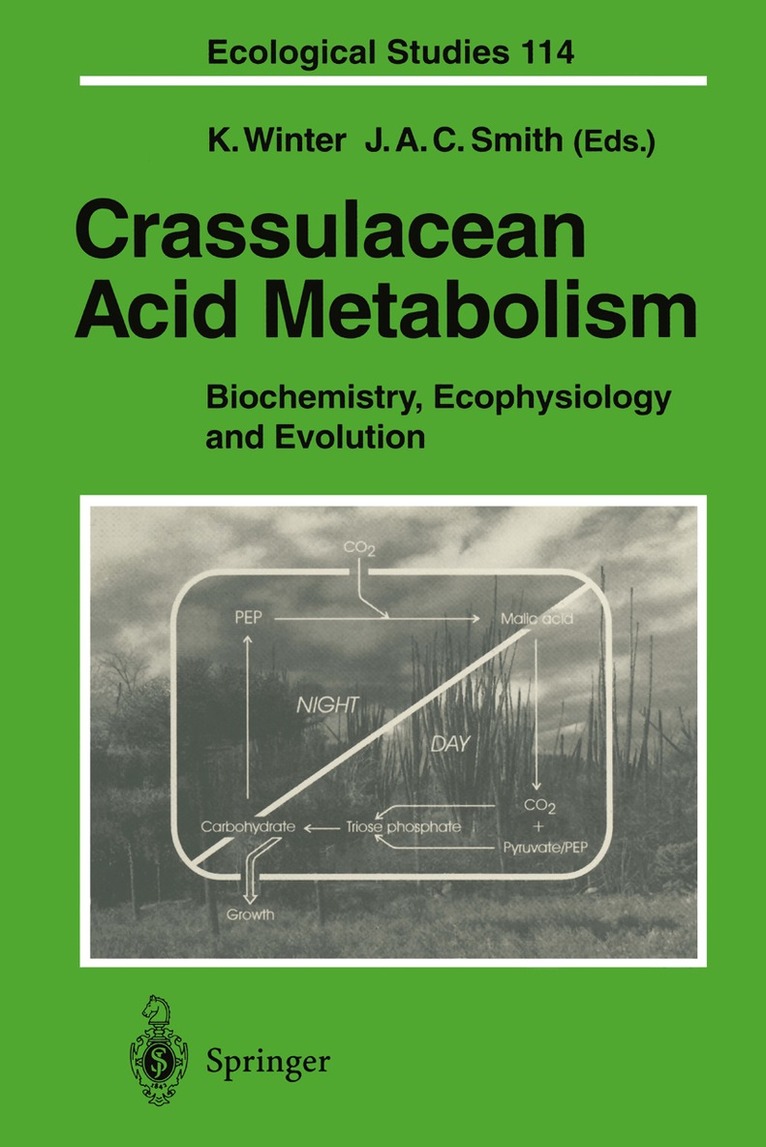
    Crassulacean Acid Metabolism

    Biochemistry, Ecophysiology and Evolution

    AvKlaus Winter,J.Andrew C. Smith

    Häftad, Engelska, 2011

    Del i serien Ecological Studies

    1 086 kr

    Beställningsvara. Skickas inom 10-15 vardagar. Fri frakt över 249 kr.

    Beskrivning

    Crassulacean acid metabolism (CAM) represents one of the best-studied metabolic examples of an ecological adaptation to environmental stress. Well over 5 % of all vascular plant species engage in this water-conserving photosynthetic pathway. Intensified research activities over the last 10 years have led to major advances in understanding the biology of CAM plants. New areas of research reviewed in detail in this book include regulation of gene expression and the molecular basis of CAM, the ecophysiology of CAM plants from tropical environments, the productivity of agronomically important cacti and agaves, the ecophysiology of CAM in submerged aquatic plants, and the taxonomic diversity and evolutionary origins of CAM.

    Produktinformation

    • Utgivningsdatum:2011-12-13
    • Mått:155 x 235 x 27 mm
    • Vikt:733 g
    • Format:Häftad
    • Språk:Engelska
    • Serie:Ecological Studies
    • Antal sidor:449
    • Förlag:Springer-Verlag Berlin and Heidelberg GmbH & Co. KG
    • ISBN:9783642790621

    Utforska kategorier

    • Växtböcker inom Djur och Natur
    • Geovetenskap inom Naturvetenskap och teknik
    • Botanik inom Naturvetenskap och teknik

    Recensioner i media

    "The book presents an exciting case study in physiological ecology, which should be read by anybody attempting to understand the full range of possibilities for carbon assimilation in nature" - trends in plant sciences

    Innehållsförteckning

    • An Introduction to Crassulacean Acid Metabolism. Biochemical Principles and Ecological Diversity.- Discovery of Dark CO2 Fixation.- Biochemistry.- Phenotypic Plasticity.- Ecophysiology and Species Diversity.- Conclusions.- References.- A: Biochemistry of Carbon Flow During Crassulacean Acid Metabolism: Preface.- 1 Stoichiometric Nightmares: Studies of Photosynthetic O2 and CO2 Exchanges in CAM Plants.- 2 Alternative Carbohydrate Reserves Usedin the Daily Cycle of Crassulacean Acid Metabolism.- 3 Roles of Circadian Rhythms, Light and Temperature in the Regulation of Phosphoenolpyruvate Carboxylase in Crassulacean Acid Metabolism.- 4 Transport Across the Vacuolar Membrane in CAM Plants.- 5 The Tonoplast as a Target of Temperature Effects in Crassulacean Acid Metabolism.- 6 Regulation of Crassulacean Acid Metabolism in Kalanchoe pinnata as Studied by Gas Exchange and Measurements of Chlorophyll Fluorescence.- 7 Energy Dissipation and the Xanthophyll Cycle in CAM Plants.- B: Environmental and Developmental Control of Crassulacean Acid Metabolism: Preface.- 8 Factors Affecting the Induction of Crassulacean Acid Metabolism in Mesembryanthemum crystallinum.- 9 Transcriptional Activation of CAM Genes During Development and Environmental Stress.- 10 Environmental Control of CAM Induction in Mesembryanthemum crystallinum - a Role for Cytokinin, Abscisic Acid and Jasmonate?.- 11 Regulation of Crassulacean Acid Metabolism by Water Status in the C3/CAM Intermediate Sedum telephium.- 12 Putative Causes and Consequences of Recycling CO2 via Crassulacean Acid Metabolism.- 13 Ontogenetic Development of Crassulacean Acid Metabolism as Modified by Water Stress in Peperomia.- 14 Crassulacean Acid Metabolism in Leaves and Stems of Cissus quadrangularis.- 15 Variations in the Phases of Crassulacean Acid Metabolism and Regulation of Carboxylation Patterns Determined by Carbon-Isotope-Discrimination Techniques.- C: Ecophysiology and Evolution of Crassulacean Acid Metabolism: Preface.- 16 High Productivity of Certain Agronomic CAM Species.- 17 Features of Roots of CAM Plants.- 18 Aquatic CAM Photosynthesis.- 19 Clusia: Plasticity and Diversity in a Genus of C3/CAM Intermediate Tropical Trees.- 20 Seasonal Changes in Daytime Versus Nighttime CO2 Fixation of Clusia uvitana In Situ.- 21 Crassulacean Acid Metabolism in the Genus Kalanchoe: Ecological, Physiological and Biochemical Aspects.- 22 Carbon-and Hydrogen-Isotope Discrimination in Crassulacean Acid Metabolism.- 23 Evolutionary Aspects of Crassulacean Acid Metabolism in the Crassulaceae.- 24 The Evolution of Crassulacean Acid Metabolism.- D.- 25 Crassulacean Acid Metabolism: Current Status and Perspectives.- 26 Taxonomic Distribution of Crassulacean Acid Metabolism.