• Fri frakt över 249 kr
  • •
  • Snabba leveranser
  • •
  • Billiga böcker
Kundservice

Du är på sajten för privatpersoner.

Företag, bibliotek eller offentlig verksamhet?

Du handlar på classic.bokus.com, där alla dina funktioner finns intakta.
Till classic.bokus.com
Bokus logotyp. Gå till startsidan.
  • Erbjudanden
  • Nyheter
  • Student
  • Topplistor
  • Barn & ungdom
  • Bokus Play
  • E-böcker
  • Pocketböcker
  • Spel & pussel

10% rabatt på allt med kod: NYSTART10 →

Sidfot

Mina sidor

    Hjälp

    • Kundservice
    • Vanliga frågor och svar
    • Frakt och leverans
    • Retur vid ångerrätt
    • Reklamera vara
    • Betalning
    • Köpvillkor
    • Allmänna villkor
    • Information om webbplatsens tillgänglighet

    Om Bokus

    • Om oss
    • Pressrum
    • För studenter
    • För företag
    • För bibliotek och offentlig verksamhet
    • För leverantörer
    • Hållbarhet

    Populärt

    • Aktuella erbjudanden
    • Presentkort
    • Studentlitteratur
    • Nya böcker
    • Topplistor
    • Signerade böcker
    • Engelska böcker

    Inspiration

    • Boktips
    • BookTok
    • Populära bokserier
    • Barnbokskaraktärer
    • Populära författare
    Logotyp för Bokus
    Följ oss på Facebook (extern länk)Följ oss på Instagram (extern länk)Följ oss på YouTube (extern länk)Följ oss på TikTok (extern länk)
    bokus @ CookiesAnpassa cookiesIntegritetspolicyKöpvillkor
    Till Citymail hemsida (extern länk)Till Budbee hemsida (extern länk)Till Postnord hemsida (extern länk)Till Schenker hemsida (extern länk)Till Early Bird hemsida (extern länk)Till Walleys hemsida (extern länk)
    1. Naturvetenskap och teknik
    2. Matematik och naturvetenskap
    3. Biologi
    4. Zoologi

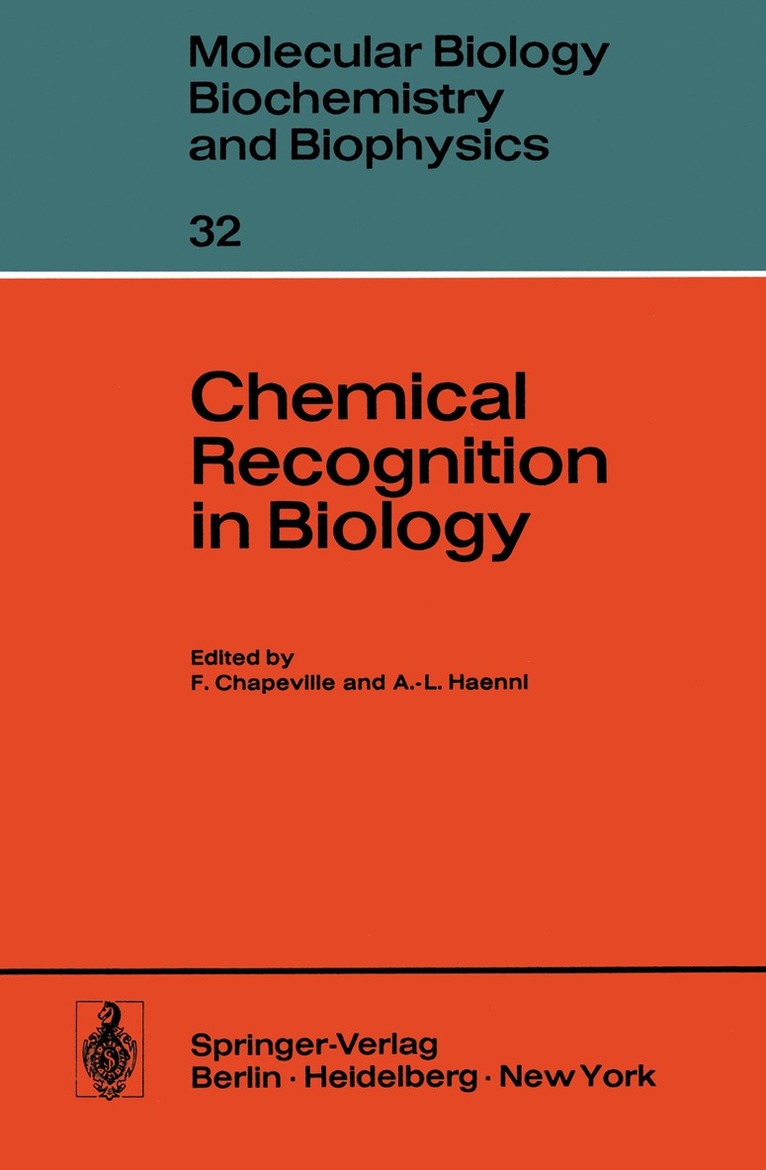
    Chemical Recognition in Biology

    AvF. Chapeville,A. L. Haenni

    Häftad, Engelska, 2011

    Del i serien Molecular Biology, Biochemistry and Biophysics Molekularbiologie, Biochemie und Biophysik

    1 086 kr

    Beställningsvara. Skickas inom 10-15 vardagar. Fri frakt över 249 kr.

    Beskrivning

    Studies of chemical recognition in biology were initiated about half a century ago with the flrst kinetic data obtained on enzyme catalysis and inhibition. They led to a rather static representation of the recognition process illustrated by the lock and key model that still continues to influence our overall image of recognition and its specificity. In several cases, crystallographic studies of enzyme-substrate complexes have supported this model. Indeed, in a crystallized ligand-enzyme complex, a close fltting is observed between the active center of the enzyme and the functional groups of the ligand. How­ ever, this does not necessarily result from a direct recognition process between rigid structures, but may result from a progressive adaptation during which the initial struc­ tures of the enzyme and the ligand are modified (induced-flt mechanism). Recently, a great deal of work has been devoted to the study of recognition in more complex systems such as the replication or the translation machin~ries; clearly, the extraordinary precision of such systems cannot be explained solely in terms of physical matching between enzymes and their substrates. This has led to a noticeable change of perspective in these areas. As a result of the new kinetic viewpoint, one rather focuses on the time-course of the processes, on the kinetic balance between steps of the reaction, on the energy-accuracy relationships and on the strategies which permit the achievement of high precision using relatively error-prone components in an appropriate dynamic interplay.

    Produktinformation

    • Utgivningsdatum:2011-12-28
    • Mått:170 x 244 x 24 mm
    • Vikt:761 g
    • Format:Häftad
    • Språk:Engelska
    • Serie:Molecular Biology, Biochemistry and Biophysics Molekularbiologie, Biochemie und Biophysik
    • Antal sidor:430
    • Förlag:Springer-Verlag Berlin and Heidelberg GmbH & Co. KG
    • ISBN:9783642815058

    Utforska kategorier

    • Zoologi inom Naturvetenskap och teknik
    • Djurböcker inom Djur och Natur

    Innehållsförteckning

    • A. Recognition of Ligands — Enzymic Catalysis.- 1. What Everyone Wanted to Know About Tight Binding and Enzyme Catalysis, but Never Thought of Asking.- 2. The Cytochromes c: Paradigms for Chemical Recognition.- 3. Recognition of Ligands by Haem Proteins.- 4. Influences of Solvent Water on the Transition State Affinity of Enzymes, Protein Folding, and the Composition of the Genetic Code.- 5. Suicide Substrates: Mechanism-Based Inactivators of Specific Target Enzymes.- 6. Recognition: the Kinetic Concepts.- 7. Coupled Oscillator Theory of Enzyme Action.- 8. Stereochemical Aspects of Chain Lengthening and Cyclization Processes in Terpenoid Biosynthesis.- B. Enzyme Regulation.- 1. Three Multifunctional Protein Kinase Systems in Transmembrane Control.- 2. Effect of Catabolite Repression on Chemotaxis in Salmonella typhimurium.- 3. Subunit Interaction of Adenylylated Glutamine Synthetase.- 4. Dynamic Compartmentation.- 5. The Genes for and Regulation of the Enzyme Activities of two Multifunctional Proteins Required for the De Novo Pathway for UMP Biosynthesis in Mammals.- 6. Regulation of Muscle Contraction by Ca Ion.- 7. Why is Phosphate so Useful?.- 8. ppGpp, a Signal Molecule.- 9. Gramicidin S-Synthetase: On the Structure of a Polyenzyme Template in Polypeptide Synthesis.- 10. A Molecular Approach to Immunity and Pathogenicity in an Insect-Bacterial System.- C. Nucleic Acid — Protein Interactions; Mutagenesis.- 1. Structure of the Gene 5 DNA Binding Protein from Bacteriophage fd and its DNA Binding Cleft.- 2. Recognition of Nucleic Acids and Chemically-Damaged DNA by Peptides and Proteins.- 3. Specific Interaction of Base-Specific Nucleases with Nucleosides and Nucleotides.- 4. Structural and Dynamic Aspects of Recognition Between tRNAs and Aminoacyl-tRNA Synthetases.-5. Recognition of Promoter Sequences by RNA Polymerases from Different Sources.- 6. DNA as a Target for a Protein Antibiotic: Molecular Basis of Action.- 7. Site-Specific Mutagenesis in the Analysis of a Viral Replicon.- D. Protein Biosynthesis.- 1. Molecular Mechanism of Protein Biosynthesis and an Approach to the Mechanism of Energy Transduction.- 2. On Codon — Anticodon Interactions.- 3. Fluorescent tRNA Derivatives and Ribosome Recognition.- 4. Structure and Evolution of Ribosomes.- E. Philosophical Reflexions.- 1. Molecular Biology, Culture, and Society.- 2. Personal Recollections of Fritz Lipmann During the Early Years of Coenzyme A Research.