• Fri frakt över 249 kr
  • •
  • Snabba leveranser
  • •
  • Billiga böcker
Kundservice

Du är på sajten för privatpersoner.

Företag, bibliotek eller offentlig verksamhet?

Du handlar på classic.bokus.com, där alla dina funktioner finns intakta.
Till classic.bokus.com
Bokus logotyp. Gå till startsidan.
  • Erbjudanden
  • Nyheter
  • Student
  • Topplistor
  • Barn & ungdom
  • Bokus Play
  • E-böcker
  • Pocketböcker
  • Spel & pussel

10% rabatt på allt med kod NYSTART10 →

Sidfot

Mina sidor

    Hjälp

    • Kundservice
    • Vanliga frågor och svar
    • Frakt och leverans
    • Retur vid ångerrätt
    • Reklamera vara
    • Betalning
    • Köpvillkor
    • Allmänna villkor
    • Information om webbplatsens tillgänglighet

    Om Bokus

    • Om oss
    • Pressrum
    • För studenter
    • För företag
    • För bibliotek och offentlig verksamhet
    • För leverantörer
    • Hållbarhet

    Populärt

    • Aktuella erbjudanden
    • Presentkort
    • Studentlitteratur
    • Nya böcker
    • Topplistor
    • Signerade böcker
    • Engelska böcker

    Inspiration

    • Boktips
    • BookTok
    • Populära bokserier
    • Barnbokskaraktärer
    • Populära författare
    Logotyp för Bokus
    Följ oss på Facebook (extern länk)Följ oss på Instagram (extern länk)Följ oss på YouTube (extern länk)Följ oss på TikTok (extern länk)
    bokus @ CookiesAnpassa cookiesIntegritetspolicyKöpvillkor
    Till Citymail hemsida (extern länk)Till Budbee hemsida (extern länk)Till Postnord hemsida (extern länk)Till Schenker hemsida (extern länk)Till Early Bird hemsida (extern länk)Till Walleys hemsida (extern länk)
    1. Naturvetenskap och teknik
    2. Teknik och industri
    3. Maskinteknik och material

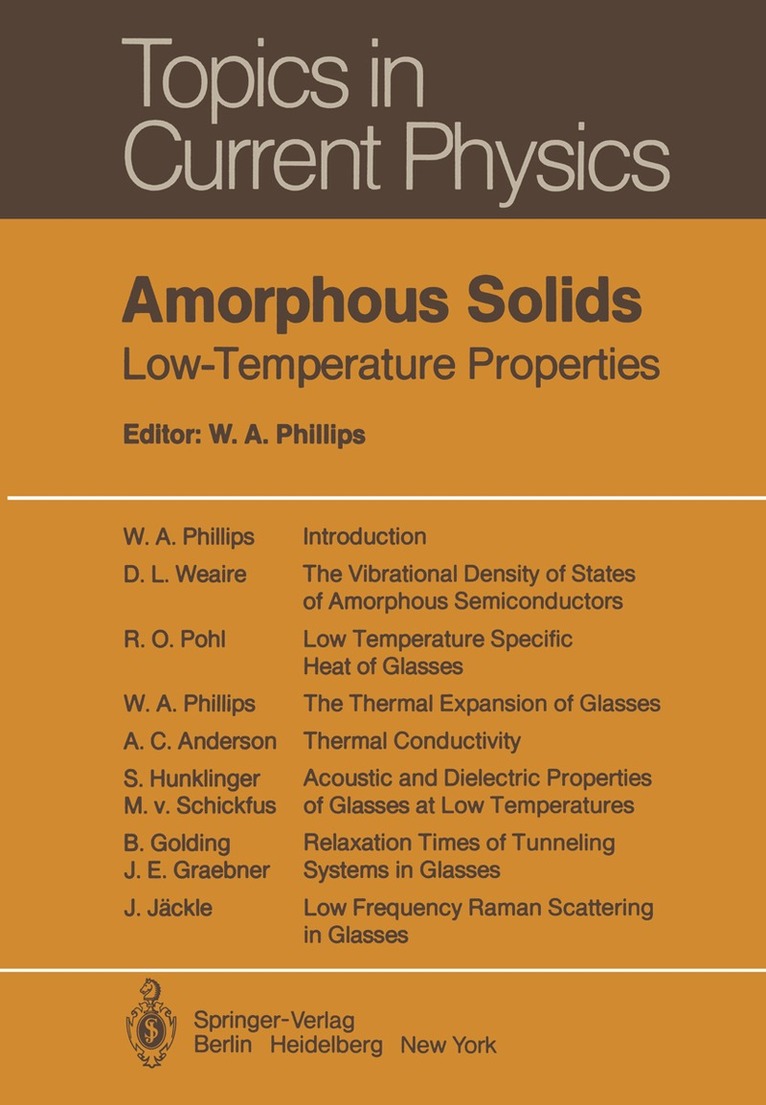
    Amorphous Solids

    Low-Temperature Properties

    AvWilliam A. Phillips

    Häftad, Engelska, 2011

    Del 24 i serien Topics in Current Physics

    546 kr

    Beställningsvara. Skickas inom 10-15 vardagar. Fri frakt över 249 kr.

    Beskrivning

    It is now ten years since it was first convincingly shown that below 1 K the ther­ mal conductivity and the heat capacity of amorphous solids behave in a way which is strikingly different to that of crystalline solids. Since that time there has been a wide variety of experimental and theoretical studies which have not only defined and clarified the low temperature problem more closely, but have also linked these differences between amorphous and crystalline solids to those suggested by older acoustic and thermal experiments (extending up to 100 K). The interest in this somewhat restricted branch of physics lies to a considerable extent in the fact that the differences were so unexpected. It might be thought that as the tempera­ ture, probing frequency, or more generally the energy decreases, a continuum de­ scription in which structural differences between glass and crystal are concealed should become more accurate. In a sense this is true, but it appears that there exists in an amorphous solid a large density of additional excitations which have no counterpart in normal crystals. This book presents a survey of the wide range of experimental investigations of these low energy excitations, together with a re­ view of the various theoretical models put forward to explain their existence and nature.

    Produktinformation

    • Utgivningsdatum:2011-12-21
    • Mått:170 x 244 x 11 mm
    • Vikt:329 g
    • Format:Häftad
    • Språk:Engelska
    • Serie:Topics in Current Physics
    • Antal sidor:170
    • Förlag:Springer-Verlag Berlin and Heidelberg GmbH & Co. KG
    • ISBN:9783642815362

    Utforska kategorier

    • Maskinteknik och material inom Naturvetenskap och teknik

    Innehållsförteckning

    • 1. Introduction.- 1.1 Historical Background.- 1.2 Tunneling States.- 1.3 Organization of the Book.- References.- 2. The Vibrational Density of States of Amorphous Semiconductors.- 2.1 The Vibrational Density of States.- 2.2 Experimental Techniques.- 2.3 The Theoretical Problem.- 2.4 Brute Force Theory.- 2.5 More Refined Approaches.- 2.6 The Incorporation of Matrix Elements.- 2.7 Can One Derive Structural Information from g(?)?.- 2.8 A Less Myopic View of the Field.- References.- 3. Low Temperature Specific Heat of Glasses.- 3.1 Review of the Experimental Situation.- 3.2 Comparison with Theoretical Models.- 3.3 Summary and Outlook.- References.- 4. The Thermal Expansion of Glasses.- 4.1 Theoretical Background.- 4.2 The High Temperature Expansion of Vitreous Silica.- 4.3 The Low Temperature Expansion of Glasses.- References.- 5. Thermal Conductivity.- 5.1 Thermal Transport in Crystalline Materials.- 5.2 Thermal Transport in Amorphous Materials.- 5.3 Probing the Localized Excitations.- 5.4 Synopsis.- References.- 6. Acoustic and Dielectric Properties of Glasses at Low Temperatures.- 6.1 General Comments.- 6.2 Acoustic and Dielectric Properties Above 10 K.- 6.3 Acoustic and Dielectric Properties Below 10 K.- 6.4 Theoretical Description of the Acoustic and Dielectric Properties by Two-Level Systems.- 6.5 Comparispn Between Theory and Experiment.- 6.6 Microscopic Description: Tunneling Model.- 6.7 Summary.- References.- 7. Relaxation Times of Tunneling Systems in Glasses.- 7.1 Background.- 7.2 Resonance Dynamics of Two-Level Systems.- 7.3 Experiments Measuring Relaxation Times.- 7.4 Critical Assessment of Data.- 7.5 Conclusions.- References.- 8. Low Frequency Raman Scattering in Glasses.- 8.1 Introductory Comments.- 8.2 Vibrational Raman Spectrum of First Order.- 8.3Quasielastic Spectrum.- 8.4 Conclusion.- References.- Additional References with Titles.- Subject and Material Index.