• Fri frakt över 249 kr
  • •
  • Snabba leveranser
  • •
  • Billiga böcker
Kundservice

Du är på sajten för privatpersoner.

Företag, bibliotek eller offentlig verksamhet?

Du handlar på classic.bokus.com, där alla dina funktioner finns intakta.
Till classic.bokus.com
Bokus logotyp. Gå till startsidan.
  • Erbjudanden
  • Nyheter
  • Student
  • Topplistor
  • Barn & ungdom
  • Bokus Play
  • E-böcker
  • Pocketböcker
  • Spel & pussel

10% rabatt på allt med kod NYSTART10 →

Sidfot

Mina sidor

    Hjälp

    • Kundservice
    • Vanliga frågor och svar
    • Frakt och leverans
    • Retur vid ångerrätt
    • Reklamera vara
    • Betalning
    • Köpvillkor
    • Allmänna villkor
    • Information om webbplatsens tillgänglighet

    Om Bokus

    • Om oss
    • Pressrum
    • För studenter
    • För företag
    • För bibliotek och offentlig verksamhet
    • För leverantörer
    • Hållbarhet

    Populärt

    • Aktuella erbjudanden
    • Presentkort
    • Studentlitteratur
    • Nya böcker
    • Topplistor
    • Signerade böcker
    • Engelska böcker

    Inspiration

    • Boktips
    • BookTok
    • Populära bokserier
    • Barnbokskaraktärer
    • Populära författare
    Logotyp för Bokus
    Följ oss på Facebook (extern länk)Följ oss på Instagram (extern länk)Följ oss på YouTube (extern länk)Följ oss på TikTok (extern länk)
    bokus @ CookiesAnpassa cookiesIntegritetspolicyKöpvillkor
    Till Citymail hemsida (extern länk)Till Budbee hemsida (extern länk)Till Postnord hemsida (extern länk)Till Schenker hemsida (extern länk)Till Early Bird hemsida (extern länk)Till Walleys hemsida (extern länk)
    1. Naturvetenskap och teknik
    2. Teknik och industri
    3. Elektronik och kommunikationer

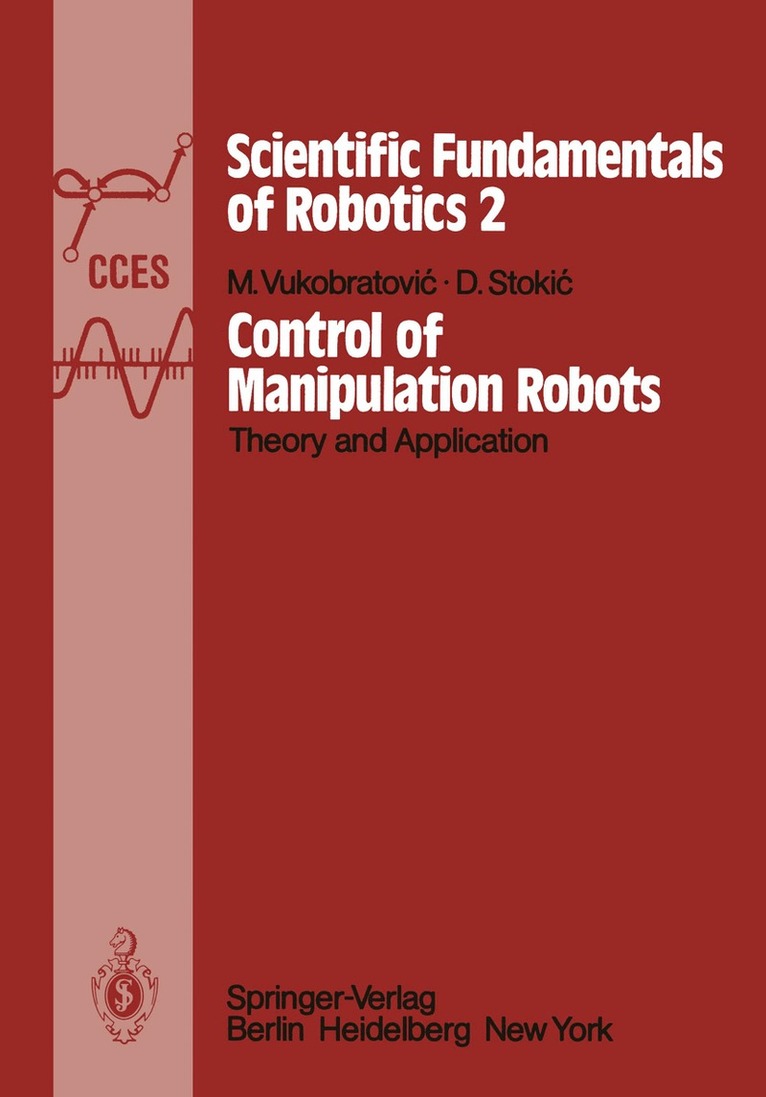
    Control of Manipulation Robots

    Theory and Application

    AvM. Vukobratovic,D. Stokic

    Häftad, Engelska, 2011

    Del 2 i serien Communications and Control Engineering

    546 kr

    Beställningsvara. Skickas inom 10-15 vardagar. Fri frakt över 249 kr.

    Beskrivning

    This monograph represents the second book of the series entitled: "SCI­ ENTIFIC FUNDAl-1ENTALS OF ROBOTICS". While the first volume provides a study of the dynamics of spatial mechanisms and its application to the design of these mechanisms, the present one focuses on the synthesis -of control based~n the knowledge of dynamic models (presented in de­ tail in the first_ volume). In this way a logical continuity is formed in which one may easily recognize a "dynamic" approach to the design of manipulation r-obots and the synthesis of control algorithms based on exact mathematical models of dynamics of open spatial mechanisms. When writing the monograph, the authors had the following objective: to prove that a study of dynamic properties of manipulation mechanisms is justifiable, to use the dynamic properties in the synthesis of con­ trol algorithms, and to determine, from one case to another, a proper measure of dynamics depending on the type of manipulation task, the "v$!locity at which "it is carried out, and on the type of the manipu- tion mechanisms itself. The authors believe they have thus made the study of dynamics,' aimed at synthesizing algorithms for dynamic con­ trol, free from unnecessary academicism and allowed the readers to apply all the results presented here to practical purposes of manipu­ lator design in thfil broader sense of the word. At this point, the au­ thors would like to present some concepts which were their guidelines in preparing this text.

    Produktinformation

    • Utgivningsdatum:2011-12-08
    • Mått:170 x 244 x 21 mm
    • Vikt:661 g
    • Format:Häftad
    • Språk:Engelska
    • Serie:Communications and Control Engineering
    • Antal sidor:366
    • Förlag:Springer-Verlag Berlin and Heidelberg GmbH & Co. KG
    • ISBN:9783642818592

    Utforska kategorier

    • Elektronik och kommunikationer inom Naturvetenskap och teknik
    • Ledarskapsböcker inom Ekonomi och Ledarskap
    • Teknik: allmänt inom Naturvetenskap och teknik

    Innehållsförteckning

    • General Principles of Control Synthesis of Robots and Manipulators.- — system class definition.- Classification of robots.- Requirements of robot control synthesis.- Brief survey of results from the domain of robot control synthesis.- Principles of robot control synthesis.- References.- 1 Dynamics of Manipulators.- 1.1. Method for the construction of dynamic equation based on the basic theorems of mechanics.- 1.2. The complete dynamical model of manipulation systems.- 1.3. Computer oriented method for linearization of dynamic models of open kinematic chains.- References.- 2 Synthesis of Manipulation Control.- 2.1. Introduction.- 2.2. Definition of the control task.- 2.3. Stage of nominal dynamics.- 2.4. Stage of perturbed dynamics.- 2.5. Linear optimal regulator.- 2.6. Synthesis of decentralized and global control-stage of perturbed dynamics.- 2.7. Discrete-time control synthesis.- 2.8. An interactive computer-oriented algorithm for control synthesis.- 2.9. Conclusion.- References.- Appendix 2. A. Suboptimality of Global Control.- Appendix 2. B. Analysis of »Distribution of the Model« Between Subsystems and Coupling.- Reference.- Appendix 2. C. Stability Analysis of System with Decentralized Regulator and Observer.- References.- 3 Control Synthesis for Typical Manipulations Tasks.- 3.1. Introduction.- 3.2. Task of transferring the manipulator tip along a desired trajectory.- 3.3. Transfer of working object with desired orientation along prescribed trajectory.- 3.4. Control of orientation of gripper using load-feedback.- 3.5. Assembly process.- 3.6. Multiprocessor realization of decentralized and global control.- 3.7. Conclusion.- References.- Appendix 3. A. Simulation Algorithm for Assembly.