• Fri frakt över 249 kr
  • •
  • Snabba leveranser
  • •
  • Billiga böcker
Kundservice

Du är på sajten för privatpersoner.

Företag, bibliotek eller offentlig verksamhet?

Du handlar på classic.bokus.com, där alla dina funktioner finns intakta.
Till classic.bokus.com
Bokus logotyp. Gå till startsidan.
  • Erbjudanden
  • Nyheter
  • Student
  • Topplistor
  • Barn & ungdom
  • Bokus Play
  • E-böcker
  • Pocketböcker
  • Spel & pussel

10% rabatt på allt med kod NYSTART10 →

Sidfot

Mina sidor

    Hjälp

    • Kundservice
    • Vanliga frågor och svar
    • Frakt och leverans
    • Retur vid ångerrätt
    • Reklamera vara
    • Betalning
    • Köpvillkor
    • Allmänna villkor
    • Information om webbplatsens tillgänglighet

    Om Bokus

    • Om oss
    • Pressrum
    • För studenter
    • För företag
    • För bibliotek och offentlig verksamhet
    • För leverantörer
    • Hållbarhet

    Populärt

    • Aktuella erbjudanden
    • Presentkort
    • Studentlitteratur
    • Nya böcker
    • Topplistor
    • Signerade böcker
    • Engelska böcker

    Inspiration

    • Boktips
    • BookTok
    • Populära bokserier
    • Barnbokskaraktärer
    • Populära författare
    Logotyp för Bokus
    Följ oss på Facebook (extern länk)Följ oss på Instagram (extern länk)Följ oss på YouTube (extern länk)Följ oss på TikTok (extern länk)
    bokus @ CookiesAnpassa cookiesIntegritetspolicyKöpvillkor
    Till Citymail hemsida (extern länk)Till Budbee hemsida (extern länk)Till Postnord hemsida (extern länk)Till Schenker hemsida (extern länk)Till Early Bird hemsida (extern länk)Till Walleys hemsida (extern länk)
    1. Data och IT
    2. Systemvetenskap och AI

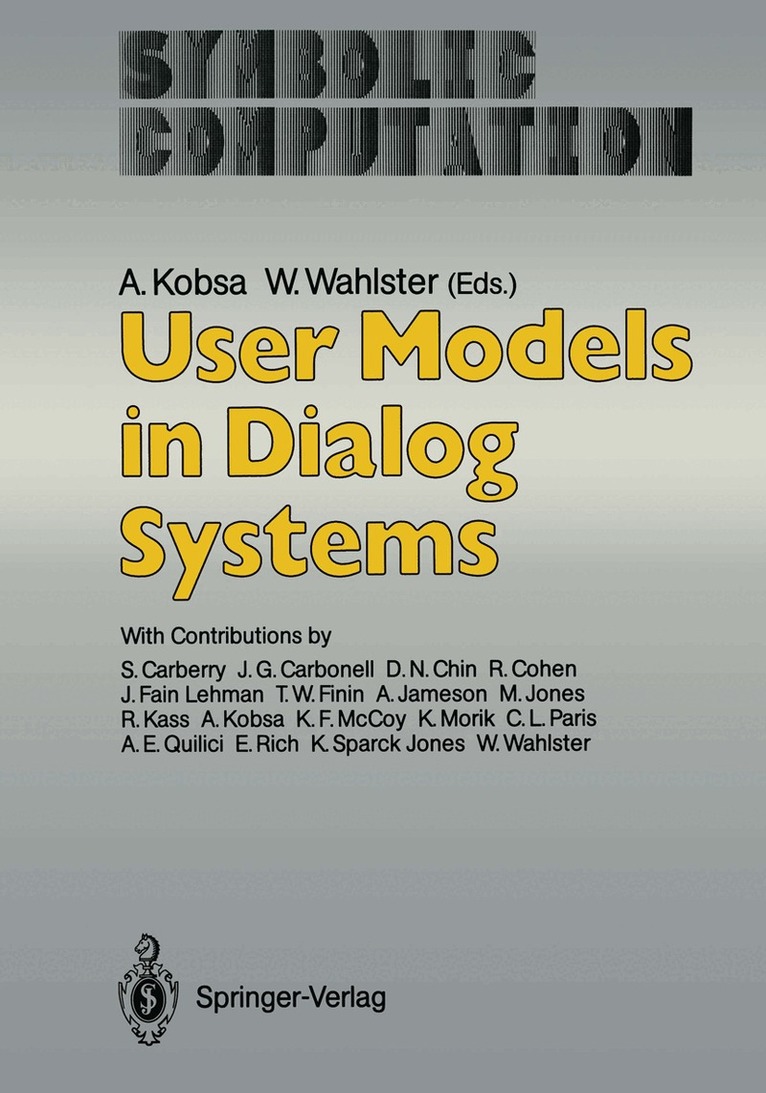
    User Models in Dialog Systems

    AvAlfred Kobsa,Wolfgang Wahlster

    Häftad, Engelska, 2011

    Del i serien Symbolic Computation

    1 085 kr

    Beställningsvara. Skickas inom 10-15 vardagar. Fri frakt över 249 kr.

    Beskrivning

    User models have recently attracted much research interest in the field of artificial intelligence dialog systems. It has become evident that flexible user-oriented dialog behavior of such systems can be achieved only if the system has access to a model of the user containing assumptions about his/her background knowledge as well as his/her goals and plans in consulting the system. Research in the field of user models investigates how such assumptions can be automatically created, represented and exploited by the system in the course of an "on-line" interaction with the user. The communication medium in this interaction need not necessarily be a natural language, such as English or German. Formal interaction languages are also permit­ ted. The emphasis is placed on systems with natural language input and output, however. A dozen major and several more minor user modeling systems have been de­ signed and implemented in the last decade, mostly in the context of natural-language dialog systems. The goal of UM86, the first international workshop on user model­ ing, was to bring together the researchers working on these projects so that results could be discussed and analyzed, and hopefully general insights be found, that could prove useful for future research. The meeting took place in Maria Laach, a small village some 40 miles south of Bonn, West Germany. 25 prominent researchers were invited to participate.

    Produktinformation

    • Utgivningsdatum:2011-12-08
    • Mått:170 x 242 x 27 mm
    • Vikt:834 g
    • Format:Häftad
    • Språk:Engelska
    • Serie:Symbolic Computation
    • Antal sidor:471
    • Förlag:Springer-Verlag Berlin and Heidelberg GmbH & Co. KG
    • ISBN:9783642832321

    Utforska kategorier

    • Systemvetenskap och AI inom Data och IT
    • Artificiell intelligens inom Data och IT
    • Tillämpad datateknik inom Data och IT

    Innehållsförteckning

    • I. A Survey of User Modeling.- 1 User Models in Dialog Systems.- 2 Stereotypes and User Modeling.- 3 A Taxonomy of Beliefs and Goals for User Models in Dialog Systems.- II. Building User Models.- 4 KNOME: Modeling What the User Knows in UC.- 5 Detecting and Responding to Plan-Oriented Misconceptions.- 6 Plan Recognition and Its Use in Understanding Dialog.- 7 Learning the User’s Language: A Step Towards Automated Creation of User Models.- III. Exploiting User Models.- 8 The Use of Explicit User Models in a Generation System for Tailoring Answers to the User’s Level of Expertise.- 9 Highlighting a User Model to Respond to Misconceptions.- 10 But What Will the Listener Think? Belief Ascription and Image Maintenance in Dialog.- 11 Incorporating User Models into Expert Systems for Educational Diagnosis.- IV. Shortcomings of Current Models, Prospects for the Future.- 12 Realism About User Modeling.- 13 User Models and Conversational Settings: Modeling the User’s Wants.- 14 Student Modeling in Intelligent Tutoring Systems — Implications for User Modeling.- 15 GUMS — A General User Modeling Shell.- Appendices.- List of Contributors.