• Fri frakt över 249 kr
  • •
  • Snabba leveranser
  • •
  • Billiga böcker
Kundservice

Du är på sajten för privatpersoner.

Företag, bibliotek eller offentlig verksamhet?

Du handlar på classic.bokus.com, där alla dina funktioner finns intakta.
Till classic.bokus.com
Bokus logotyp. Gå till startsidan.
  • Erbjudanden
  • Student
  • Topplistor
  • Barn & ungdom
  • Bokus Play
  • E-böcker
  • Ljudböcker
  • Pocketböcker
  • Spel & pussel

Upp till 25% på utvalda nyheter →

Sidfot

Mina sidor

    Hjälp

    • Kundservice
    • Vanliga frågor och svar
    • Frakt och leverans
    • Retur vid ångerrätt
    • Reklamera vara
    • Betalning
    • Köpvillkor
    • Allmänna villkor
    • Information om webbplatsens tillgänglighet

    Om Bokus

    • Om oss
    • Pressrum
    • För studenter
    • För företag
    • För bibliotek och offentlig verksamhet
    • För leverantörer
    • Hållbarhet

    Populärt

    • Aktuella erbjudanden
    • Presentkort
    • Studentlitteratur
    • Nya böcker
    • Topplistor
    • Signerade böcker
    • Engelska böcker

    Inspiration

    • Boktips
    • BookTok
    • Populära bokserier
    • Barnbokskaraktärer
    • Populära författare
    Logotyp för Bokus
    Följ oss på Facebook (extern länk)Följ oss på Instagram (extern länk)Följ oss på YouTube (extern länk)Följ oss på TikTok (extern länk)
    bokus @ CookiesAnpassa cookiesIntegritetspolicyKöpvillkor
    Till Citymail hemsida (extern länk)Till Budbee hemsida (extern länk)Till Postnord hemsida (extern länk)Till Schenker hemsida (extern länk)Till Early Bird hemsida (extern länk)Till Walleys hemsida (extern länk)
    1. Naturvetenskap och teknik
    2. Teknik och industri
    3. Elektronik och kommunikationer

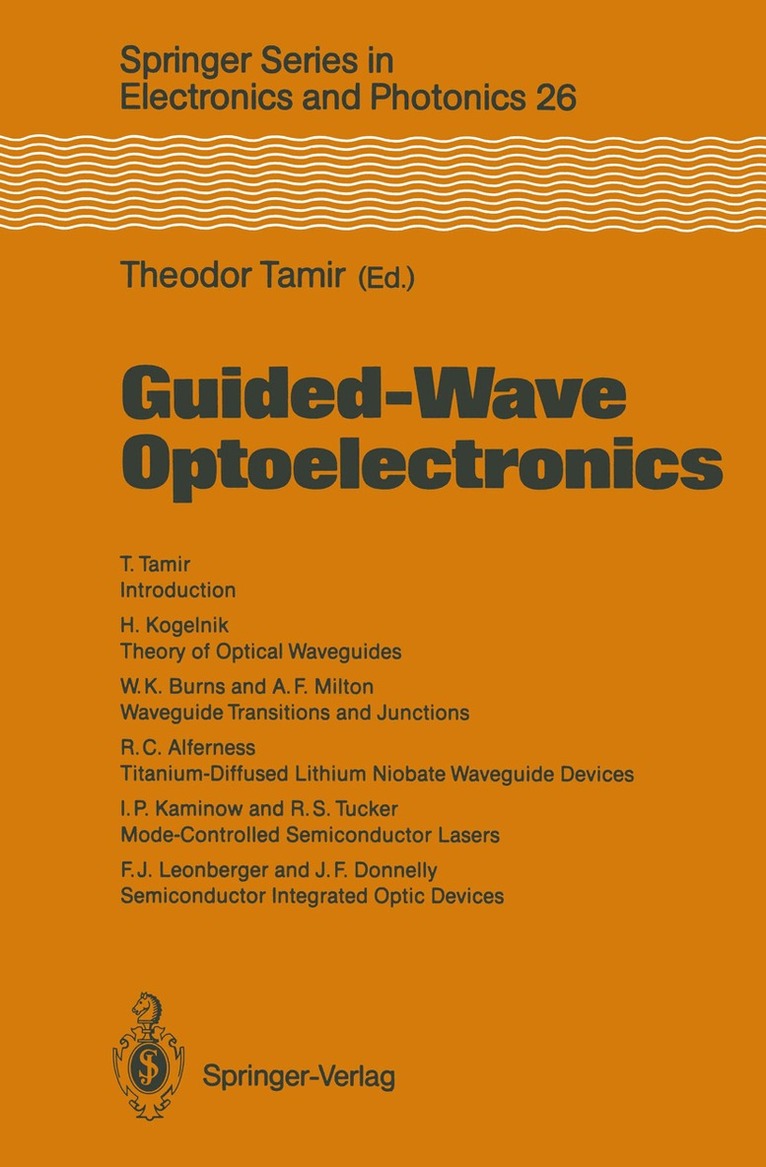
    Guided-Wave Optoelectronics

    AvTheodor Tamir

    Häftad, Engelska, 2012

    Del i serien Springer Series in Electronics and Photonics

    725 kr

    Beställningsvara. Skickas inom 5-8 vardagar. Fri frakt över 249 kr.

    Beskrivning

    The first guided-wave components that employed signals in the form of light beams traveling along thin films were fabricated a little more than two decades ago. The parallel development of semiconductor lasers and the subsequent availability of low-loss optical fibers made possible the imple­ mentation of completely optical systems for communications, signal pro­ cessing and other applications that had used only electronic circuitry in the past. Referred to as integrated optics, this technology has been rein­ forced by utilizing electronic components that act as controlling elements or perform other functions for which the optical counterparts are not as effec­ tive. The broader area thus generated was aptly named optoelectronics and it currently represents a fascinating, rapidly evolving and most promising technology. Specifically, the amalgamation of electronic and optics compo­ nents into an integrated optoelectronics format is expected to provide a wide range of systems having miniaturized, high speed, broad band and reliable components for telecommunications, data processing, optical computing and other applications in the near and far future. This book is intended to cover primarily the optical portion of the op­ toelectronics area by focusing on the theory and applications of components that use guided optical waves. Hence all aspects of integrated optics are dis­ cussed, but optoelectronic components having primarily electronic rather than optical functions have not been included. Each chapter has been writ­ ten by experts who have actively participated in developing the specific areas addressed by them.

    Produktinformation

    • Utgivningsdatum:2012-01-23
    • Mått:155 x 235 x undefined mm
    • Vikt:628 g
    • Format:Häftad
    • Språk:Engelska
    • Serie:Springer Series in Electronics and Photonics
    • Antal sidor:401
    • Förlag:Springer-Verlag Berlin and Heidelberg GmbH & Co. KG
    • ISBN:9783642970764

    Utforska kategorier

    • Elektronik och kommunikationer inom Naturvetenskap och teknik
    • Fysik inom Naturvetenskap och teknik

    Innehållsförteckning

    • 1. Introduction.- 1.1 Overview.- 1.2 Organization of the Book.- References.- 2. Theory of Optical Waveguides.- 2.1 Ray Optics of the Slab Waveguide.- 2.2 Fundamentals of the Electromagnetic Theory of Dielectric Waveguides.- 2.3 Modes of the Planar Slab Guide.- 2.4 Planar Guides with Graded-Index Profiles.- 2.5 Channel Waveguides.- 2.6 Coupled-Mode Formalism and Periodic Waveguides.- References.- 3. Waveguide Transitions and Junctions.- 3.1 Waveguide Modes and Coupled-Mode Theory.- 3.2 Fast and Slow Transitions.- 3.3 Mode Coupling Between Local Normal Modes.- 3.4 Two-Arm Branches.- 3.5 Waveguide Horns.- 3.6 Branches with Three Arms.- 3.7 Conclusion.- References.- 4. Titanium-Diffused Lithium Niobate Waveguide Devices.- 4.1 Waveguide Fabrication.- 4.2 Basic Device Considerations.- 4.3 Switch/Modulator.- 4.4 On/Off Modulators.- 4.5 Polarization Devices.- 4.6 Wavelength Filters.- 4.7 Polarization-Insensitive Devices.- 4.8 Some Ti:LiNbO3 Integrated-Optic Circuits.- 4.9 Applications.- 5. Mode-Controlled Semiconductor Lasers.- 5.1 Organization of the Chapter.- 5.2 Laser Basics.- 5.3 Structures for Transverse-Mode Control.- 5.4 Longitudinal Mode Control.- 5.5 Linewidth.- 5.6 High-Speed Modulation.- 5.7 Luminescent Diodes and Laser Amplifiers.- Appendix 5A: Glossary of Symbols.- References.- 6. Semiconductor Integrated Optic Devices.- 6.1 Semiconductor Waveguide Theory.- 6.2 Material Technology.- 6.3 Passive Waveguide Devices — Fabrication and Characterization.- 6.4 Electro-Optic Guided-Wave Modulators — Theory.- 6.5 Electro-Optic Guided-Wave Modulator Characteristics.- 6.6 Optoelectronic Integrated Circuits (OEIC).- 6.7 Concluding Remarks.- References.