Theodor Tamir - Böcker
Visar alla böcker från författaren Theodor Tamir. Handla med fri frakt och snabb leverans.
4 produkter
4 produkter
2 110 kr
Skickas inom 10-15 vardagar
In 1945, Dr. Ernst Weber founded, and was the first Director of, the Microwave Research Institute (MRI) at Polytechnic University (at that time named the Polytechnic Institute of Brooklyn). MRI gained worldwide recognition in the 50s and 60s for its research in electromagnetic theory, antennas and radiation, network theory and microwave networks, microwave components, and devices. It was also known through its series of 24 topical symposia and the widely distributed hardbound MRI Symposium Proceedings. Rededicated as the Weber Research Institute (WRI) in 1986, the institute currently conducts research in such areas as electromagnetic propagation and antennas, ultrabroadband electromagnetics, pulse power, acoustics, gaseous electronics, plasma physics, solid-state materials, quantum electronics, electromagnetic launchers, and networks. Following MRI tradition, WRI has launched its own series of in-depth topical conferences with published proceedings. Previous conferences in this series were: Directions in Electromagnetic Wave Modeling; October 1990 Ultra-Wideband Short-Pulse Electromagnetics; October, 1992 Ultra-Wideband Short-Pulse Electromagnetics, II; October, 1994 The proceedings of these conferences were also published by Plenum Press. This volume constitutes the proceedings of the fourth WRI International Conference dealing with Guided-Wave Optoelectronics: Device Characterization, Analysis and Design. The conference was held October 26-28, 1994, at the Polytechnic University in Brooklyn, New York, in cooperation with the IEEE Lasers and Electro Optics Society, and with the Optical Society of America. Theodor Tamir Giora Griffel Henry L. Bertoni v CONTENTS INTRODUCTORY Scanning the symposium. . . . . . . . . . . . . . . . . . . . . . . . . . . . . 1 . . . . . . .. . . . T. Tamir and G. Griffel Photonics in telecommunications. . . . . . . . . . . . . . . . . . . . . . . 3 . . . . . . . . . H.
2 101 kr
Skickas inom 10-15 vardagar
In 1945, Dr. Ernst Weber founded, and was the first Director of, the Microwave Research Institute (MRI) at Polytechnic University (at that time named the Polytechnic Institute of Brooklyn). MRI gained worldwide recognition in the 50s and 60s for its research in electromagnetic theory, antennas and radiation, network theory and microwave networks, microwave components, and devices. It was also known through its series of 24 topical symposia and the widely distributed hardbound MRI Symposium Proceedings. Rededicated as the Weber Research Institute (WRI) in 1986, the institute currently conducts research in such areas as electromagnetic propagation and antennas, ultrabroadband electromagnetics, pulse power, acoustics, gaseous electronics, plasma physics, solid-state materials, quantum electronics, electromagnetic launchers, and networks. Following MRI tradition, WRI has launched its own series of in-depth topical conferences with published proceedings. Previous conferences in this series were: Directions in Electromagnetic Wave Modeling; October 1990 Ultra-Wideband Short-Pulse Electromagnetics; October, 1992 Ultra-Wideband Short-Pulse Electromagnetics, II; October, 1994 The proceedings of these conferences were also published by Plenum Press. This volume constitutes the proceedings of the fourth WRI International Conference dealing with Guided-Wave Optoelectronics: Device Characterization, Analysis and Design. The conference was held October 26-28, 1994, at the Polytechnic University in Brooklyn, New York, in cooperation with the IEEE Lasers and Electro Optics Society, and with the Optical Society of America. Theodor Tamir Giora Griffel Henry L. Bertoni v CONTENTS INTRODUCTORY Scanning the symposium. . . . . . . . . . . . . . . . . . . . . . . . . . . . . 1 . . . . . . .. . . . T. Tamir and G. Griffel Photonics in telecommunications. . . . . . . . . . . . . . . . . . . . . . . 3 . . . . . . . . . H.
Del 26 - Springer Series in Electronics and Photonics
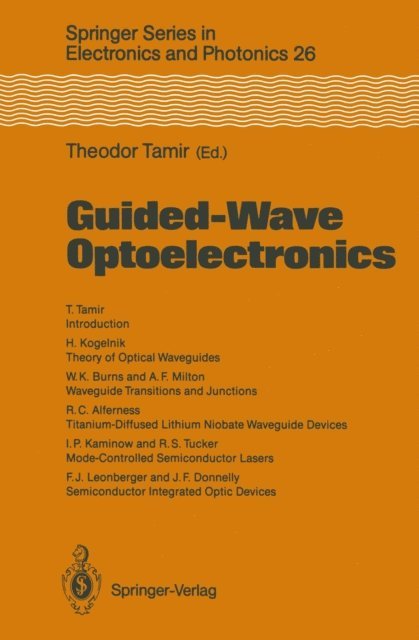
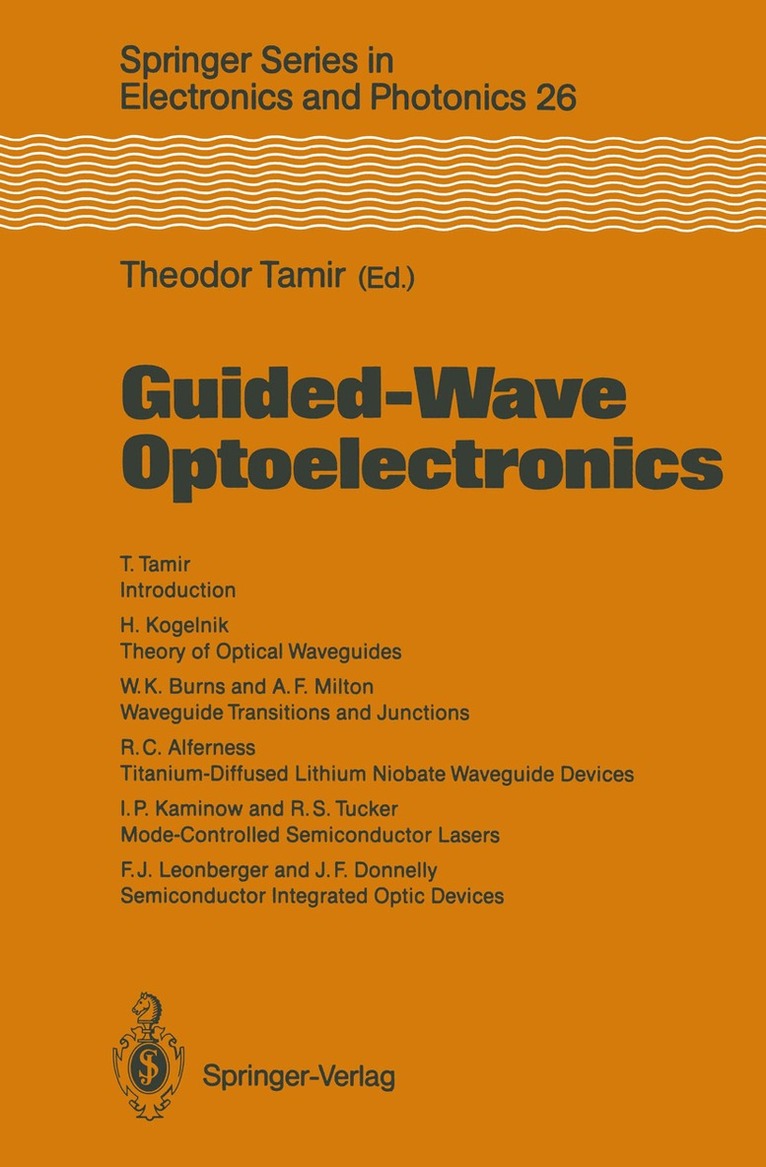
Guided-Wave Optoelectronics
Häftad, Engelska, 1990
536 kr
Skickas inom 10-15 vardagar
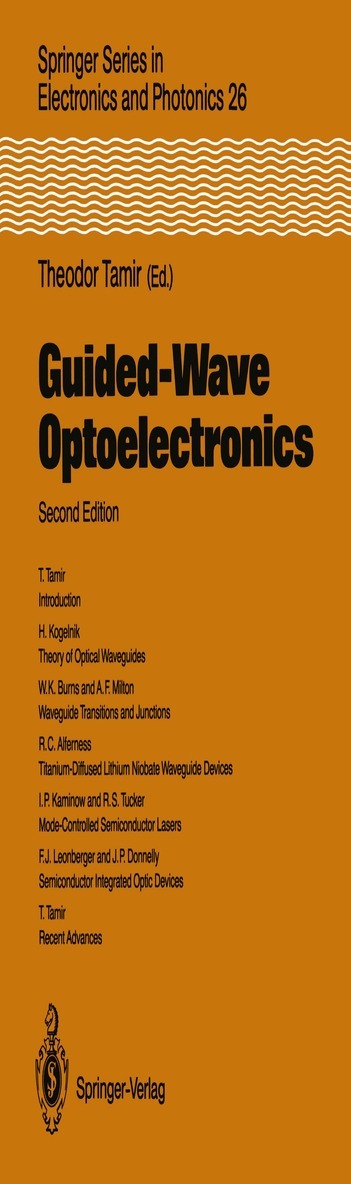
This text surveys the most recent advances in integrated optics and optoelectronics. It contains chapters on optical waveguides, light-wave junctions and other thin-film components, lithium-niobate (LiNbO3) devices, guided-mode semiconductor (GaAs and related) lasers and integrated optic devices. Included are sections on basic theory as well as descriptions of fabrication technology, applications and a number of available devices. The book will be of interest to researchers and engineers involved with integrated optics, optoelectronics and electro-optic systems and devices. In addition, it will serve as a reference manual for the theory and application of the most recent thin-film optical and optoelectronic technology. This 2nd edition contains an additional chapter summarizing the latest progress in the field.
Del 26 - Springer Series in Electronics and Photonics
Guided-Wave Optoelectronics
Häftad, Engelska, 2012
536 kr
Skickas inom 10-15 vardagar
The first guided-wave components that employed signals in the form of light beams traveling along thin films were fabricated a little more than two decades ago. The parallel development of semiconductor lasers and the subsequent availability of low-loss optical fibers made possible the imple mentation of completely optical systems for communications, signal pro cessing and other applications that had used only electronic circuitry in the past. Referred to as integrated optics, this technology has been rein forced by utilizing electronic components that act as controlling elements or perform other functions for which the optical counterparts are not as effec tive. The broader area thus generated was aptly named optoelectronics and it currently represents a fascinating, rapidly evolving and most promising technology. Specifically, the amalgamation of electronic and optics compo nents into an integrated optoelectronics format is expected to provide a wide range of systems having miniaturized, high speed, broad band and reliable components for telecommunications, data processing, optical computing and other applications in the near and far future. This book is intended to cover primarily the optical portion of the op toelectronics area by focusing on the theory and applications of components that use guided optical waves. Hence all aspects of integrated optics are dis cussed, but optoelectronic components having primarily electronic rather than optical functions have not been included. Each chapter has been writ ten by experts who have actively participated in developing the specific areas addressed by them.