• Fri frakt över 249 kr
  • •
  • Snabba leveranser
  • •
  • Billiga böcker
Kundservice

Du är på sajten för privatpersoner.

Företag, bibliotek eller offentlig verksamhet?

Du handlar på classic.bokus.com, där alla dina funktioner finns intakta.
Till classic.bokus.com
Bokus logotyp. Gå till startsidan.
  • Erbjudanden
  • Nyheter
  • Student
  • Topplistor
  • Barn & ungdom
  • Bokus Play
  • E-böcker
  • Pocketböcker
  • Spel & pussel

10% rabatt på allt med kod: NYSTART10 →

Sidfot

Mina sidor

    Hjälp

    • Kundservice
    • Vanliga frågor och svar
    • Frakt och leverans
    • Retur vid ångerrätt
    • Reklamera vara
    • Betalning
    • Köpvillkor
    • Allmänna villkor
    • Information om webbplatsens tillgänglighet

    Om Bokus

    • Om oss
    • Pressrum
    • För studenter
    • För företag
    • För bibliotek och offentlig verksamhet
    • För leverantörer
    • Hållbarhet

    Populärt

    • Aktuella erbjudanden
    • Presentkort
    • Studentlitteratur
    • Nya böcker
    • Topplistor
    • Signerade böcker
    • Engelska böcker

    Inspiration

    • Boktips
    • BookTok
    • Populära bokserier
    • Barnbokskaraktärer
    • Populära författare
    Logotyp för Bokus
    Följ oss på Facebook (extern länk)Följ oss på Instagram (extern länk)Följ oss på YouTube (extern länk)Följ oss på TikTok (extern länk)
    bokus @ CookiesAnpassa cookiesIntegritetspolicyKöpvillkor
    Till Citymail hemsida (extern länk)Till Budbee hemsida (extern länk)Till Postnord hemsida (extern länk)Till Schenker hemsida (extern länk)Till Early Bird hemsida (extern länk)Till Walleys hemsida (extern länk)
    1. Data och IT
    2. Systemvetenskap och AI

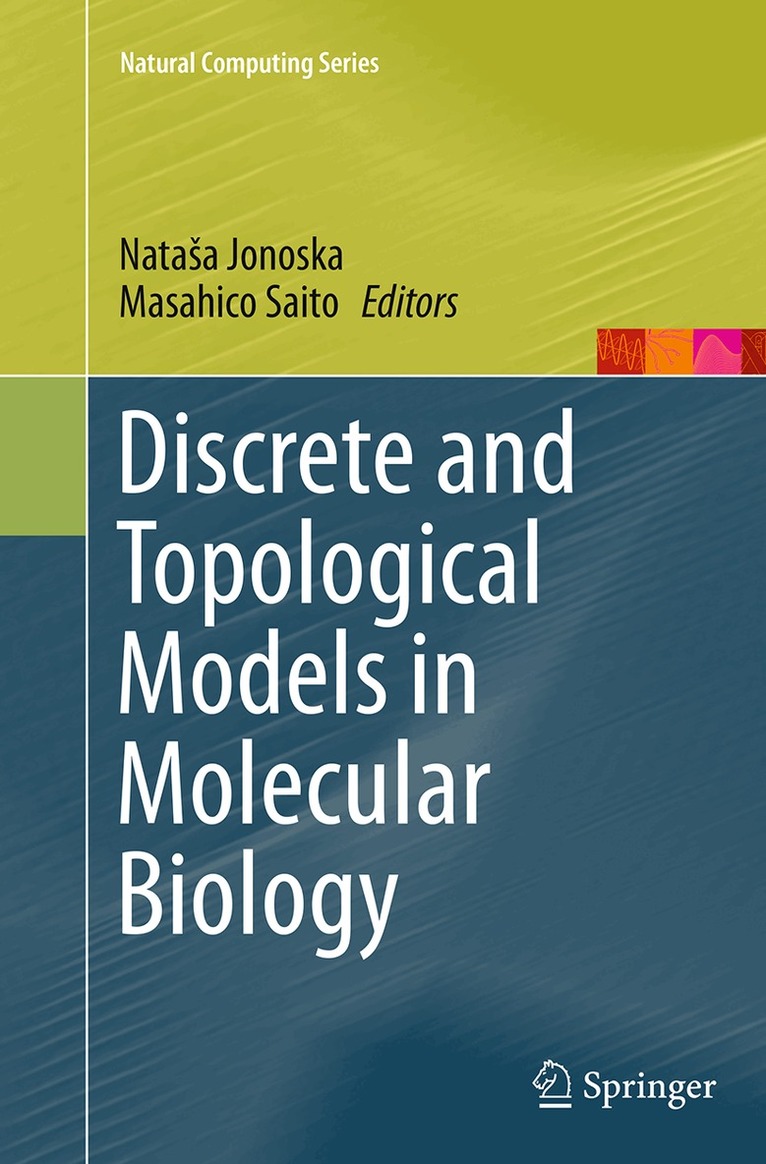
    Discrete and Topological Models in Molecular Biology

    AvNataša Jonoska,Masahico Saito

    Häftad, Engelska, 2016

    Del i serien Natural Computing Series

    1 086 kr

    Beställningsvara. Skickas inom 10-15 vardagar. Fri frakt över 249 kr.

    Beskrivning

    Theoretical tools and insights from discrete mathematics, theoretical computer science, and topology now play essential roles in our understanding of vital biomolecular processes. The related methods are now employed in various fields of mathematical biology as instruments to "zoom in" on processes at a molecular level.This book contains expository chapters on how contemporary models from discrete mathematics – in domains such as algebra, combinatorics, and graph and knot theories – can provide perspective on biomolecular problems ranging from data analysis, molecular and gene arrangements and structures, and knotted DNA embeddings via spatial graph models to the dynamics and kinetics of molecular interactions.The contributing authors are among the leading scientists in this field and the book is a reference for researchers in mathematics and theoretical computer science who are engaged with modeling molecular and biological phenomena using discrete methods. It may also serve as aguide and supplement for graduate courses in mathematical biology or bioinformatics, introducing nontraditional aspects of mathematical biology.

    Produktinformation

    • Utgivningsdatum:2016-08-23
    • Mått:155 x 235 x 29 mm
    • Vikt:809 g
    • Format:Häftad
    • Språk:Engelska
    • Serie:Natural Computing Series
    • Antal sidor:524
    • Förlag:Springer-Verlag Berlin and Heidelberg GmbH & Co. KG
    • ISBN:9783662514092

    Utforska kategorier

    • Systemvetenskap och AI inom Data och IT
    • Cellbiologi inom Naturvetenskap och teknik
    • Biovetenskap inom Naturvetenskap och teknik

    Mer om författaren

    Prof. Nataša Jonoska is a professor in the Dept. of Mathematics and Statistics of the University of South Florida, Tampa, USA. She received her PhD from the Dept. of Mathematical Sciences, SUNY Binghamton in 1993. Her research is driven by the issue of how biology computes, in particular using formal models such as cellular or other finite types of automata, formal language theory symbolic dynamics, and topological graph theory to describe molecular computation. She is a board member of related prestigious journals such as Theoretical Computer Science, the Int. J. of Foundations of Computer Science, Computability, and Natural Computing. She has edited a number of books, among them the Springer book Nanotechnology: Science and Computation. Dr. Masahico Saito is a researcher in the Dept. of Mathematics and Statistics, University of South Florida, Tampa, USA. He is a member of the Discrete and Topological Methods for DNA Assembly team, and his research interests include knots and quandles.

    Innehållsförteckning

    • Chap. 1 - Perspectives in Computational Genome Analysis.- Chap. 2 - The Sequence Reconstruction Problem.- Chap. 3 - Extracting Coevolving Characters from a Tree of Species.- Chap. 4 - When and How the Perfect Phylogeny Model Explains Evolution.- Chap. 5 - An Invitation to the Study of Brain Networks with Some Statistical Analysis of Thresholding Techniques.- Chap. 6 - Simplicial Models and Topological Inference in Biological Systems.- Chap. 7 - Combinatorial Insights into RNA Secondary Structure.- Chap. 8 - Redundant and Critical Noncovalent Interactions in Protein Rigid Cluster Analysis.- Chap. 9 - Modeling Autonomous Supramolecular Assembly.- Chap. 10 - The Role of Symmetry in Conformational Changes of Viral Capsids: A Mathematical Approach.- Chap. 11 - Minimal Tile and Bond-Edge Types for Self-Assembling DNA Graphs.- Chap. 12 - Programmed Genome Processing in Ciliates.- Chap. 13 - The Algebra of Gene Assembly in Ciliates.- Chap. 14 - Invariants of Graphs Modeling Nucleotide Rearrangements.- Chap. 15 - Introduction to DNA Topology.- Chap. 16 - Reactions Mediated by Topoisomerases and Other Enzymes: Modelling Localised DNA Transformations.- Chap. 17 - Site-Specific Recombination on Unknot and Unlink Substrates Producing Two-Bridge Links.- Chap. 18 - Site-Specific Recombination Modeled as a Band Surgery: Applications to Xer Recombination.- Chap. 19 - Understanding DNA Looping Through Cre-Recombination Kinetics .- Chap. 20 - The QSSA in Chemical Kinetics: As taught and as Practiced.- Chap. 21 - Algebraic Models and Their Use in Systems Biology.- Chap. 22 - Deconstructing Complex Nonlinear Models in System Design Space.- Chap. 23 - IBCell Morphocharts: A Computational Model for Linking Cell Molecular Activity with Emerging Tissue Morphology.