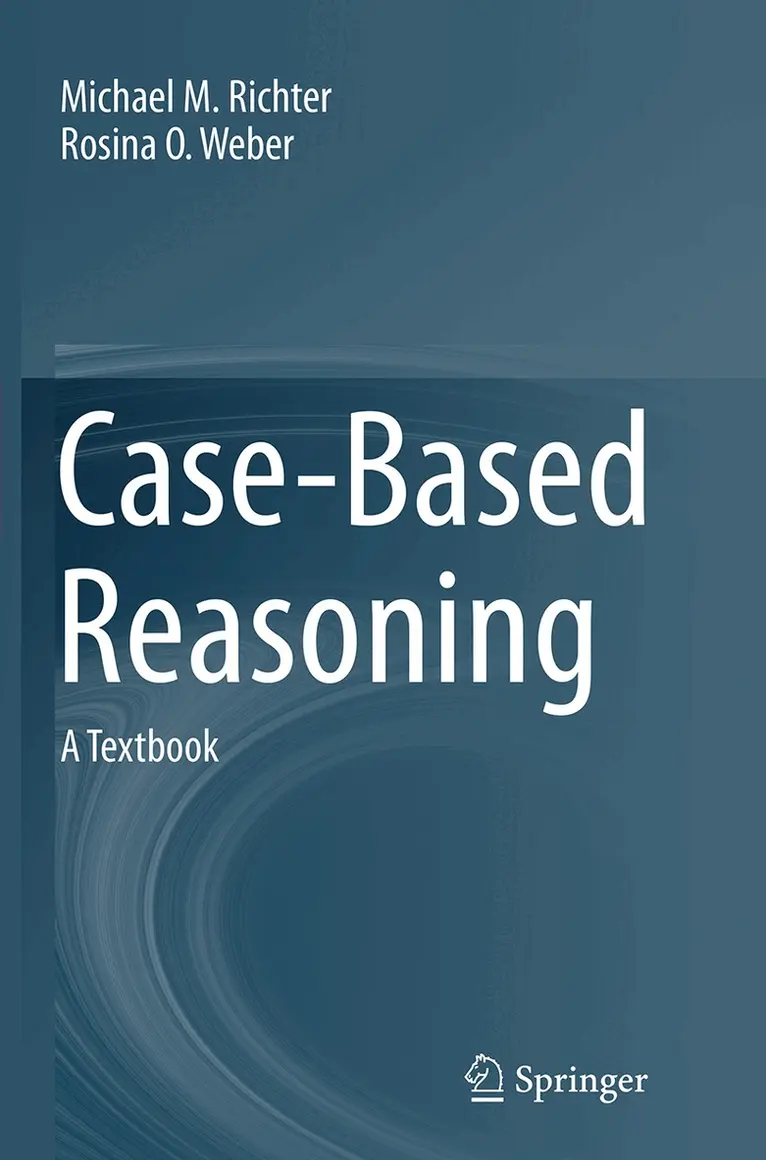
Häftad, Engelska, 2016
Case-Based Reasoning
Av Michael M. Richter, Rosina O. Weber
736 kr
Beställningsvara. Skickas inom 10-15 vardagar. Fri frakt över 249 kr.
Beskrivning
While it is relatively easy to record billions of experiences in a database, the wisdom of a system is not measured by the number of its experiences but rather by its ability to make use of them. Case-based reasoning (CBR) can be viewed as experience mining, with analogical reasoning applied to problem–solution pairs. As cases are typically not identical, simple storage and recall of experiences is not sufficient, we must define and analyze similarity and adaptation. The fundamentals of the approach are now well-established, and there are many successful commercial applications in diverse fields, attracting interest from researchers across various disciplines. This textbook presents case-based reasoning in a systematic approach with two goals: to present rigorous and formally valid structures for precise reasoning, and to demonstrate the range of techniques, methods, and tools available for many applications. In the chapters in Part I the authors present the basic elements of CBR without assuming prior reader knowledge; Part II explains the core methods, in particular case representations, similarity topics, retrieval, adaptation, evaluation, revisions, learning, development, and maintenance; Part III offers advanced views of these topics, additionally covering uncertainty and probabilities; and Part IV shows the range of knowledge sources, with chapters on textual CBR, images, sensor data and speech, conversational CBR, and knowledge management. The book concludes with appendices that offer short descriptions of the basic formal definitions and methods, and comparisons between CBR and other techniques. The authors draw on years of teaching and training experience in academic and business environments, and they employ chapter summaries, background notes, and exercises throughout the book. It's suitable for advanced undergraduate and graduate students of computer science, management, and related disciplines, and it's also a practical introduction and guide for industrial researchers and practitioners engaged with knowledge engineering systems.
Produktinformation
- Utgivningsdatum: 2016-08-23
- Mått: 155 x 235 x 33 mm
- Vikt: 836 g
- Format: Häftad
- Språk: Engelska
- Antal sidor: 546
- Förlag: Springer-Verlag Berlin and Heidelberg GmbH & Co. KG
- ISBN: 9783662523773
Utforska kategorier
Betyg & recensioner
0 recensioner
Inga recensioner tillgängliga.