• Fri frakt över 249 kr
  • •
  • Snabba leveranser
  • •
  • Billiga böcker
Kundservice

Du är på sajten för privatpersoner.

Företag, bibliotek eller offentlig verksamhet?

Du handlar på classic.bokus.com, där alla dina funktioner finns intakta.
Till classic.bokus.com
Bokus logotyp. Gå till startsidan.
  • Erbjudanden
  • Student
  • Topplistor
  • Barn & ungdom
  • Bokus Play
  • E-böcker
  • Ljudböcker
  • Pocketböcker
  • Spel och pussel

5% studentrabatt – använd koden KURSBOK27 →

Sidfot

Mina sidor

    Hjälp

    • Kundservice
    • Vanliga frågor och svar
    • Frakt och leverans
    • Retur vid ångerrätt
    • Reklamera vara
    • Betalning
    • Köpvillkor
    • Allmänna villkor
    • Information om webbplatsens tillgänglighet

    Om Bokus

    • Om oss
    • Pressrum
    • För studenter
    • För företag
    • För bibliotek och offentlig verksamhet
    • För leverantörer
    • Hållbarhet

    Populärt

    • Aktuella erbjudanden
    • Presentkort
    • Studentlitteratur
    • Nya böcker
    • Topplistor
    • Signerade böcker
    • Engelska böcker

    Inspiration

    • Boktips
    • BookTok
    • Barnbokskaraktärer
    • Populära författare
    Logotyp för Bokus
    Följ oss på Facebook (extern länk)Följ oss på Instagram (extern länk)Följ oss på YouTube (extern länk)Följ oss på TikTok (extern länk)
    bokus @ CookiesAnpassa cookiesIntegritetspolicyKöpvillkor
    Till Citymail hemsida (extern länk)Till Budbee hemsida (extern länk)Till Postnord hemsida (extern länk)Till Schenker hemsida (extern länk)Till Early Bird hemsida (extern länk)Till Walleys hemsida (extern länk)
    1. Data och IT
    2. Systemvetenskap och AI

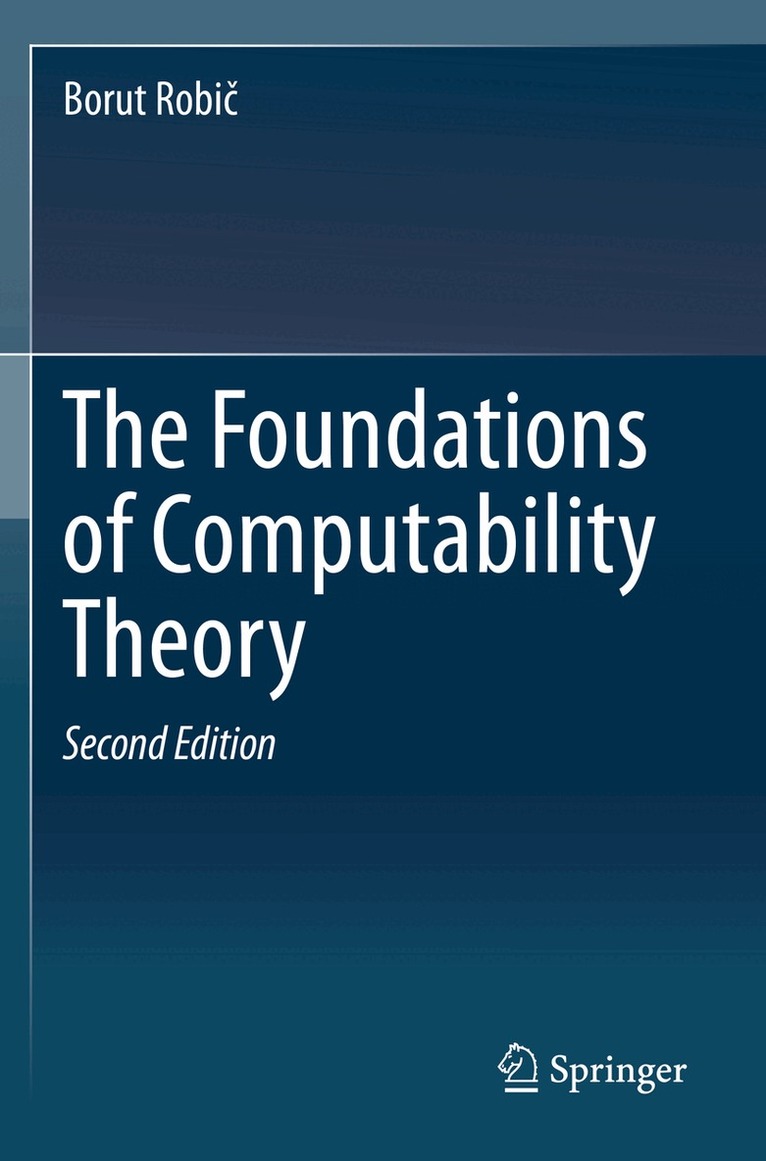
    Foundations of Computability Theory

    AvBorut Robič

    Häftad, Engelska, 2021

    757 kr

    Beställningsvara. Skickas inom 10-15 vardagar. Fri frakt över 249 kr.

    Fler format och utgåvor

    E-bok

    837 kr

    Inbunden

    1 078 kr

    E-bok

    947 kr

    Beskrivning

    This book offers an original and informative view of the development of fundamental concepts of computability theory. The treatment is put into historical context, emphasizing the motivation for ideas as well as their logical and formal development. In Part I the author introduces computability theory, with chapters on the foundational crisis of mathematics in the early twentieth century, and formalism. In Part II he explains classical computability theory, with chapters on the quest for formalization, the Turing Machine, and early successes such as defining incomputable problems, c.e. (computably enumerable) sets, and developing methods for proving incomputability. In Part III he explains relative computability, with chapters on computation with external help, degrees of unsolvability, the Turing hierarchy of unsolvability, the class of degrees of unsolvability, c.e. degrees and the priority method, and the arithmetical hierarchy. Finally, in the new Part IV the author revisits thecomputability (Church-Turing) thesis in greater detail. He offers a systematic and detailed account of its origins, evolution, and meaning, he describes more powerful, modern versions of the thesis, and he discusses recent speculative proposals for new computing paradigms such as hypercomputing. This is a gentle introduction from the origins of computability theory up to current research, and it will be of value as a textbook and guide for advanced undergraduate and graduate students and researchers in the domains of computability theory and theoretical computer science.This new edition is completely revised, with almost one hundred pages of new material. In particular the author applied more up-to-date, more consistent terminology, and he addressed some notational redundancies and minor errors. He developed a glossary relating to computability theory, expanded the bibliographic references with new entries, and added the new part described above and other new sections.

    Produktinformation

    • Utgivningsdatum:2021-11-14
    • Mått:155 x 235 x 24 mm
    • Vikt:668 g
    • Format:Häftad
    • Språk:Engelska
    • Antal sidor:422
    • Upplaga:2
    • Förlag:Springer-Verlag Berlin and Heidelberg GmbH & Co. KG
    • ISBN:9783662624234

    Utforska kategorier

    • Systemvetenskap och AI inom Data och IT
    • Teknik: allmänt inom Naturvetenskap och teknik
    • Matematikens grunder inom Naturvetenskap och teknik

    Mer om författaren

    Prof. Borut Robič received his Ph.D. in Computer Science from the University of Ljubljana in 1993. He is a member of the Faculty of Computer and Information Science of the University of Ljubljana where he leads the Laboratory for Algorithms and Data Structures. He has had guest professorships, fellowships and collaborations with the University of Cambridge, the University of Augsburg, the University of Grenoble, and the Jožef Stefan Institute in Ljubljana. His research interests and teaching experience address algorithms; computability and computational complexity theory; parallel, distributed and grid computing; operating systems; and processor architectures. In addition to the 1st ed. of the current book, Prof. Robič coauthored the books "Processor Architecture: From Dataflow to Superscalar and Beyond" (Springer 1999) and "Introduction to Parallel Computing: From Algorithms to Programming on State-of-the-Art Platforms" (Springer 2018).

    Innehållsförteckning

    • Part I, The Roots of Computability Theory.- Introduction.- The Foundational Crisis of Mathematics.- Formalism.- Hilbert’s Attempt at Recovery.- Part II, Classicial Computability Theory.- The Quest for a Formalization.- The Turing Machine.- The First Basic Results.- Incomputable Problems.- Methods of Proving Incomputability.- Part III, Relative Computability.- Computation with External Help.- Degrees of Unsolvability.- The Turing Hierarchy of Unsolvability.- The Class D of Degrees of Unsolvability.- C.E. Degrees and the Priority Method.- The Arithmetical Hierarchy.- Part IV, Back to the Roots.- Computability (Church-Turing) Thesis Revisited.- Further Reading.- App. A, Mathematical Background.- App. B, Notation Index.- Glossary.- References.- Index.