• Fri frakt över 249 kr
  • •
  • Snabba leveranser
  • •
  • Billiga böcker
Kundservice

Du är på sajten för privatpersoner.

Företag, bibliotek eller offentlig verksamhet?

Du handlar på classic.bokus.com, där alla dina funktioner finns intakta.
Till classic.bokus.com
Bokus logotyp. Gå till startsidan.
  • Erbjudanden
  • Student
  • Topplistor
  • Barn & ungdom
  • Bokus Play
  • E-böcker
  • Ljudböcker
  • Pocketböcker
  • Spel och pussel

Pocketfynda! Hundratals böcker för 49 kr/st →

Sidfot

Mina sidor

    Hjälp

    • Kundservice
    • Vanliga frågor och svar
    • Frakt och leverans
    • Retur vid ångerrätt
    • Reklamera vara
    • Betalning
    • Köpvillkor
    • Allmänna villkor
    • Information om webbplatsens tillgänglighet

    Om Bokus

    • Om oss
    • Pressrum
    • För studenter
    • För företag
    • För bibliotek och offentlig verksamhet
    • För leverantörer
    • Hållbarhet

    Populärt

    • Aktuella erbjudanden
    • Presentkort
    • Studentlitteratur
    • Nya böcker
    • Topplistor
    • Signerade böcker
    • Engelska böcker

    Inspiration

    • Boktips
    • BookTok
    • Barnbokskaraktärer
    • Populära författare
    Logotyp för Bokus
    Följ oss på Facebook (extern länk)Följ oss på Instagram (extern länk)Följ oss på YouTube (extern länk)Följ oss på TikTok (extern länk)
    bokus @ CookiesAnpassa cookiesIntegritetspolicyKöpvillkor
    Till Citymail hemsida (extern länk)Till Budbee hemsida (extern länk)Till Postnord hemsida (extern länk)Till Schenker hemsida (extern länk)Till Early Bird hemsida (extern länk)Till Walleys hemsida (extern länk)
    1. Medicin
    2. Andra medicinska specialiteter
    3. Farmakologi

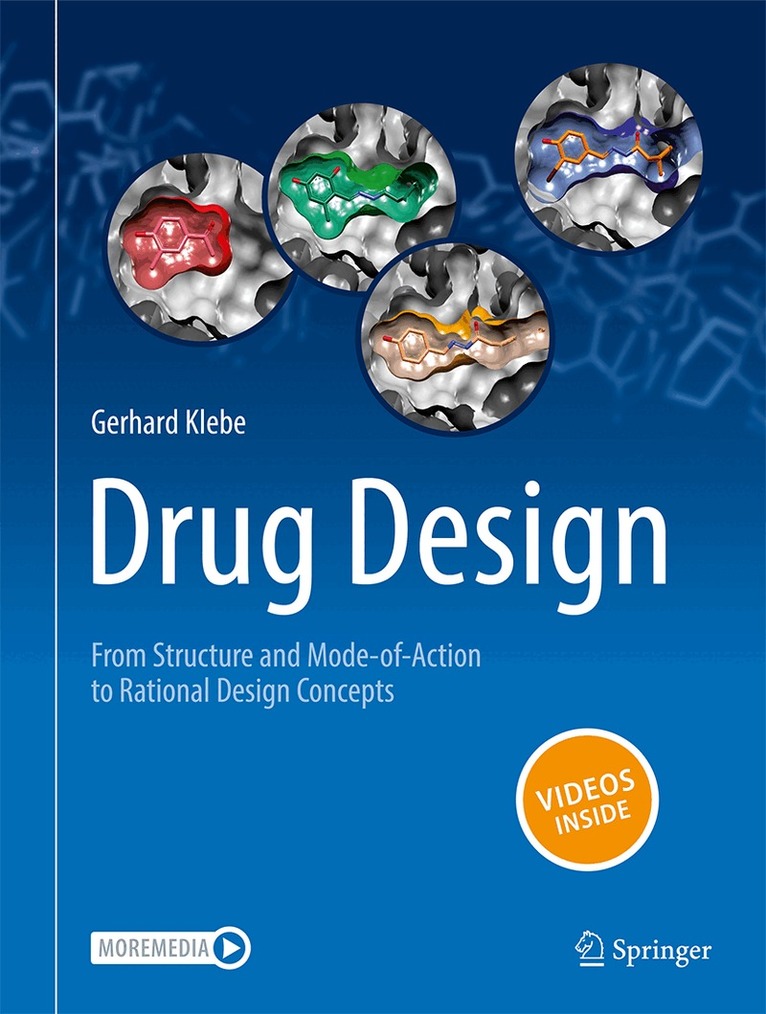
    Drug Design

    From Structure and Mode-of-Action to Rational Design Concepts

    AvGerhard Klebe

    Inbunden, Engelska, 2025

    890 kr

    Beställningsvara. Skickas inom 5-8 vardagar. Fri frakt över 249 kr.

    Fler format och utgåvor

    Inbunden

    9 934 kr

    E-bok

    1 138 kr

    Beskrivning

    This English-language textbook, based on the successful German edition 'Wirkstoffdesign', brings the subject of drug design back to the cutting edge of research. The reader learns about new methods in genetic engineering and the expanded range of structural biological methods. Especially in the last 10 years, many complex target structures such as G-protein coupled receptors or ion channels have been elucidated by using these methods. The reader learns how these long-sought complex structures with classical drugs look like and how the therapeutic effect is achieved.This textbook is aimed at students of pharmacy, chemistry and the life sciences, but also at career changers and medicinal chemists in research and development departments of the pharmaceutical industry. Conceptually, it is very different from classical textbooks on pharmaceutical chemistry. It focuses on the path to a new drug substance. The selection of case studies is based on didactic aspects and attempts to give a broad overview of methods and strategies without forgetting to look back at the beginnings of this field of work. Thus, the arc spans from the history of drug research, the mechanisms of action of drugs and the methods for lead structure search and optimisation to structure determination methods, modelling, molecular dynamics and QSAR methods to structure- and computer-aided design.This textbook also discusses new methods and concepts such as epigenetics, the PROTAC approach, CRISPR-Cas9 gene scissors, structural predictions from sequence, the use of artificial intelligence and new screening technologies from biophysics. It presents successes in disrupting or enhancing protein-protein interactions as a concept for drug therapy and discusses optimising drugs considering their thermodynamic as well as kinetic binding profiles .Videos via app: simply download the SN More Media app free of charge, scan a link with the play button and immediately play the video on your smartphone or tablet.

    Produktinformation

    • Utgivningsdatum:2025-02-05
    • Mått:210 x 279 x 42 mm
    • Vikt:2 176 g
    • Format:Inbunden
    • Språk:Engelska
    • Antal sidor:686
    • Förlag:Springer-Verlag Berlin and Heidelberg GmbH & Co. KG
    • ISBN:9783662689974
    • Originaltitel:Wirkstoffdesign: Entwurf und Wirkung von Arzneistoffen

    Utforska kategorier

    • Farmakologi inom Medicin
    • Kemi inom Naturvetenskap och teknik
    • Tillverkningsteknik inom Naturvetenskap och teknik

    Mer om författaren

    Gerhard Klebe is Professor of Pharmaceutical Chemistry at Philipps-Universität Marburg. He retired in April 2020. His research focuses on structure-activity relationships, 3D-QSAR methods, conformational and pharmacophore analyses, docking methods, database analyses, protein crystallography, structure-based drug design and the biophysical characterisation of protein-ligand interactions. Before his appointment in Marburg, he taught at the University of Heidelberg and worked in the main laboratory of BASF AG in Ludwigshafen in the field of drug design and crystallography.

    Innehållsförteckning

    • Preface.- Introduction.- Part I Fundamentals of drug research.- 1 Drug research yesterday, today, tomorrow.- 2 In the beginning there was serendipity.- 3 Examples of classical drug research.- 4 Protein-ligand interactions as the basis of drug action.- 5 Optical activity and biological action.- Part II The search for lead structure.- 6 The classical search for lead structure.- 7 Screening technologies for lead structure search.- 8 The optimisation of lead structure.- 9 The design of prodrugs.- 10 Peptidomimetics. 6 The classical search for lead structure.- 7 Screening technologies for lead structure search.- 8 Lead structure optimisation.- 9 Design of prodrugs.- 10 Peptidomimetics.Part III Experimental and theoretical methods.- 11 Combinatorics: chemistry with large numbers.- 12 Genetic engineering in drug discovery.- 13 Experimental methods for structure elucidation.- 14 Description of the structure of biomolecules.- 15 Molecular modelling.- 16 Conformational analysis.- Part IV Quantitative structure-activity relationships and design methods.- 17 Pharmacophore hypotheses, molecular comparisons and database searches.- 18 Quantitative structure-activity relationships.- 19 From in vitro to in vivo: optimising ADME tox properties.- 20 Protein modelling and structure-based drug design.- 21 An example: structure-based design of inhibitors of tRNA-guanine transglycosylase.- Part V Successes in rational drug design.- 22 How drugs work: targets for therapy.- 23 Inhibitors for hydrolases with acyl enzyme intermediates.- 24 Inhibitors of aspartyl proteases.- 25 Inhibitors of hydrolytically cleaving metalloenzymes.- 26 Inhibitors for transferases.- 27 Inhibitors for oxidoreductases.- 28 Agonists and antagonists for nuclear receptors.- 29 Agonists and antagonists of membrane receptors.- 30 Ligands for channels, pores and transporters.- 31 Ligands for surface receptors.- 32 Biopharmaceuticals: peptides, proteins, nucleotides and macrolides as active substances.