• Fri frakt över 249 kr
  • •
  • Snabba leveranser
  • •
  • Billiga böcker
Kundservice

Du är på sajten för privatpersoner.

Företag, bibliotek eller offentlig verksamhet?

Du handlar på classic.bokus.com, där alla dina funktioner finns intakta.
Till classic.bokus.com
Bokus logotyp. Gå till startsidan.
  • Erbjudanden
  • Student
  • Topplistor
  • Barn & ungdom
  • Bokus Play
  • E-böcker
  • Ljudböcker
  • Pocketböcker
  • Spel och pussel

Upp till 25% på utvalda nyheter →

Sidfot

Mina sidor

    Hjälp

    • Kundservice
    • Vanliga frågor och svar
    • Frakt och leverans
    • Retur vid ångerrätt
    • Reklamera vara
    • Betalning
    • Köpvillkor
    • Allmänna villkor
    • Information om webbplatsens tillgänglighet

    Om Bokus

    • Om oss
    • Pressrum
    • För studenter
    • För företag
    • För bibliotek och offentlig verksamhet
    • För leverantörer
    • Hållbarhet

    Populärt

    • Aktuella erbjudanden
    • Presentkort
    • Studentlitteratur
    • Nya böcker
    • Topplistor
    • Signerade böcker
    • Engelska böcker

    Inspiration

    • Boktips
    • BookTok
    • Barnbokskaraktärer
    • Populära författare
    Logotyp för Bokus
    Följ oss på Facebook (extern länk)Följ oss på Instagram (extern länk)Följ oss på YouTube (extern länk)Följ oss på TikTok (extern länk)
    bokus @ CookiesAnpassa cookiesIntegritetspolicyKöpvillkor
    Till Citymail hemsida (extern länk)Till Budbee hemsida (extern länk)Till Postnord hemsida (extern länk)Till Schenker hemsida (extern länk)Till Early Bird hemsida (extern länk)Till Walleys hemsida (extern länk)
    1. Data och IT
    2. Systemvetenskap och AI
    3. Artificiell intelligens

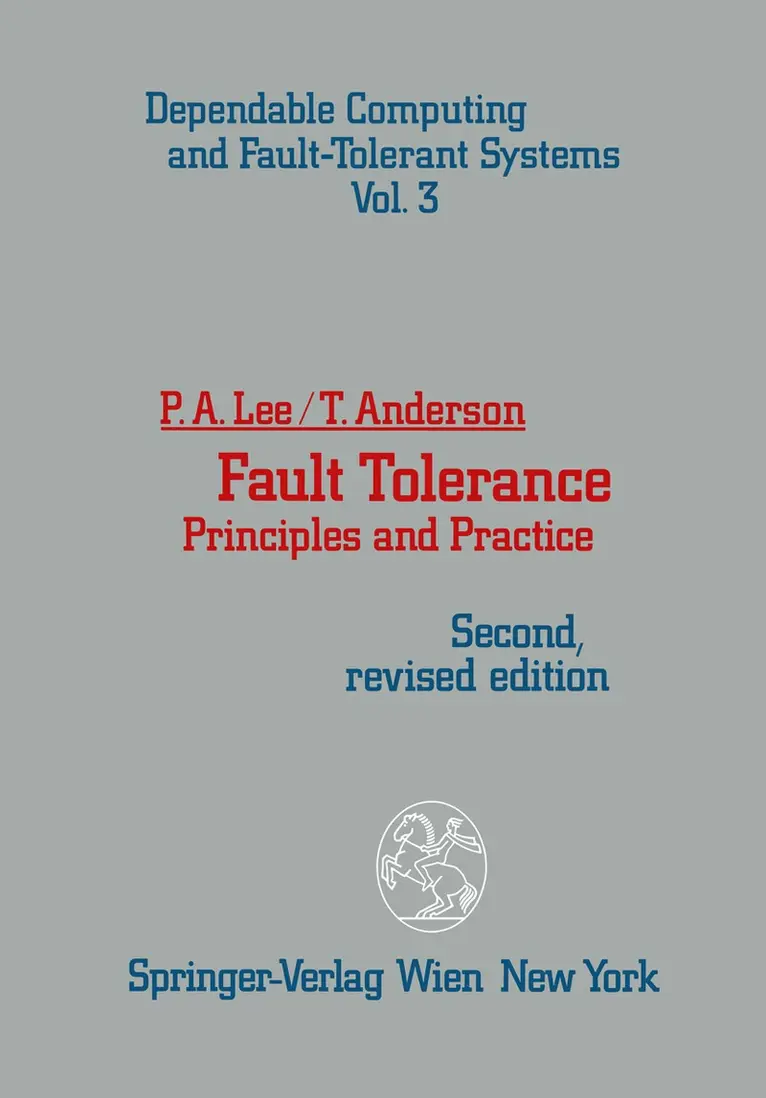
    Fault Tolerance

    Principles and Practice

    AvPeter A. Lee,Thomas Anderson

    Häftad, Engelska, 2012

    Del 3 i serien Dependable Computing and Fault-Tolerant Systems

    561 kr

    Beställningsvara. Skickas inom 10-15 vardagar. Fri frakt över 249 kr.

    Beskrivning

    The production of a new version of any book is a daunting task, as many authors will recognise. In the field of computer science, the task is made even more daunting by the speed with which the subject and its supporting technology move forward. Since the publication of the first edition of this book in 1981 much research has been conducted, and many papers have been written, on the subject of fault tolerance. Our aim then was to present for the first time the principles of fault tolerance together with current practice to illustrate those principles. We believe that the principles have (so far) stood the test of time and are as appropriate today as they were in 1981. Much work on the practical applications of fault tolerance has been undertaken, and techniques have been developed for ever more complex situations, such as those required for distributed systems. Nevertheless, the basic principles remain the same.

    Produktinformation

    • Utgivningsdatum:2012-01-07
    • Mått:170 x 244 x 19 mm
    • Vikt:588 g
    • Format:Häftad
    • Språk:Engelska
    • Serie:Dependable Computing and Fault-Tolerant Systems
    • Antal sidor:320
    • Upplaga:2
    • Förlag:Springer Verlag GmbH
    • ISBN:9783709189924

    Utforska kategorier

    • Artificiell intelligens inom Data och IT
    • Hårdvara inom Data och IT

    Innehållsförteckning

    • 1 Introduction.- Fault Prevention and Fault Tolerance.- Anticipated and Unanticipated Faults.- Book Aim.- References.- 2 System Structure and Dependability.- System Structure.- System Dependability and Reliability.- Summary.- References.- 3 Fault Tolerance.- Fault Tolerance: How.- Fault Tolerance: Where and How Much.- An Implementation Framework.- References.- 4 Fault Tolerant Systems.- ESS No. lA.- SIFT and Ftmp.- Tandem.- Stratus.- References.- 5 Error Detection.- Measures for Error Detection.- Mechanisms for Error Detection.- Structuring Error Detection in Systems.- References.- 6 Damage Confinement and Assessment.- Damage Confinement.- Measures for Damage Confinement.- Measures for Damage Assessment.- Mechanisms for Damage Confinement.- Mechanisms for Damage Assessment.- Summary.- References.- 7 Error Recovery.- Concepts of Error Recovery.- Measures for Forward Error Recovery.- Backward Error Recovery.- Recovery in Concurrent Systems.- Recovery in Idealised Fault Tolerant Components.- Summary.- References.- 8 Fault Treatment and Continued Service.- Fault Location.- System Repair.- Resuming Normal Service.- Idealised Fault Tolerant Components.- Summary.- References.- 9 Software Fault Tolerance.- The Recovery Block Scheme.- The N-Version Programming Scheme.- Summary.- References.- 10 Conclusion.- Methodology and Framework for Fault Tolerance.- The Future.- References.- References.- Annotated Bibliography.- Multiple Sources.- Fault Tolerant Systems.- August Systems.- COMTRAC.- COPRA.- C.vmp.- ESS Systems (Bell Laboratories).- Fault Tolerant Multiprocessor (FTMP).- Fault Tolerant Spaceborne Computer (FTSC).- IBM 9020.- JPL-STAR Computer.- MARS.- Plessey System 250.- Pluribus.- PRIME.- Sequoia.- Software Implemented Fault Tolerance (SIFT).- Space Shuttle Computer Complex.- Stratus.- Tandem.- VOTRICS.- Software Fault Tolerance.- Multiple Source.- Recovery Blocks.- N-Version Programming.- Other Software Fault Tolerance Papers.- Exception Handling.