• Fri frakt över 249 kr
  • •
  • Snabba leveranser
  • •
  • Billiga böcker
Kundservice

Du är på sajten för privatpersoner.

Företag, bibliotek eller offentlig verksamhet?

Du handlar på classic.bokus.com, där alla dina funktioner finns intakta.
Till classic.bokus.com
Bokus logotyp. Gå till startsidan.
  • Erbjudanden
  • Nyheter
  • Student
  • Topplistor
  • Barn & ungdom
  • Bokus Play
  • E-böcker
  • Pocketböcker
  • Spel & pussel

10% rabatt på allt med kod: NYSTART10 →

Sidfot

Mina sidor

    Hjälp

    • Kundservice
    • Vanliga frågor och svar
    • Frakt och leverans
    • Retur vid ångerrätt
    • Reklamera vara
    • Betalning
    • Köpvillkor
    • Allmänna villkor
    • Information om webbplatsens tillgänglighet

    Om Bokus

    • Om oss
    • Pressrum
    • För studenter
    • För företag
    • För bibliotek och offentlig verksamhet
    • För leverantörer
    • Hållbarhet

    Populärt

    • Aktuella erbjudanden
    • Presentkort
    • Studentlitteratur
    • Nya böcker
    • Topplistor
    • Signerade böcker
    • Engelska böcker

    Inspiration

    • Boktips
    • BookTok
    • Populära bokserier
    • Barnbokskaraktärer
    • Populära författare
    Logotyp för Bokus
    Följ oss på Facebook (extern länk)Följ oss på Instagram (extern länk)Följ oss på YouTube (extern länk)Följ oss på TikTok (extern länk)
    bokus @ CookiesAnpassa cookiesIntegritetspolicyKöpvillkor
    Till Citymail hemsida (extern länk)Till Budbee hemsida (extern länk)Till Postnord hemsida (extern länk)Till Schenker hemsida (extern länk)Till Early Bird hemsida (extern länk)Till Walleys hemsida (extern länk)
    1. Naturvetenskap och teknik
    2. Matematik och naturvetenskap
    3. Matematik
    4. Tillämpad matematik

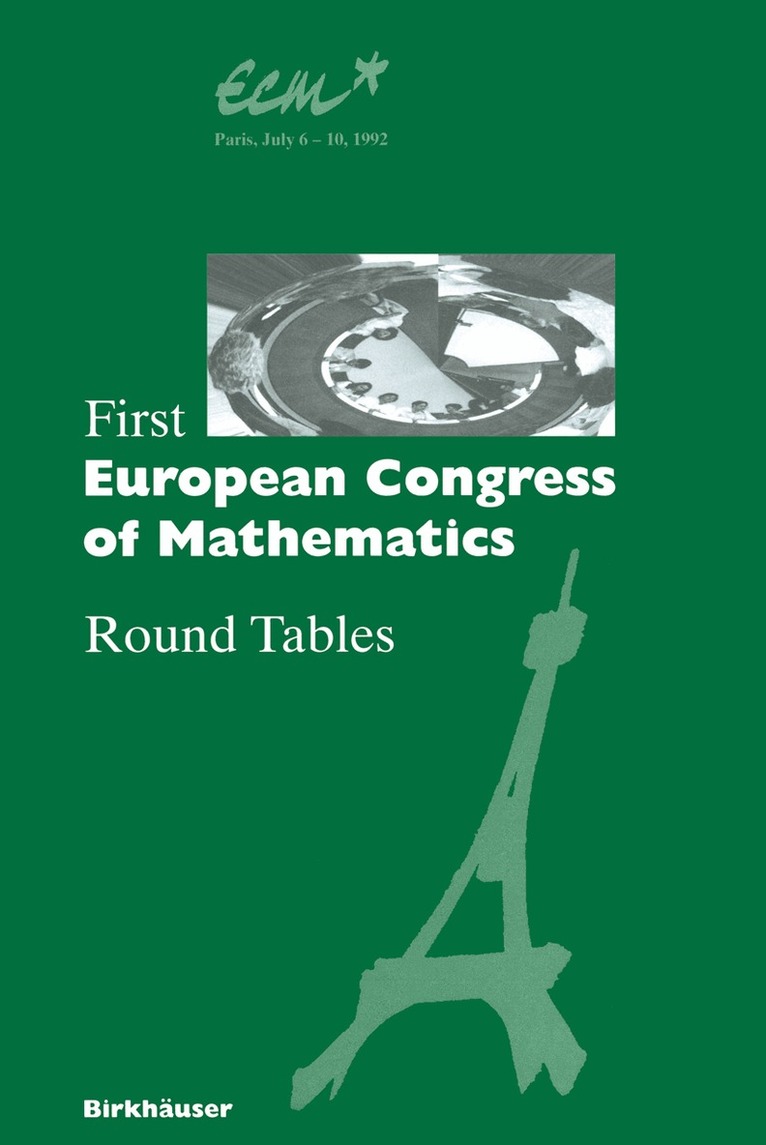
    First European Congress of Mathematics

    Paris, July 6–10, 1992 Round Tables

    AvAnthony Joseph,Fulbert Mignot

    Inbunden, Engelska, 1994

    Del 121 i serien Progress in Mathematics

    1 410 kr

    Beställningsvara. Skickas inom 10-15 vardagar. Fri frakt över 249 kr.

    Beskrivning

    The first European Congress of Mathematics was held in Paris from July 6 to July 10, 1992, at the Sorbonne and Pantheon-Sorbonne universities. It was hoped that the Congress would constitute a symbol of the development of the community of European nations. More than 1,300 persons attended the Congress. The purpose of the Congress was twofold. On the one hand, there was a scientific facet which consisted of forty-nine invited mathematical lectures that were intended to establish the state of the art in the various branches of pure and applied mathematics. This scientific facet also included poster sessions where participants had the opportunity of presenting their work. Furthermore, twenty­ four specialized meetings were held before and after the Congress. The second facet of the Congress was more original. It consisted of sixteen round tables whose aim was to review the prospects for the interactions of mathe­ matics, not only with other sciences, but also with society and in particular with education, European policy and industry. In connection with this second goal, the Congress also succeeded in bringing mathematics to a broader public. In addition to the round tables specifically devoted to this question, there was a mini-festival of mathematical films and two mathematical exhibits. Moreover, a Junior Mathematical Congress was organized, in parallel with the Congress, which brought together two hundred high school students.


    Produktinformation

    • Utgivningsdatum:1994-08-01
    • Mått:155 x 235 x 38 mm
    • Vikt:1 074 g
    • Format:Inbunden
    • Språk:Engelska
    • Serie:Progress in Mathematics
    • Antal sidor:574
    • Upplaga:1994
    • Förlag:Birkhauser Verlag AG
    • ISBN:9783764328009

    Utforska kategorier

    • Tillämpad matematik inom Naturvetenskap och teknik
    • Matematikens filosofi inom Naturvetenskap och teknik

    Innehållsförteckning

    • Table of Contents of Volume III.- Round Table A: Mathematics and the General Public.- Appendix: Replies to a Questionnaire.- Round Table B: Women and Mathematics.- Round Table C: Mathematics and Educational Policy.- Mathematics in the School Curricula in Flemish Speaking Belgium.- Mathematics in the French Educational System.- The Role of Mathematics in Educational Policies in Germany.- Italy: Mathematics in Higher Education.- Mathematics and Educational Policy (United Kingdom).- Round Table D: Let’s Cultivate Mathematics!.- Introductory Remarks.- Institutional Dimension in the Definition of Cultural Strategies in Mathematics.- Television Mathematics: Cultivation or Distortion?.- Mathematicians and the Need for Critical Self-Reflection.- Mathematics in its Historical Context.- Ecology of Mathematical Knowledge: An Alternative Vision of the Popularization of Mathematics.- Round Table E: Mathematical Europe, Myth or Historical Reality?.- The Creation of (the History of) Algebra.- The Perenniality of Programmes.- Mathematical Europe from Outside Europe.- At the Beginning of our World: The Nineteenth Century.- Centers and Peripheries.- Conclusions.- Round Table F: Philosophie des mathématiques: pourquoi? comment?.- Formes, opérations, objets en mathématiques et en philosophic.- Le platonisme transcendantal et le probléme de l’objectivité.- Reflexions on Formalism and Reductionism in Logic and Computer Science.- Pourquoi les mathématiques sont-elles difficiles?.- Le geste bien plutôt que la règle.- Discussion.- Round Table G: Mathématiques et sciences sociales.- au débat.- On the Use of Mathematics in Social Sciences: Some Remarks.- La sociologie face à la mathématisation.- Round Table H: Mathematics and Industry.- Round Table I: Degree Harmonization andStudent Exchange Programmes.- Round Table J: The Pythagoras Programme A European Policy for Mathematics.- Round Table K: Collaboration with Developing Countries.- Appendix I: Contributions made by Mathematical Societies.- Appendix II: Individual Reports.- Appendix III: Centers in Collaboration.- Round Table L: Mathematical Libraries in Europe.- Financing of the Libraries.- The Situation of Libraries in Russia.- The Situation of Libraries in Poland.- The Financial Situation of Mathematical Libraries in Hungary.- Scientific Publishing and Problems of Documentation.- Documentary Inflation and the Rising Cost of Journals.- New Technologies and Computerization.- Computerization of Spanish Libraries.- The French Experience and Norms.- Appendix 1: Results of the Questionnaire.- Appendix 2: Statistical Data.- Appendix 3: Manufacturing Costs.- Appendix 4: Electronic Publishing: A Few Remarks.- Questionnaire.- Round Table M: Mathematics and Economics.- Round Table O: Mathématiques et chimie.- Mathématiques et modélisation en dynamique chimique.- Mathématiques et science des matériaux.- Knowledge Acquisition in Chemistry.- Mathematical Methods for Determining Crystal Structure.- La théorie des groupes en chimie.- Mathématiques et chimie quantique.- Mathématiques et chimie en recherche pharmaceutique.- Two Global Methods for Molecular Geometry Optimization.- Géométrie fractale et équations différentielles d’ordre non entier en chimie physique.- Round Table P: Mathematics in Medicine and Biology.- Medical Statistics: an Example from Diabetes Epidemiology.- Point Process Approach of Life Histories: Causal Chains.- Two Signal Cell Activation Explored with Simple Mathematics.- A Theory of the Functional Organization of Biological Systems Applied to Neural Networks.-Stochastic Vistas to the Analysis of Physical Mapping of the Genome.- Rhythms and Chaos in Biological Systems.- Discussion and conclusions.- Index of Authors of Volume III.