• Fri frakt över 249 kr
  • •
  • Snabba leveranser
  • •
  • Billiga böcker
Kundservice

Du är på sajten för privatpersoner.

Företag, bibliotek eller offentlig verksamhet?

Du handlar på classic.bokus.com, där alla dina funktioner finns intakta.
Till classic.bokus.com
Bokus logotyp. Gå till startsidan.
  • Erbjudanden
  • Nyheter
  • Student
  • Topplistor
  • Barn & ungdom
  • Bokus Play
  • E-böcker
  • Pocketböcker
  • Spel & pussel

10% rabatt på allt med kod NYSTART10 →

Sidfot

Mina sidor

    Hjälp

    • Kundservice
    • Vanliga frågor och svar
    • Frakt och leverans
    • Retur vid ångerrätt
    • Reklamera vara
    • Betalning
    • Köpvillkor
    • Allmänna villkor
    • Information om webbplatsens tillgänglighet

    Om Bokus

    • Om oss
    • Pressrum
    • För studenter
    • För företag
    • För bibliotek och offentlig verksamhet
    • För leverantörer
    • Hållbarhet

    Populärt

    • Aktuella erbjudanden
    • Presentkort
    • Studentlitteratur
    • Nya böcker
    • Topplistor
    • Signerade böcker
    • Engelska böcker

    Inspiration

    • Boktips
    • BookTok
    • Populära bokserier
    • Barnbokskaraktärer
    • Populära författare
    Logotyp för Bokus
    Följ oss på Facebook (extern länk)Följ oss på Instagram (extern länk)Följ oss på YouTube (extern länk)Följ oss på TikTok (extern länk)
    bokus @ CookiesAnpassa cookiesIntegritetspolicyKöpvillkor
    Till Citymail hemsida (extern länk)Till Budbee hemsida (extern länk)Till Postnord hemsida (extern länk)Till Schenker hemsida (extern länk)Till Early Bird hemsida (extern länk)Till Walleys hemsida (extern länk)
    1. Naturvetenskap och teknik
    2. Matematik och naturvetenskap
    3. Biologi

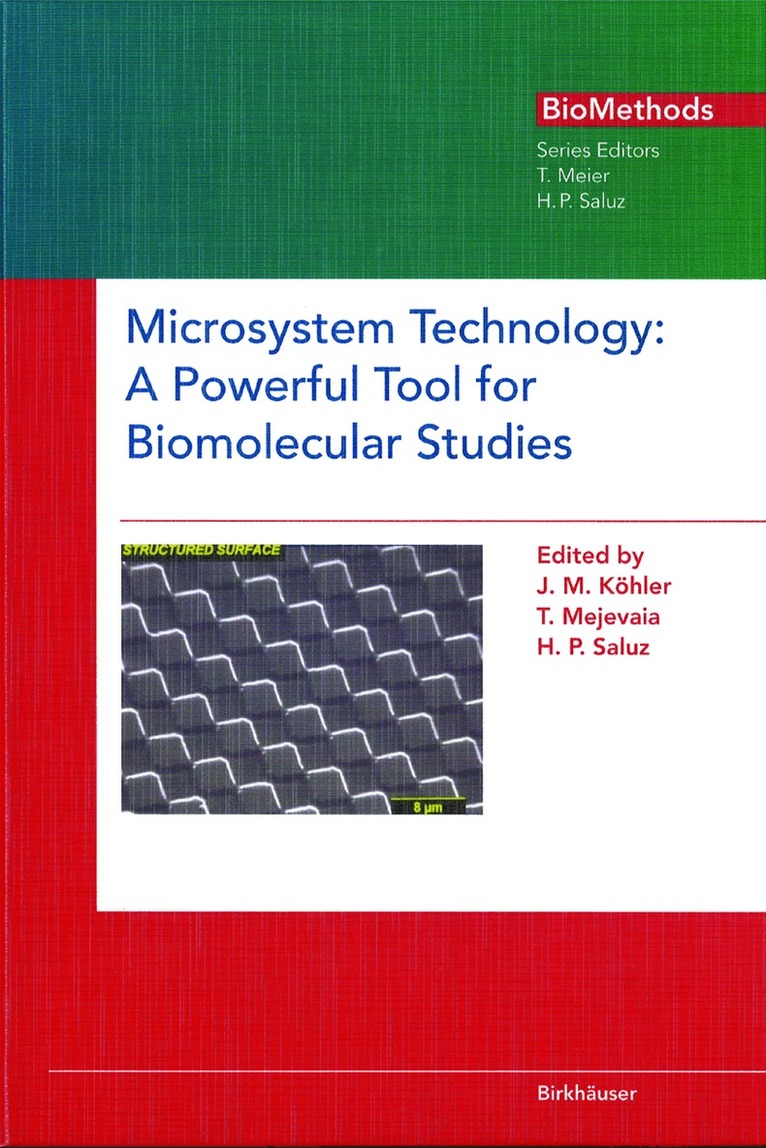
    Microsystem Technology

    A Powerful Tool for Biomolecular Studies

    AvHans-Peter Saluz,M. Köhler

    Inbunden, Engelska, 1999

    Del i serien Biomethods

    1 086 kr

    Beställningsvara. Skickas inom 10-15 vardagar. Fri frakt över 249 kr.

    Beskrivning

    Biomolecular studies are the trial of Man to understand how Nature manages information at the molecular level. The understanding of molecular informa­ tion handling in nature is essential for the molecular optimization in chem­ istry, molecular biology, molecular pharmacology and therefore - as an ex­ ample - for the development of specifically acting drugs. The famous recent method of technical information management is digital electronics. Over the past few years, evidence has arisen that computerized and molecular information managements have many similar and overlapping aspects. For example, both technology and nature use digitized information and both use small structures for the efficient handling of information. Furthermore, they optimize their processes in order to gain a maximum of information with a minimum of invested energy. During the last two decades, novel experimental techniques in biomolec­ ular sciences have paved the way for artificial biomolecular optimization. In the same time interval, the progress of micro system technology has been extended from the field of digital electronics and sensing to micro liquid hand­ ling, and the field of chip-supported substance handling began. It appears that the "marriage" of physical micro technology and molecular processing will be consummated soon. The contact of both fields has been realized in for ex­ ample DNA chips. Such connections will also become relevant in additional fields in the near future. Biomolecular investigations are the first to profit from these fast growing scientific and technical connections between micro systems and molecular sciences.

    Produktinformation

    • Utgivningsdatum:1999-06-01
    • Mått:170 x 244 x 38 mm
    • Vikt:1 216 g
    • Format:Inbunden
    • Språk:Engelska
    • Serie:Biomethods
    • Antal sidor:581
    • Upplaga:1999
    • Förlag:Birkhauser Verlag AG
    • ISBN:9783764357740

    Utforska kategorier

    • Biologi inom Naturvetenskap och teknik
    • Biokemisk teknik inom Naturvetenskap och teknik

    Innehållsförteckning

    • 1 Molecular building principles in nature.- 2 Robotic equipment and microsystem technology in biological research.- 3 Components and systems for microliquid handling.- 4 Nanotiterplates for screening and synthesis.- 5 Chip technology for micro-separation.- 6 Rapid multisample PCR in miniaturized ultrathin-walled microwell plates.- 7 Generation of large libraries.- 8 Generation and screening of solution-phase synthetic peptide combinatorial libraries.- 9 Using oligonucleotide probe arrays to access genetic diversity.- 10 Generation of libraries by print technologies.- 11 Synthesis and screening of bead-based libraries.- 12 Sensors for biomolecular studies.- 13 Fluorescence detection of single molecules applicable to small volume assays.- 14 Fluorescence correlation spectrometry (FCS): Measuring biological interactions in microstructures.- 15 Scanning force microscopy: A microstructured device for imaging, probing, and manipulation of biomolecules at the nanometer scale.- 16 DNA resequencing, mutation detection and gene expression analysis of oligonucleotide microchips.- 17 Miniaturized arrays for DNA analysis.- 18 Manipulation of particles, cells and liquid droplets by high frequency electric fields.- 19 Optical trapping and manipulation.- 20 Computer modeling of protein, nucleic acid, and drug structures.- 21 Optimizing structure and function relationship of nucleic acid molecules.- 22 Optimisation of molecular function.- 23 Appendix.