• Fri frakt över 249 kr
  • •
  • Snabba leveranser
  • •
  • Billiga böcker
Kundservice

Du är på sajten för privatpersoner.

Företag, bibliotek eller offentlig verksamhet?

Du handlar på classic.bokus.com, där alla dina funktioner finns intakta.
Till classic.bokus.com
Bokus logotyp. Gå till startsidan.
  • Erbjudanden
  • Nyheter
  • Student
  • Topplistor
  • Barn & ungdom
  • Bokus Play
  • E-böcker
  • Pocketböcker
  • Spel & pussel

10% rabatt på allt med kod: NYSTART10 →

Sidfot

Mina sidor

    Hjälp

    • Kundservice
    • Vanliga frågor och svar
    • Frakt och leverans
    • Retur vid ångerrätt
    • Reklamera vara
    • Betalning
    • Köpvillkor
    • Allmänna villkor
    • Information om webbplatsens tillgänglighet

    Om Bokus

    • Om oss
    • Pressrum
    • För studenter
    • För företag
    • För bibliotek och offentlig verksamhet
    • För leverantörer
    • Hållbarhet

    Populärt

    • Aktuella erbjudanden
    • Presentkort
    • Studentlitteratur
    • Nya böcker
    • Topplistor
    • Signerade böcker
    • Engelska böcker

    Inspiration

    • Boktips
    • BookTok
    • Populära bokserier
    • Barnbokskaraktärer
    • Populära författare
    Logotyp för Bokus
    Följ oss på Facebook (extern länk)Följ oss på Instagram (extern länk)Följ oss på YouTube (extern länk)Följ oss på TikTok (extern länk)
    bokus @ CookiesAnpassa cookiesIntegritetspolicyKöpvillkor
    Till Citymail hemsida (extern länk)Till Budbee hemsida (extern länk)Till Postnord hemsida (extern länk)Till Schenker hemsida (extern länk)Till Early Bird hemsida (extern länk)Till Walleys hemsida (extern länk)
    1. Ekonomi och Ledarskap
    2. Nationalekonomi

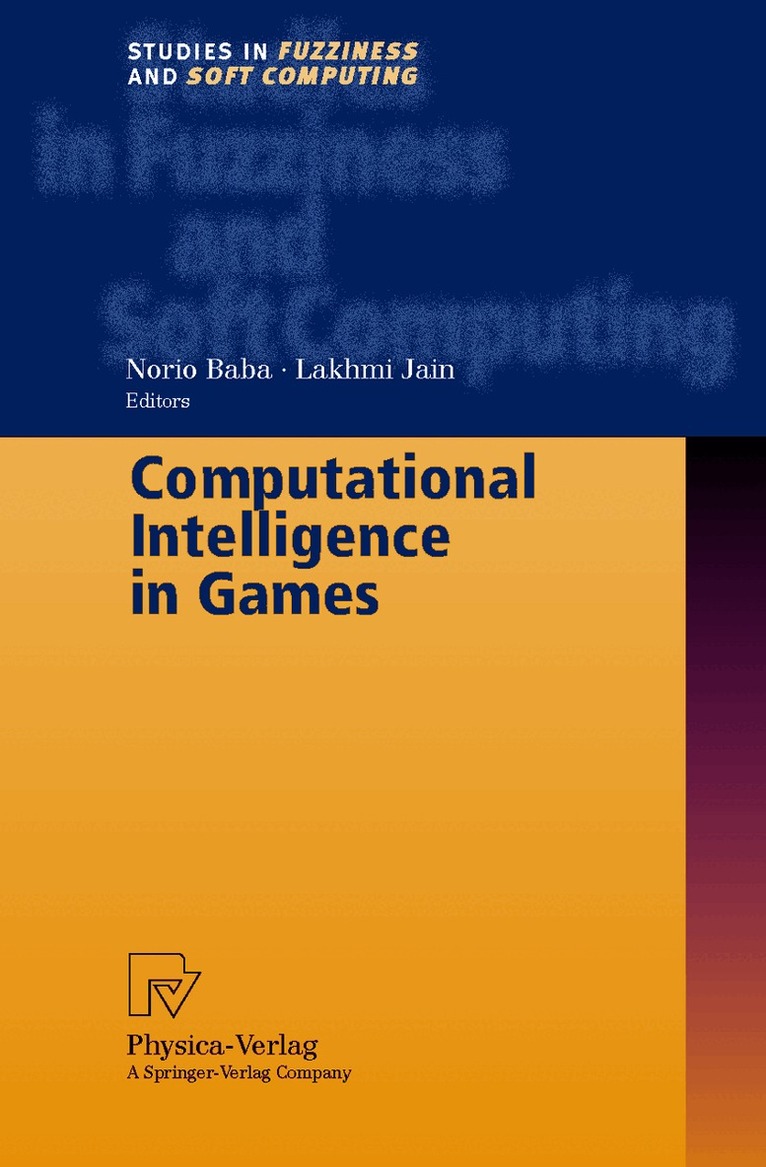
    Computational Intelligence in Games

    AvNorio Baba

    Inbunden, Engelska, 2001

    Del 62 i serien Studies in Fuzziness and Soft Computing

    1 086 kr

    Beställningsvara. Skickas inom 10-15 vardagar. Fri frakt över 249 kr.

    Beskrivning

    The most powerful computers in the world are not only used for scientific research, defence, and business, but also in game playing. Computer games are a multi-billion dollar industry. Recent advances in computational intelligence paradigms have generated tremendous interest among researchers in the theory and implementation of games. Game theory is a branch of operational research dealing with decision theory in a competitive situation. Game theory involves the mathematical calculations and heuristics to optimize the efficient lines of play. This book presents a sample of the most recent research on the application of computational intelligence techniques in games. This book contains 7 chapters. The first chapter, by Chen, Fanelli, Castellano, and Jain, is an introduction to computational intelligence paradigms. It presents the basics of the main constituents of compu­ tational intelligence paradigms including knowledge representation, probability-based approaches, fuzzy logic, neural networks, genetic algorithms, and rough sets. In the second chapter, Chellapilla and Fogel present the evolution of a neural network to play checkers without human expertise. This chapter focuses on the use of a population of neural networks, where each network serves as an evaluation function to describe the quality of the current board position. After only a little more than 800 generations, the evolutionary process has generated a neural network that can play checkers at the expert level as designated by the u.s. Chess Federation rating system. The program developed by the authors has also competed well against commercially available software.

    Produktinformation

    • Utgivningsdatum:2001-02-27
    • Mått:155 x 235 x 15 mm
    • Vikt:436 g
    • Format:Inbunden
    • Språk:Engelska
    • Serie:Studies in Fuzziness and Soft Computing
    • Antal sidor:161
    • Förlag:Springer-Verlag Berlin and Heidelberg GmbH & Co. KG
    • ISBN:9783790813487

    Utforska kategorier

    • Nationalekonomi inom Ekonomi och Ledarskap
    • Artificiell intelligens inom Data och IT
    • Maskinteknik och material inom Naturvetenskap och teknik

    Innehållsförteckning

    • 1 Introduction to computational intelligence paradigms.- 1 Introduction.- 2 Search and knowledge representation.- 3 Probability-based approaches.- 4 Fuzzy logic.- 5 Artificial neural networks.- 6 Genetic algorithms.- 7 Rough sets.- 8 Fusion.- 9 Discussion and conclusion.- References.- 2 Evolving a neural network to play checkers without human expertise.- 1 Introduction.- 2 Background on neural networks and evolutionary computation.- 3 Background on computer programs for checkers.- 4 Method and results of evolving neural networks for checkers from scratch.- 5 Discussion.- References.- Appendix: Moves for Game 1 — Anaconda vs. “Beatrice” from Hoyle’s Classic Games.- 3 Retrograde analysis of patterns versus metaprogramming.- 1 Introduction.- 2 The game of Hex and the game of Go.- 3 Retrograde analysis of patterns.- 4 Metaprogramming.- 5 Using the generated knowledge.- 6 Future work and conclusion.- References.- 4 Learning to evaluate Go positions via temporal difference methods.- 1 Introduction.- 2 Temporal difference learning.- 3 Network architecture.- 4 Training strategies.- 5 Empirical results.- 6 Summary.- References.- 5 Model-based reinforcement learning for evolving soccer strategies.- 1 Introduction.- 2 The soccer simulator.- 3 RL with CMAC models.- 4 PIPE.- 5 Experiments.- 6 Conclusion.- References.- Appendix A: Prioritized sweeping.- Appendix B: Non-pessimistic value functions.- Appendix C: Q(?)-learning.- 6 Fuzzy rule-based strategy for a market selection game.- 1 Introduction.- 2 Market selection game.- 3 Game strategies.- 4 Fuzzy rule-based strategy.- 4.1 Fuzzy Q-learning.- 4.2 Simulation results.- 4.3 Knowledge acquisition.- 5 Conclusions.- References.- List of Contributors.