• Fri frakt över 249 kr
  • •
  • Snabba leveranser
  • •
  • Billiga böcker
Kundservice

Du är på sajten för privatpersoner.

Företag, bibliotek eller offentlig verksamhet?

Du handlar på classic.bokus.com, där alla dina funktioner finns intakta.
Till classic.bokus.com
Bokus logotyp. Gå till startsidan.
  • Erbjudanden
  • Student
  • Topplistor
  • Barn & ungdom
  • Bokus Play
  • E-böcker
  • Ljudböcker
  • Pocketböcker
  • Spel och pussel

Pocketfynda! Hundratals böcker för 49 kr/st →

Sidfot

Mina sidor

    Hjälp

    • Kundservice
    • Vanliga frågor och svar
    • Frakt och leverans
    • Retur vid ångerrätt
    • Reklamera vara
    • Betalning
    • Köpvillkor
    • Allmänna villkor
    • Information om webbplatsens tillgänglighet

    Om Bokus

    • Om oss
    • Pressrum
    • För studenter
    • För företag
    • För bibliotek och offentlig verksamhet
    • För leverantörer
    • Hållbarhet

    Populärt

    • Aktuella erbjudanden
    • Presentkort
    • Studentlitteratur
    • Nya böcker
    • Topplistor
    • Signerade böcker
    • Engelska böcker

    Inspiration

    • Boktips
    • BookTok
    • Barnbokskaraktärer
    • Populära författare
    Logotyp för Bokus
    Följ oss på Facebook (extern länk)Följ oss på Instagram (extern länk)Följ oss på YouTube (extern länk)Följ oss på TikTok (extern länk)
    bokus @ CookiesAnpassa cookiesIntegritetspolicyKöpvillkor
    Till Citymail hemsida (extern länk)Till Budbee hemsida (extern länk)Till Postnord hemsida (extern länk)Till Schenker hemsida (extern länk)Till Early Bird hemsida (extern länk)Till Walleys hemsida (extern länk)
    1. Ekonomi och Ledarskap
    2. Ledarskapsböcker
    3. Ledarskap och motivation

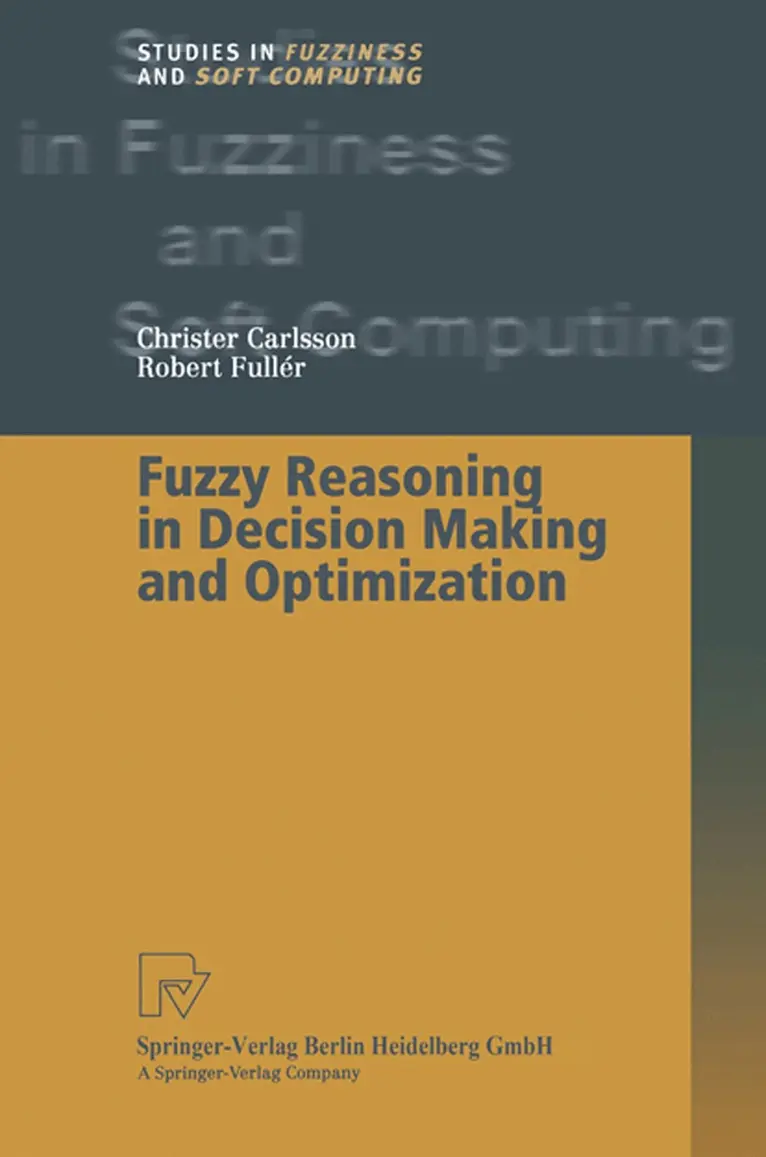
    Fuzzy Reasoning in Decision Making and Optimization

    AvChrister Carlsson,Robert Fuller

    Häftad, Engelska, 2010

    Del 82 i serien Studies in Fuzziness and Soft Computing

    1 662 kr

    Beställningsvara. Skickas inom 10-15 vardagar. Fri frakt över 249 kr.

    Fler format och utgåvor

    Inbunden

    1 613 kr

    Beskrivning

    Many decision-making tasks are too complex to be understood quantitatively, however, humans succeed by using knowledge that is imprecise rather than precise. Fuzzy logic resembles human reasoning in its use of imprecise informa­ tion to generate decisions. Unlike classical logic which requires a deep under­ standing of a system, exact equations, and precise numeric values, fuzzy logic incorporates an alternative way of thinking, which allows modeling complex systems using a higher level of abstraction originating from our knowledge and experience. Fuzzy logic allows expressing this knowledge with subjective concepts such as very big and a long time which are mapped into exact numeric ranges. Since knowledge can be expressed in a more natural by using fuzzy sets, many decision (and engineering) problems can be greatly simplified. Fuzzy logic provides an inference morphology that enables approximate human reasoning capabilities to be applied to knowledge-based systems. The theory of fuzzy logic provides a mathematical strength to capture the un­ certainties associated with human cognitive processes, such as thinking and reasoning. The conventional approaches to knowledge representation lack the means for representating the meaning of fuzzy concepts. As a consequence, the approaches based on first order logic do not provide an appropriate con­ ceptual framework for dealing with the representation of commonsense knowl­ edge, since such knowledge is by its nature both lexically imprecise and non­ categorical.

    Produktinformation

    • Utgivningsdatum:2010-10-21
    • Mått:155 x 235 x 20 mm
    • Vikt:540 g
    • Format:Häftad
    • Språk:Engelska
    • Serie:Studies in Fuzziness and Soft Computing
    • Antal sidor:338
    • Förlag:Springer-Verlag Berlin and Heidelberg GmbH & Co. KG
    • ISBN:9783790824971

    Utforska kategorier

    • Ledarskap och motivation inom Ekonomi och Ledarskap
    • Artificiell intelligens inom Data och IT
    • Företagsekonomi inom Ekonomi och Ledarskap

    Innehållsförteckning

    • 1. Fuzzy Sets and Fuzzy Logic.- 1.1 Fuzzy sets.- 1.2 Operations on fuzzy sets.- 1.3 The extension principle.- 1.4 t-norm-based operations on fuzzy numbers.- 1.5 Product-sum of triangular fuzzy numbers.- 1.6 Hamacher-sum of triangular fuzzy numbers.- 1.7 t-norm-based addition of fuzzy numbers.- 1.8 A functional relationship between t-norm-based addition and multiplication.- 1.9 On generalization of Nguyen’s theorems.- 1.10 Measures of possibility and necessity.- 1.11 A law of large numbers for fuzzy numbers.- 1.12 Metrics for fuzzy numbers.- 1.13 Possibilistic mean value and variance of fuzzy numbers.- 1.14 Auxiliary lemmas.- 1.15 Fuzzy implications.- 1.16 Linguistic variables.- 2. Fuzzy Multicriteria Decision Making.- 2.1 Averaging operators.- 2.2 Obtaining maximal entropy OWA operator weights.- 2.3 OWA Operators for Ph.D. student selection.- 2.4 Possibility and necessity in weighted aggregation.- 2.5 Benchmarking in linguistic importance weighted aggregations.- 3. Fuzzy Reasoning.- 3.1 The theory of approximate reasoning.- 3.2 Aggregation in fuzzy system modeling.- 3.3 Multiple fuzzy reasoning schemes.- 3.4 Some properties of the compositional rule of inference.- 3.5 Computation of the compositional rule of inference under t-norms.- 3.6 On the generalized method-of-case inference rule.- 4. Fuzzy Optimization.- 4.1 Possibilistic linear equality systems.- 4.2 Sensitivity analysis of ãx = b? and ã?x = b??..- 4.3 Possibilistic systems with trapezoid fuzzy numbers.- 4.4 Flexible linear programming.- 4.5 Fuzzy linear programming with crisp relations.- 4.6 Possibilistic linear programming.- 4.7 Possibilistic quadratic programming.- 4.8 Multiobjective possibilistic linear programming.- 5. Fuzzy Reasoning for Fuzzy Optimization.- 5.1 Fuzzy reasoning for FMP.- 5.2Optimization with linguistic variables.- 5.3 Multiobjective optimization with lingusitic variables.- 5.4 Interdependent multiple criteria decision making.- 5.4.1 The linear case.- 5.4.2 Application functions.- 5.5 MOP with interdependent objectives.- 5.6 Additive linear interdependences.- 5.7 Additive nonlinear interdependences.- 5.8 Compound interdependences.- 5.9 Biobjective interdependent decision problems.- 6. Applications in Management.- 6.1 Nordic Paper Inc.- 6.2 A fuzzy approach to real option valuation.- 6.3 The Woodstrat project.- 6.4 Soft computing methods for reducing the bullwhip effect.- 6.4.1 The bullwhip effect, some additional details.- 6.4.2 Explanations for the bullwhip effect: standard results.- 6.4.3 Demand signal processing.- 6.4.4 Order batching.- 6.4.5 Price variations.- 6.4.6 A fuzzy approach to demand signal processing.- 6.4.7 A fuzzy logic controller to demand signal processing.- 6.4.8 A hybrid soft computing platform for taming the bullwhip effect.- 7. Future Trends in Fuzzy Reasoning and Decision Making.- 7.1 Software agents and agent-based systems.- 7.2 Intelligence and software agents.- 7.3 Scenario agents.- 7.4 Scenarios and scenario planning: key features.- 7.5 Forecasting.- 7.6 Industry foresight.- 7.7 The scenario agent.- 7.8 Interpretation agent.- 7.9 Coping with imprecision.- 7.10 Interpretation in a business environment.- 7.11 Mental models and cognitive maps.- 7.12 A preliminary description of an interpretation agent.- 7.13 An interpretation agent: details.