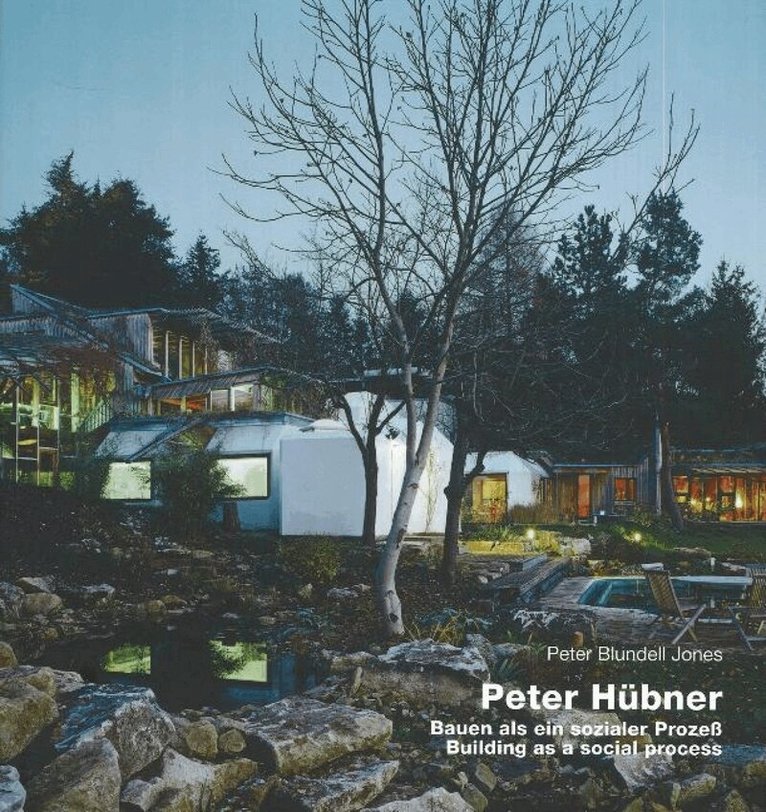
Inbunden, Engelska, Tyska, 2007
Peter Hübner
643 kr
Beställningsvara. Skickas inom 11-20 vardagar. Fri frakt över 249 kr.
Beskrivning
Text in English and German. Peter Hübner began his career as an orthopaedic shoemaker and moved on to cabinet-making before studying architecture. In the 1960s he became a successful designer of prefabricated buildings and sanitary units. This expertise gained him a chair in building construction at the University of Stuttgart where, in collaboration with fellow professor Peter Sulzer, he undertook a series of experiments that changed the course of his architecture. It began with an elaboration of the Walter Segal building method, but culminated in a student hostel designed, built and lived-in by architectural students at Stuttgart University's Vaihingen campus. Using student labour and superfluous or recycled materials it was very cheap, but it also reflected the capabilities and aspirations of its owners in a surprising and potent way, imbuing them with confidence. Hübner was struck by the importance of building as a social process, and understood that the mechanised construction he had earlier been involved in had largely taken the soul out of it. As word about the Vaihingen project got about, Hübner received requests for more cheap self-help buildings and discovered a new professional role as facilitator and ringmaster. Unable to predict how these improvised buildings would turn out, he yielded up the aesthetic control of the designer-despot in favour of experiencing the pleasure of human relationships as a project unfolds. Most new buildings are received by their users with comparative indifference, but the self-help projects engender passionate commitment, and it continues long after they are finished. People identify with the spaces they helped to determine, and naturally appropriate them. As a producer of such anarchic work, it is perhaps surprising to discover that Hübner has also long been at the forefront of CAD, but this is a natural development of systematisation, for if computers can calculate all the variants and irregularities, we need no longer conform to Ford's production line. Hübner uses three-dimensional programmes which connect design directly with production. His work also responds to ecological concerns, not only through the use of recycled and low-energy materials and in avoiding toxicity, but also in passive energy collection. All these issues are explored in the book.
Produktinformation
- Utgivningsdatum: 2007-06-01
- Mått: 310 x 285 x 31 mm
- Vikt: 2 156 g
- Format: Inbunden
- Språk: Engelska, Tyska
- Antal sidor: 358
- Förlag: Edition Axel Menges
- ISBN: 9783932565021
Utforska kategorier
Betyg & recensioner
0 recensioner
Inga recensioner tillgängliga.