• Fri frakt över 249 kr
  • •
  • Snabba leveranser
  • •
  • Billiga böcker
Kundservice

Du är på sajten för privatpersoner.

Företag, bibliotek eller offentlig verksamhet?

Du handlar på classic.bokus.com, där alla dina funktioner finns intakta.
Till classic.bokus.com
Bokus logotyp. Gå till startsidan.
  • Erbjudanden
  • Nyheter
  • Student
  • Topplistor
  • Barn & ungdom
  • Bokus Play
  • E-böcker
  • Pocketböcker
  • Spel & pussel

10% rabatt på allt med kod: NYSTART10 →

Sidfot

Mina sidor

    Hjälp

    • Kundservice
    • Vanliga frågor och svar
    • Frakt och leverans
    • Retur vid ångerrätt
    • Reklamera vara
    • Betalning
    • Köpvillkor
    • Allmänna villkor
    • Information om webbplatsens tillgänglighet

    Om Bokus

    • Om oss
    • Pressrum
    • För studenter
    • För företag
    • För bibliotek och offentlig verksamhet
    • För leverantörer
    • Hållbarhet

    Populärt

    • Aktuella erbjudanden
    • Presentkort
    • Studentlitteratur
    • Nya böcker
    • Topplistor
    • Signerade böcker
    • Engelska böcker

    Inspiration

    • Boktips
    • BookTok
    • Populära bokserier
    • Barnbokskaraktärer
    • Populära författare
    Logotyp för Bokus
    Följ oss på Facebook (extern länk)Följ oss på Instagram (extern länk)Följ oss på YouTube (extern länk)Följ oss på TikTok (extern länk)
    bokus @ CookiesAnpassa cookiesIntegritetspolicyKöpvillkor
    Till Citymail hemsida (extern länk)Till Budbee hemsida (extern länk)Till Postnord hemsida (extern länk)Till Schenker hemsida (extern länk)Till Early Bird hemsida (extern länk)Till Walleys hemsida (extern länk)
    1. Ekonomi och Ledarskap
    2. Nationalekonomi
    3. Ekonomisk historia

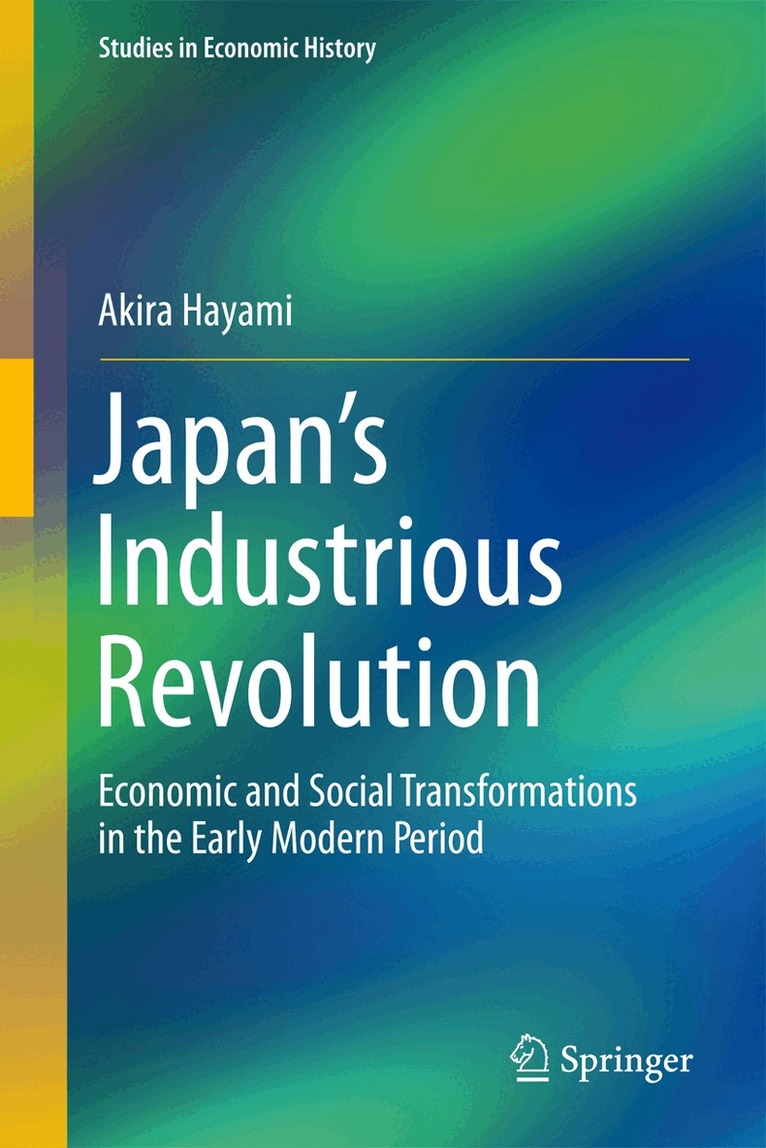
    Japan’s Industrious Revolution

    Economic and Social Transformations in the Early Modern Period

    AvAkira Hayami

    Inbunden, Engelska, 2015

    Del i serien Studies in Economic History

    563 kr

    Beställningsvara. Skickas inom 10-15 vardagar. Fri frakt över 249 kr.

    Fler format och utgåvor

    E-bok

    732 kr

    Häftad

    563 kr

    Beskrivning

    This book explains in fascinating detail how economic and social transformations in pre-1600 Japan led to an industrious revolution in the early modern period and how the fruits of the Industrious Revolution are what have supported Japan since the eighteenth century, improving living standards and leading to the formation of the work ethic of modern Japan. The arrival of the Sengoku Period in the sixteenth century saw the emergence and domination of government by the warrior class. It was Tokugawa Ieyasu who unified the realm. Yet this unity did not give rise to an autocratic state, as the shogun was recognized merely as a main pillar of the warrior class.Economically, however, from the fourteenth century, currency payments for shōen nengu (taxes paid to the proprietor) became standard, and currency circulation began, primarily in the central region. Under Tokugawa rule, organized domestic coinage of currency began, opening the way to establishing a national economic society. Also, agricultural land was surveyed through cadastral surveys known as kenchi. Land values were converted in terms of rice, so the expected rice yields for each village were assessed, and the lords used this as a benchmark for imposing taxes. In the sixteenth and seventeenth centuries, Japan experienced a “great transition,” and conditions for peasants, agriculture, and farming villages underwent great changes. Inefficient traditional agriculture using peasants in a state of servitude was transformed into highly efficient small-sized farming operations which relied on family labor. As production yields increased due to labor-intensive agriculture, the profits obtained by the peasants improved their living standards. The stem-family system became the norm through which work ethics and even literacy were transmitted. This very change was the result of the “industrious revolution” in Japan.           The book thus presents theframework of the facts of pre-industrial Japanese history and depicts pre-modern Japan from a macroscopic point of view, showing how the industrious revolution came about. It is certain to be of great interest to economists and historians alike.

    Produktinformation

    • Utgivningsdatum:2015-05-29
    • Mått:155 x 235 x 14 mm
    • Vikt:401 g
    • Format:Inbunden
    • Språk:Engelska
    • Serie:Studies in Economic History
    • Antal sidor:130
    • Förlag:Springer Verlag, Japan
    • ISBN:9784431551416

    Utforska kategorier

    • Ekonomisk historia inom Ekonomi och Ledarskap
    • Asiens historia inom Historia och arkeologi

    Mer om författaren

    Akira Hayami is a member of the Japan Academy and a correspondent member of the Academy of the Moral and Political Sciences, France. He is professor emeritus of Keio University (Tokyo), the International Research Center for Japanese Studies (Kyoto), and Reitaku University (Kashiwa). Hayami is also the former vice president of the International Association of Economic History, honorary president of the International Committee of Historical Demography and former president of the Socio-economic History Society in Japan. He was awarded the Order of Cultural Merit (Japan) in 2009.Major publications include The Historical Demography of Pre-Modern Japan (University of Tokyo Press, 2001), Population, Family and Society in Pre-Modern Japan (Global Oriental, 2009), and Population and Family in Early-Modern Central Japan (International Research Center for Japanese Studies, 2010). He also co-edited with Ad Van Der Woude the volume Urbanization in History: A Process of Dynamic Interactions (Oxford University Press, 1990) and co-edited with Osamu Saito the book Emergence of Economic Society in Japan, 1600–1859 (Oxford University Press, 2004).Hayami’s major contributions include the application of historical demography methods to early-modern Japanese data, the finding of fresh facts made possible by the methodological breakthrough, which in turn emancipated early-modern Japanese historiography from a “dark age” imagery, and the coining of the term “Industrious Revolution.”

    Innehållsförteckning

    • Part I Socio-Economic Development in Modern Japan.- 1. Analyzing Japanese Economic History.- 2. Before the Formulation of a Socio-Economic History.- 3. The Formulation of a Economic Society.- 4. Economy and Society in the Edo Era.- 5. The Industrialization of Modern Japan.- Part II Characteristics of the Economic Society in the Edo Era.- Part III Economic Development in Modern Japan.- 6. Economic Development in Modern Japan.- 7. Industrious Revolution and Economic Development.- 8. Industrious Revolution v.s. Industrial Revolution.