• Fri frakt över 249 kr
  • •
  • Snabba leveranser
  • •
  • Billiga böcker
Kundservice

Du är på sajten för privatpersoner.

Företag, bibliotek eller offentlig verksamhet?

Du handlar på classic.bokus.com, där alla dina funktioner finns intakta.
Till classic.bokus.com
Bokus logotyp. Gå till startsidan.
  • Erbjudanden
  • Student
  • Topplistor
  • Barn & ungdom
  • Bokus Play
  • E-böcker
  • Ljudböcker
  • Pocketböcker
  • Spel & pussel

Upp till 25% på utvalda nyheter →

Sidfot

Mina sidor

    Hjälp

    • Kundservice
    • Vanliga frågor och svar
    • Frakt och leverans
    • Retur vid ångerrätt
    • Reklamera vara
    • Betalning
    • Köpvillkor
    • Allmänna villkor
    • Information om webbplatsens tillgänglighet

    Om Bokus

    • Om oss
    • Pressrum
    • För studenter
    • För företag
    • För bibliotek och offentlig verksamhet
    • För leverantörer
    • Hållbarhet

    Populärt

    • Aktuella erbjudanden
    • Presentkort
    • Studentlitteratur
    • Nya böcker
    • Topplistor
    • Signerade böcker
    • Engelska böcker

    Inspiration

    • Boktips
    • BookTok
    • Populära bokserier
    • Barnbokskaraktärer
    • Populära författare
    Logotyp för Bokus
    Följ oss på Facebook (extern länk)Följ oss på Instagram (extern länk)Följ oss på YouTube (extern länk)Följ oss på TikTok (extern länk)
    bokus @ CookiesAnpassa cookiesIntegritetspolicyKöpvillkor
    Till Citymail hemsida (extern länk)Till Budbee hemsida (extern länk)Till Postnord hemsida (extern länk)Till Schenker hemsida (extern länk)Till Early Bird hemsida (extern länk)Till Walleys hemsida (extern länk)
    1. Data och IT
    2. Systemvetenskap och AI

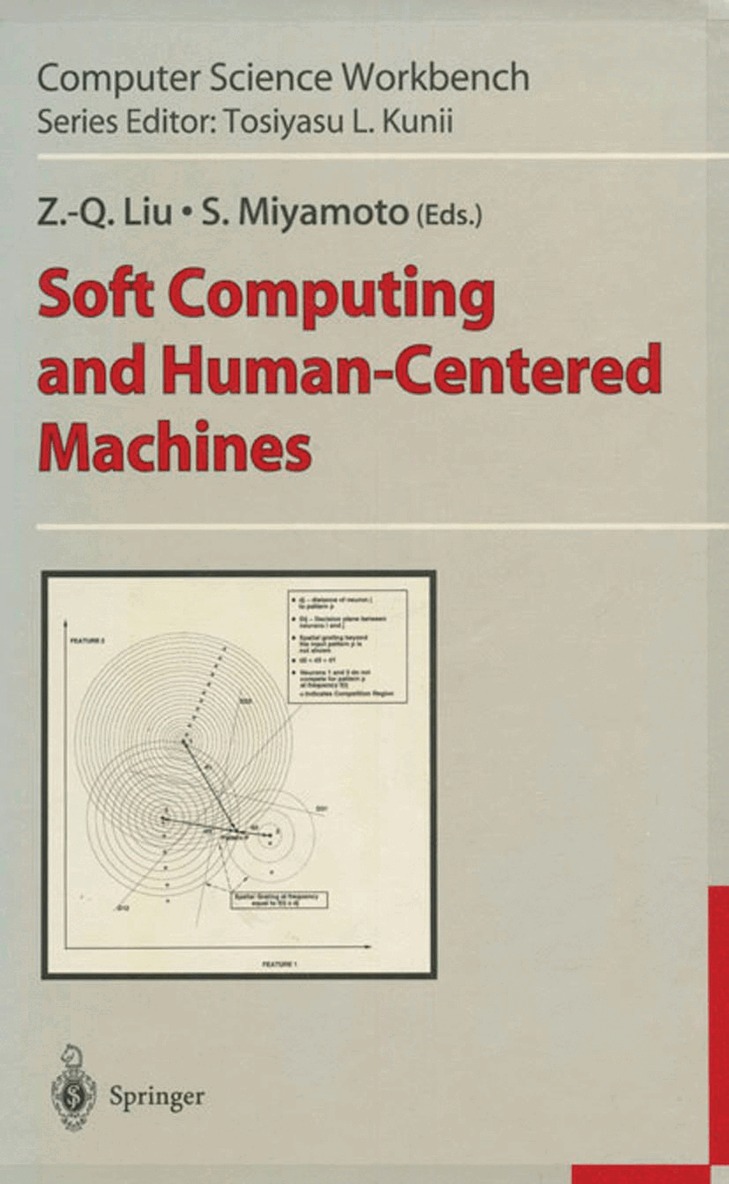
    Soft Computing and Human-Centered Machines

    AvZ.-Q. Liu,S. Miyamoto

    Häftad, Engelska, 2013

    Del i serien Computer Science Workbench

    563 kr

    Beställningsvara. Skickas inom 10-15 vardagar. Fri frakt över 249 kr.

    Beskrivning

    Computer Science Workbench is a monograph series which will provide you with an in-depth working knowledge of current developments in computer technology. Every volume in this series will deal with a topic of importance in computer science and elaborate on how you yourself can build systems related to the main theme. You will be able to develop a variety of systems, including computer software tools, computer graphics, computer animation, database management systems, and computer-aided design and manufacturing systems. Computer Science Work­ bench represents an important new contribution in the field of practical computer technology. Tosiyasu L. Kunii Preface With the advent of digital computers some five decades ago and the wide­ spread use of computer networks recently, we have gained enormous power in gathering information and manufacturing. Yet, this increase in comput­ ing power has not given us freedom in a real sense, we are increasingly enslaved by the very machine we built for gaining freedom and efficiency. Making machines to serve mankind is an essential issue we are facing. Building human-centered systems is an imperative task for scientists and engineers in the new millennium. The topic of human-centered servant modules covers a vast area. In our projects we have focused our efforts on developing theories and techn!ques based on fuzzy theories. Chapters 2 to 12 in this book collectively deal with the theoretical, methodological, and applicational aspects of human­ centered systems. Each chapter presents the most recent research results by the authors on a particular topic.

    Produktinformation

    • Utgivningsdatum:2013-10-03
    • Mått:155 x 235 x 19 mm
    • Vikt:528 g
    • Format:Häftad
    • Språk:Engelska
    • Serie:Computer Science Workbench
    • Antal sidor:327
    • Förlag:Springer Verlag, Japan
    • ISBN:9784431679868

    Utforska kategorier

    • Systemvetenskap och AI inom Data och IT
    • Artificiell intelligens inom Data och IT

    Innehållsförteckning

    • 1 Introduction.- 1.1 The Third Industrial Revolution: human-centered machines.- 1.2 Soft Computing: a unifying framework for intelligent systems.- 2 Multisets and Fuzzy Multisets.- 2.1 Introduction.- 2.2 Multisets.- 2.3 Fuzzy Multisets.- 2.4 Infinite Fuzzy Multisets.- 2.5 Another Ftizzification.- 2.6 Application to Query Language for Fuzzy Database.- 2.7 Conclusion.- 2.8 References.- 3 Modal Logic, Rough Sets, and Fuzzy Sets.- 3.1 Introduction.- 3.2 Language for Modal Logic.- 3.3 Kripke Semantics for Modal Logic.- 3.4 Truth Sets and Generalized Lower and Upper Approximations.- 3.5 Validity.- 3.6 What is a System of Modal Logic?.- 3.7 Normal Systems of Modal Logic.- 3.8 Soundness.- 3.9 Completeness.- 3.10 Fuzzy Sets and Rough Sets.- 3.11 Concluding Remarks.- 3.12 References.- 4 Fuzzy Cognitive Maps: Analysis and Extensions.- 4.1 Introduction.- 4.2 Fuzzy Cognitive Maps.- 4.3 Extensions to FCM.- 4.4 Analysis of Fuzzy Cognitive Maps.- 4.5 Conclusions.- 4.6 References.- 5 Methods in Hard and Fuzzy Clustering.- 5.1 Introduction.- 5.2 Basic Methods in Clustering.- 5.3 Fuzzy c-Means.- 5.4 Other Nonhierarchical Methods.- 5.5 A Numerical Example.- 5.6 Fuzzy Hierarchical Clustering.- 5.7 Conclusions.- 5.8 References.- 6 Soft-Competitive Learning Paradigms.- 6.1 Introduction.- 6.2 Learning by Neural Networks.- 6.3 Competitive Learning Paradigm.- 6.4 Overview of Competitive Learning Schemes.- 6.5 Fuzzy Competitive Learning and Soft Competition.- 6.6 Compensated Competitive Learning.- 6.7 Conclusions.- 6.8 References.- 7 Aggregation Operations for Fusing Fuzzy Information.- 7.1 Introduction.- 7.2 Intersection and Union of Fuzzy Sets.- 7.3 Weighted Unions and Intersections.- 7.4 Uninorms.- 7.5 Mean Aggregation Operators.- 7.6 Ordered Weighted Averaging Operators.- 7.7 Linguistic Quantifiers and OWA Operators.- 7.8 Aggregation Using Fuzzy Measures.- 7.9 Conclusion.- 7.10 References.- 8 Fuzzy Gated Neural Networks in Pattern Recognition.- 8.1 Introduction.- 8.2 Generalized Gated Neuron Model.- 8.3 Fuzzy Gated Neural Networks.- 8.4 Comparison between FGNN and STFM.- 8.5 Experimental Results.- 8.6 Improvements to FGNN.- 8.7 The Improved FGNN.- 8.8 Conclusions.- 8.9 References.- 9 Soft Computing Technique in Kansei (Emotional) Information Processing.- 9.1 Introduction.- 9.2 Concept of Kansei Information.- 9.3 Study Examples of Facial Expressions.- 9.4 Conclusions.- 9.5 References.- 10 Vagueness in Human Judgment and Decision Making.- 10.1 Introduction.- 10.2 Theoretical Representation of Vagueness in Judgment and Decision Making.- 10.3 Measurement and Fuzzy-Set Representation of Vagueness in Judgment and Decision Making.- 10.4 Experimental Studies of Vagueness of Judgment and Decision Making Using the Fuzzy Rating Method.- 10.5 Regression Analyses for Fuzzy Rating Data.- 10.6 Conclusion.- 10.7 References.- 11 Chaos and Time Series Analysis.- 11.1 Introduction.- 11.2 Embedding Time Series Data.- 11.3 Deterministic Nonlinear Prediction.- 11.4 Analysis of Complicated Time Series by Deterministic Nonlinear Prediction.- 11.5 Engineering Applications of Deterministic Nonlinear Prediction.- 11.6 Chaotic Time Series Analysis and Statistical Hypothesis Testing.- 11.7 Conclusions.- 11.8 References.- 12 A Short Course for Fuzzy Set Theory.- 12.1 Classical Sets.- 12.2 Fuzzy Sets.- 12.3 Basic Operations on Fuzzy Sets.- 12.4 Extension Principle.- 12.5 Fuzzy Relations.- 12.6 Possibility and Necessity Measures.- 12.7 Fuzzy Numbers.- 12.8 Discussion and Remarks.- 12.9 References.