• Fri frakt över 249 kr
  • •
  • Snabba leveranser
  • •
  • Billiga böcker
Kundservice

Du är på sajten för privatpersoner.

Företag, bibliotek eller offentlig verksamhet?

Du handlar på classic.bokus.com, där alla dina funktioner finns intakta.
Till classic.bokus.com
Bokus logotyp. Gå till startsidan.
  • Erbjudanden
  • Nyheter
  • Student
  • Topplistor
  • Barn & ungdom
  • Bokus Play
  • E-böcker
  • Pocketböcker
  • Spel & pussel

10% rabatt på allt med kod: NYSTART10 →

Sidfot

Mina sidor

    Hjälp

    • Kundservice
    • Vanliga frågor och svar
    • Frakt och leverans
    • Retur vid ångerrätt
    • Reklamera vara
    • Betalning
    • Köpvillkor
    • Allmänna villkor
    • Information om webbplatsens tillgänglighet

    Om Bokus

    • Om oss
    • Pressrum
    • För studenter
    • För företag
    • För bibliotek och offentlig verksamhet
    • För leverantörer
    • Hållbarhet

    Populärt

    • Aktuella erbjudanden
    • Presentkort
    • Studentlitteratur
    • Nya böcker
    • Topplistor
    • Signerade böcker
    • Engelska böcker

    Inspiration

    • Boktips
    • BookTok
    • Populära bokserier
    • Barnbokskaraktärer
    • Populära författare
    Logotyp för Bokus
    Följ oss på Facebook (extern länk)Följ oss på Instagram (extern länk)Följ oss på YouTube (extern länk)Följ oss på TikTok (extern länk)
    bokus @ CookiesAnpassa cookiesIntegritetspolicyKöpvillkor
    Till Citymail hemsida (extern länk)Till Budbee hemsida (extern länk)Till Postnord hemsida (extern länk)Till Schenker hemsida (extern länk)Till Early Bird hemsida (extern länk)Till Walleys hemsida (extern länk)
    1. Naturvetenskap och teknik
    2. Geovetenskap
    3. Geovetenskap

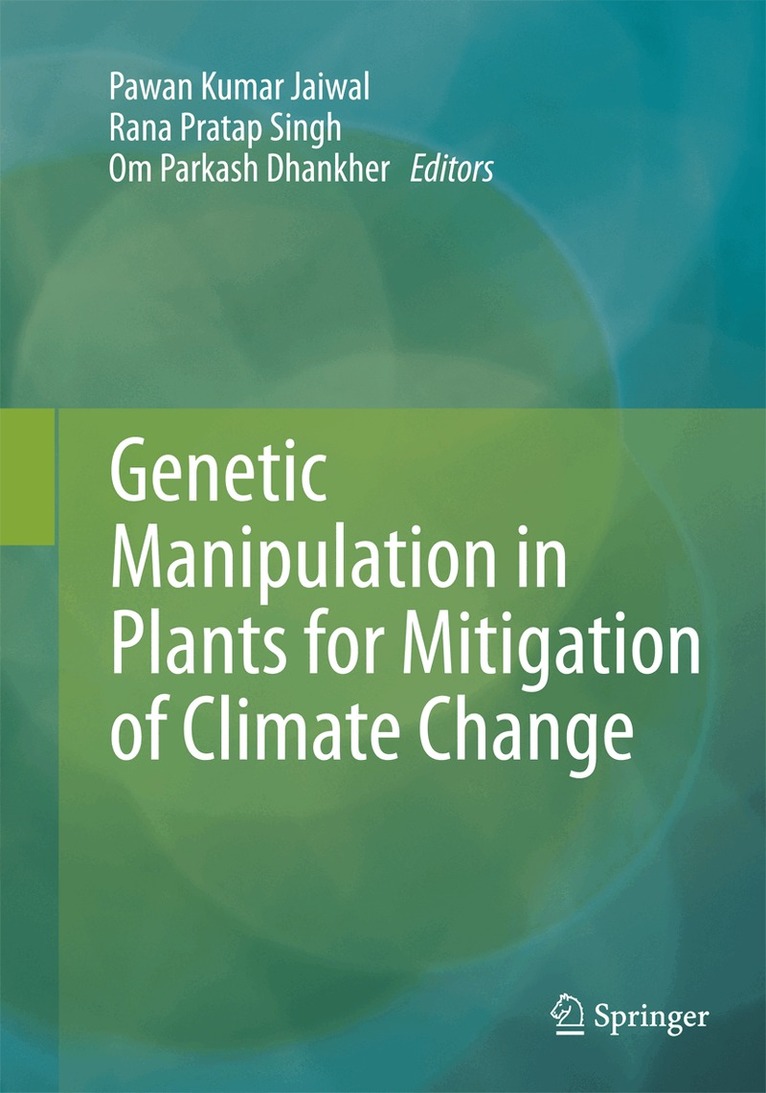
    Genetic Manipulation in Plants for Mitigation of Climate Change

    AvPawan Kumar Jaiwal,Rana Pratap Singh

    Häftad, Engelska, 2018

    1 626 kr

    Beställningsvara. Skickas inom 10-15 vardagar. Fri frakt över 249 kr.

    Beskrivning

    This book presents a detailed overview and critical evaluation of the state of the art and latest approaches in genetic manipulation studies on plants to mitigate the impact of climate change on growth and productivity. Each chapter has been written by experts in plant-stress biology and highlights the involvement of a variety of genes/pathways and their regulation in abiotic stress, recent advances in molecular breeding (identification of tightly liked markers, QTLs/genes), transgenesis (introduction of exogenous genes or changing the expression of endogenous stress- responsive genes) and genomics approaches that have made it easier to identify and isolate several key genes involved in abiotic stress such as drought, water lodging/flooding, extreme temperatures, salinity and heavy-metal toxicity.Food and nutritional security has emerged as a major global challenge due to expanding populations, and cultivated areas becoming less productive as a result of extreme climatic changes adversely affecting the quantity and quality of plants. Hence, there is an urgent need to develop crop varieties resilient to abiotic stress to ensure food security and combat increased input costs, low yields and the marginalization of land.The role of GM crops in poverty alleviation, nutrition and health in developing countries and their feasibility in times of climate change are also discussed. Recent advances in gene technologies have shown the potential for faster, more targeted crop improvements by transferring genes across the sexual barriers. The book is a valuable resource for scientists, researchers, students, planners and industrialists working in the area of biotechnology, plant agriculture, agronomy, horticulture, plant physiology, molecular biology, plant sciences and environmental sciences.

    Produktinformation

    • Utgivningsdatum:2018-03-31
    • Mått:178 x 254 x 14 mm
    • Vikt:555 g
    • Format:Häftad
    • Språk:Engelska
    • Antal sidor:241
    • Förlag:Springer, India, Private Ltd
    • ISBN:9788132238096

    Utforska kategorier

    • Geovetenskap inom Naturvetenskap och teknik
    • Agronomi inom Naturvetenskap och teknik
    • Miljöteknik inom Naturvetenskap och teknik

    Mer om författaren

    Dr Pawan K. Jaiwal is presently working as a Professor in the Centre for Biotechnology at the M.D. University, Rohtak, India and has served at various administrative positions as the Director, Dean (presently), chairman/ member of statuary bodies at University. He has 30 years of PG teaching and 35 years of research experience and has published about 85 original research papers, 27 book chapters, review articles and 14 books. He has guided over 68 M.Sc. and M. Phil. students for their Dissertations and 20 Ph.D. students for their degree. He is a member of several academic bodies and is in the Editorial Board of four International research journals. Dr Jaiwal has been awarded DST Young Scientist Project, INSA Visiting Fellowship by INSA, New Delhi, DBT Overseas Associateship by DBT, New Delhi and Prof H S Srivastava Gold medal by National Academy of Environmental Sciences, Lucknow, India. He has several international fellowships to his credit and has visited many countries for academic contributions including laboratory of Prof Ingo Potrykus at the Institute of Plant Sciences, ETH, Zurich, Switzerland. His current research interests are metabolic engineering for resistance to abiotic and biotic stresses, nutrient use efficiency and nutritional quality improvement in pulses especially Vigna species, oil crops (ze: 13.3333330154419px;">Brassica juncea and Sesame) and cereals (wheat).Dr. Rana Pratap Singh is presently working as professor in the  Department of Environmental Science, Babasaheb Bhimrao Ambedkar (A Central) University, Lucknow, (India). He has contributed significantly in understanding of ammonia assimilation and N-metabolism in plants. Besides, he has contributed some new knowledge on toxicity and remediation of soil and water ecosystems. He has 30 years of PG teaching and 35 years of research and 10 years of administrative experiences and has published about 100 original research papers, 14 review articles and 24 book chapters and 16 books. He has guided over 100 M.Sc. and M. Phil students for their Dissertations and 27 Ph.D. students for their degree. Professor Singh is Editor-in-Chief of an International Journal “Physiology and Molecular Biology of Plants and Editor of “Climate Change and Environmental Sustainability”. He has 9 academic awards and international fellowships to his credit and has visited many countries for academic contributions.Prof. Om Parkash Dhankher is a Plant Biotechnologist (Associate Professor) in the Stockbridge School of Agriculture, University of Massachusetts, Amherst (U.S.A.). He developed the first transgenic plant based approach for arsenic phytoremediation. Prof. Dhankher has published more than 40 publications in high impact factor journals including Nature Biotech and was awarded several patents. His research was also featured in headlines on National Geographic Channel, ABC, Reuter etc. His research focus is multidisciplinary in nature ranging from crop improvements, phytoremediation to biofuels. He is Editor of the International Journal Plant Biology Research; Associate Editor of Frontier’s Agricultural Biological Chemistry, Editorial board member of two international journals and a member of the Executive Committee of the American Society of Plant Biologists (ASPB). He has supervised seven Ph.D students, three M.Sc students, four visiting Professors, five postdoctoral Research Associates, and over a dozen Undergraduate honours thesis students and has several ongoing collaborations with researchers in India, China, Italy, Egypt, and USA.

    Innehållsförteckning

    • 1. Plant responses to tropospheric ozone.- 2. Plant heat stress response and thermotolerance.- 3. Genetic improvement of drought resistance in rice.- 4. Plant breeding for flood tolerance: advances and limitations. 5. Polyamine biosynthesis engineering as a tool to improve plant resistance to abiotic stress.- 6. Enhancing nutrient starvation tolerance in rice.- 7. Engineered Plants for Heavy Metals and Metalloids Tolerance.- 8. Prospects of genetic manipulation for enhanced heavy metal tolerance and bioremediation in relation to climate change.- 9. Biotechnological approaches to mitigate adverse effects of extreme climatic factors on plant productivity.- 10. Anthropogenic increase in carbon dioxide modifies plant-insect interactions.- 11. GM crops for developing world in the era of climate change: for increase of farmer’s income, poverty alleviation, nutrition and health.