• Fri frakt över 249 kr
  • •
  • Snabba leveranser
  • •
  • Billiga böcker
Kundservice

Du är på sajten för privatpersoner.

Företag, bibliotek eller offentlig verksamhet?

Du handlar på classic.bokus.com, där alla dina funktioner finns intakta.
Till classic.bokus.com
Bokus logotyp. Gå till startsidan.
  • Erbjudanden
  • Nyheter
  • Student
  • Topplistor
  • Barn & ungdom
  • Bokus Play
  • E-böcker
  • Pocketböcker
  • Spel & pussel

Må bättre, för mindre! Upp till 50% rabatt på hälsoböcker

Sidfot

Mina sidor

    Hjälp

    • Kundservice
    • Vanliga frågor och svar
    • Frakt och leverans
    • Retur vid ångerrätt
    • Reklamera vara
    • Betalning
    • Köpvillkor
    • Allmänna villkor
    • Information om webbplatsens tillgänglighet

    Om Bokus

    • Om oss
    • Pressrum
    • För studenter
    • För företag
    • För bibliotek och offentlig verksamhet
    • För leverantörer
    • Hållbarhet

    Populärt

    • Aktuella erbjudanden
    • Presentkort
    • Studentlitteratur
    • Nya böcker
    • Topplistor
    • Signerade böcker
    • Engelska böcker

    Inspiration

    • Boktips
    • BookTok
    • Populära bokserier
    • Barnbokskaraktärer
    • Populära författare
    Logotyp för Bokus
    Följ oss på Facebook (extern länk)Följ oss på Instagram (extern länk)Följ oss på YouTube (extern länk)Följ oss på TikTok (extern länk)
    bokus @ CookiesAnpassa cookiesIntegritetspolicyKöpvillkor
    Till Citymail hemsida (extern länk)Till Budbee hemsida (extern länk)Till Postnord hemsida (extern länk)Till Schenker hemsida (extern länk)Till Early Bird hemsida (extern länk)Till Walleys hemsida (extern länk)
    1. Samhälle och politik
    2. Samhälle och kultur
    3. Kultur och medier
    4. Kulturvetenskap

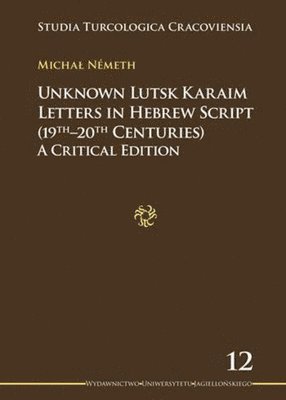
    Unknown Lutsk Karaim Letters in Hebrew Script 1 – A Critical Edition

    AvMichal Németh

    Häftad, Engelska, 2013

    455 kr

    Beställningsvara. Skickas inom 5-8 vardagar. Fri frakt över 249 kr.

    Beskrivning

    The work presents -- as far as is now possible -- the language spoken by Lutsk Karaims in the second half of the 19th and in the first two decades of the 20th centuries. This is attempted by means of editing eleven private letters and five open letters written in Lutsk Karaim -- with Hebrew interpolations. The letters were written by different authors in Hebrew script.The present publication appears to be the first critical edition of this type of text written in this particular dialect. Previous editions of south-western Karaim manuscripts either concerned very short texts from Halych or were prepared with no intention of being professional.The linguistic description of the texts aims to present a grammar of the manuscripts' language. It is complemented with a separate chapter dealing with the Slavonic structural influences exerted on the authors' idiolects, and with the lexicon of the texts. A separate part deals with the orthography and the features of the writing itself. The transcription and translation of each manuscript are preceded with a concise palaeographic description and a summary of the content.The work closes with a glossary, several indexes, maps, and the facsimile of the manuscripts.

    Produktinformation

    • Utgivningsdatum:2013-05-01
    • Mått:173 x 245 x 22 mm
    • Vikt:730 g
    • Format:Häftad
    • Språk:Engelska
    • Antal sidor:416
    • Förlag:Uniwersytet Jagiellonski, Wydawnictwo
    • ISBN:9788323332169

    Utforska kategorier

    • Kulturvetenskap inom Samhälle och politik

    Mer om författaren

    Michal Nemeth (born 1980) is an assistant lecturer in the Chair of Hungarian Philology at the Jagiellonian University. His main interests lie in historical linguistics and etymology. He studied Turkish and Hungarian philology at the Jagiellonian University. He has published one book and twelve articles. He holds a PhD degree in Linguistics (2011) from the Jagiellonian University.

    Recensioner i media

    Michael Nemeth brings both new edition of philological science previously unknown archival sources for the history of everyday Karaim language in the 19th and early 20th centuries, as well as developing their language in terms of new information that these sources contribute to Karaim knowledge. -- Marek Stachowski, Professor, Jagiellonian University